
Key Takeaways
- Both tools excel at document analytics: Page-by-page engagement tracking on shared pitch decks is a core strength of both Visible and DocSend
- DocSend has no native investor CRM: Connecting document engagement data to a pipeline requires a Zapier integration with an external CRM, a workaround that DocSend's own blog recommends and documents.
- Data rooms cost significantly more on DocSend: DocSend's "Spaces" feature requires the Advanced plan at $150 per month billed annually, with a mandatory three-user minimum, making it an expensive option for solo founders or small founding teams.
- Visible includes the full fundraising workflow in one platform: Data room, investor pipeline, and investor updates are native features connected to the same investor records, so document views, pipeline stages, and update engagement are visible in a single place.
- The free plan difference is significant: Visible offers a permanent free Starter plan that includes one data room, two pipelines, two pitch decks, and updates to 100 investors. DocSend has no free tier, and founders who have tested the Personal plan at $15/month report hitting a document visit limit within days of active fundraising outreach.
Most founders piece together their fundraise from whatever tools are closest. A deck shared through DocSend. A pipeline tracked in a spreadsheet. A data room in Google Drive or Notion. Investor updates sent from Gmail. Each tool works independently. None of them share context.
The problem shows up when the raise gets real. A serious investor requests a data room. Your co-founder wants to know how the pipeline is moving. You need to send a structured update to your early backers and have no idea who actually read the last one. At that point, the tool stack you assembled for early outreach starts working against you.
This page compares DocSend and Visible directly so you can make the right call for where you are in your raise. DocSend is built for document sharing across different use cases, industries, and personas. Visible was built for the full fundraising workflow, document tracking included, because knowing who read your deck only matters if you can act on it inside the same system where your pipeline and investor relationships live.
Trusted by Founders Closing Their Next Round
Rawand came into Seed 2 knowing exactly what hadn't worked. In earlier rounds, Helix Earth's data room was a DocSend link, the investor pipeline lived in Google Sheets, and outreach happened through scattered emails with no central tracking. Multiple team members were involved in the raise simultaneously, with no clear ownership and no defined process.
For Seed 2, a $12M round that ultimately closed oversubscribed, he rebuilt the entire workflow around Visible.
"Visible gave us the infrastructure to run a disciplined, data-driven fundraise without it consuming the entire company. It turned what used to be a scattered, reactive process into something more structured and intentional, and I believe it made a meaningful difference in the speed and outcome of our round."
Rawand, Co-founder, Helix Earth | Seed 2 · $12M · Oversubscribed
The Core Difference: Document Tracking vs. Investor Relations
Visible was built for one person: the founder running a fundraise. The data room, investor pipeline, and investor update tool are all in the same platform because they are all part of the same process. When an investor opens your data room at 11pm, you see it alongside their pipeline stage, your conversation history, and whether they read your last update. That context is what turns a document view into an informed next step.
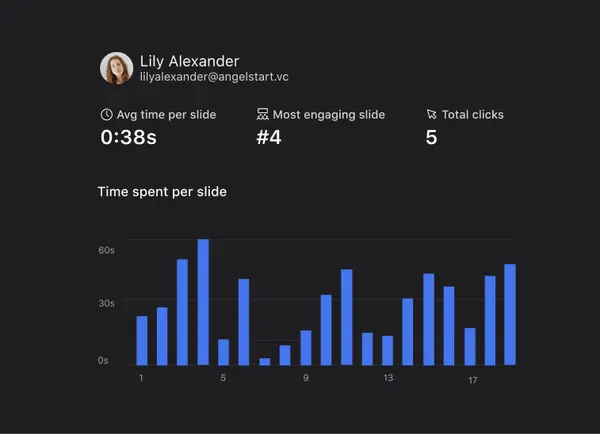
DocSend was built in 2013 as a document sharing tool, acquired by Dropbox in 2021, and has since expanded across multiple use cases and industries. Founders are one segment of a broader product. When you share a pitch deck through DocSend you can see who opened it, which slides they spent time on, and whether they forwarded the link. But the data room requires an expensive plan upgrade and still lacks the folder structure, permissions, and analytics that serious due diligence requires. There is no native investor CRM. Investor updates are not part of the product. What DocSend calls investor relations is document sharing with a tracked link.
Related resource: Startup Due Diligence: What Every Founder Needs to Prepare For
Related resource: Data Rooms for Due Diligence
Related resource: CRM for Fundraising
When three investors request a formal data room, DocSend's deal room feature called "Spaces" requires upgrading to the Advanced plan at $150/month billed annually, with a three-user minimum that does not fit most founding teams. When your co-founder asks how the pipeline is moving, there is no CRM in DocSend. Document engagement data lives in DocSend, and getting it into a pipeline requires building a Zapier integration to push it somewhere else. When you need to send a structured monthly update to your backers, there is no investor update tool. You would share a PDF as a tracked link and get page analytics on the document, which is not the same thing.
Related resource: 4 Items to Include in your Next Investor Update
The result is a stack that most founders know well: DocSend for the deck, a spreadsheet for the pipeline, email for updates, Google Drive or Notion for the data room. Each tool works independently. None of them share context.
Visible is built around a different assumption: that a fundraise is a relationship process, not a document delivery process. The data room, investor pipeline, and investor update tool are on the same platform and share the same investor records. When an investor opens your data room, you see it alongside their pipeline stage, your conversation history, and whether they have read your last update. That context is what turns a document view into an informed next step.
The choice between these two tools is not really about features. It is about which question you need answered. DocSend answers "who read my document." Visible answers "how is my fundraise going."
Visible vs. DocSend Feature Comparison
| Feature | Visible | DocSend | Notes |
|---|---|---|---|
| Data room | ✅ Included from Base plan ($59/mo annually) | ⚠️ Advanced plan only ($150/mo annually, 3-user minimum) | DocSend's Standard plan includes lightweight Spaces but without folder structure. Full data rooms with folders and granular permissions require the Advanced plan. |
| Page-by-page document analytics | ✅ View tracking, time on page, investor-level logs | ✅ Yes | Both products excel with document analytics. |
| Investor CRM / pipeline | ✅ Native, stages, contacts, notes, activity history | ❌ No native CRM | DocSend requires a Zapier integration to push view data into an external CRM. Their own blog documents this workaround. |
| Investor updates | ✅ Native update builder, templates, open tracking | ❌ No update tool | DocSend's "Investor Relations" use case is document sharing via tracked link, not a structured update workflow. |
| Free plan | ✅ Starter plan at $0, includes 1 data room, 2 pipelines, 2 pitch decks, updates to 100 investors | ❌ None | DocSend has no permanent free tier. A 14-day trial of the Advanced plan is available. |
| Pricing model | Flat-rate tiers by feature set, starting at $0 | Per-user on Personal and Standard, flat-rate with 3-user minimum on Advanced and Advanced Data Rooms | DocSend's per-user model scales poorly for growing teams. A 12-person team on Standard at monthly billing costs $9,360/year. At annual billing the figure is $6,480/year. |
| Pitch deck sharing with tracking | ✅ Yes, including per-slide analytics from Core plan ($129/mo) | ✅ Yes | Both support per slide and session analytics. |
| NDA gating | ❌ Not available | ⚠️ Advanced plan only ($150/mo annually) | DocSend includes NDA gating from the Advanced plan. Visible does not currently offer NDA gating. If this is a requirement for your data room process, DocSend's Advanced plan has an advantage here. |
| Dynamic watermarking | ✅ Growth plan only | ⚠️ Advanced plan only ($150/mo annually) | Both tools gate watermarking behind higher tiers. |
| Data room folders and granular permissions | ✅ Full folder management from Base plan ($59/mo) | ⚠️ Advanced plan only ($150/mo annually) | DocSend Standard Spaces do not include folder structure. Folders require the Advanced plan. |
| Data room analytics | ✅ Basic from Base, advanced from Core ($129/mo) | ⚠️ Advanced Data Rooms plan only ($180/mo annually) | Visible includes basic data room analytics from $59/mo. DocSend requires the $180/mo Advanced Data Rooms plan for analytics. |
| Document visit cap | Unlimited | Reported limit on Personal plan, not stated on DocSend's pricing page, but confirmed by direct user testing | Founders who have tested the Personal plan report hitting a visit limit within days of active fundraising outreach. DocSend does not prominently display this cap on its pricing page. |
| Live chat support | ✅ Support chat on all plans | ✅ Live chat on all plans, including Personal | Both tools include live chat support from their entry-level plans. |
| Dropbox integration | Standard cloud storage integrations, 1 integration on Base, 3 on Core, 5 on Growth | ✅ Native Dropbox integration across all plans | Genuine DocSend advantage for teams already running on Dropbox. |
| Fundraising pipeline guidance | ✅ Fundraising Roadmap built into product | ❌ Blog content only | Visible embeds structured fundraising guidance into the product experience. |
Why Founders Move Beyond the Tracked Link
Purpose-Built Data Rooms for Due Diligence
When an investor asks for a data room, they are signaling serious interest. What you send them in the next 24 hours matters, not just the documents inside it, but how professional, organized, and controlled the experience feels. A Google Drive folder with edit permissions open, and a DocSend Space that requires an enterprise upgrade, both send signals. Neither is the signal you want to send.
Visible's data room is built specifically for this moment. You organize documents into investor-ready folders, financials, team, product, and legal, set access controls per investor or per folder, and share a clean link that loads instantly on any device. Every time an investor opens a document, you see it: which sections they viewed, how long they spent, and whether they came back. That engagement data is tied to their record in your investor pipeline, so you are not just seeing a view, you are seeing a signal from a specific person at a specific stage of your raise.
Related resource: Startup Data Room: What It Is, What to Include, and How to Build One
Related resource: Founder-First Data Rooms & More
Visible includes one data room from the Base plan at $59/month billed annually, with full folder management, unlimited files, and basic data room analytics. Advanced data room analytics are available from the Core plan at $129/month. Three data rooms are available on Core and five on Growth. The free Starter plan includes one data room with a 25-file limit and first-level folder management, which is enough to test the workflow before committing to a paid plan.
DocSend's deal room feature, "Spaces," is a real product with built-in document tracking. The honest limitations are structural rather than qualitative. The Standard plan at $45/month, billed annually, includes lightweight Spaces but lacks folder structure, meaning documents appear in a flat list rather than an organized, investor-ready hierarchy. Folder and file-level security, granular permissions, dynamic watermarking, and NDA gating all require the Advanced plan at $150/month billed annually.
That means the floor for a solo founder who needs a properly organized data room is $150/month, regardless of team size. Data room analytics and audit logs require the Advanced Data Rooms plan, billed annually at $180/month. The engagement data you get inside a DocSend Space is also disconnected from any investor relationship context. You can see that someone viewed a document. You cannot see that view alongside the investor's pipeline stage, your conversation history, or their update open rate because none of those are available in DocSend.
For founders in early outreach sharing a single deck with a long list of investors, DocSend's analytics are exactly what you need. For founders in active diligence managing a structured data room with a small number of serious investors, the tool mismatch becomes harder to work around.
A Native Investor Pipeline (Not a Zapier Workaround)
DocSend is transparent about this gap. Their own blog recommends building a Zapier integration to push document view data from DocSend into your CRM, automatically logging investor interest so you do not have to do it manually. That is a reasonable workaround for a tool that was never designed to be a CRM. It is also an accurate description of what you are signing up for: a separate CRM, a Zapier account, a workflow to maintain, and engagement data that lives in a different system from the relationship context it is supposed to inform.
Visible's investor CRM is native. Every investor in your pipeline has a contact record with stage, conversation notes, tags, and activity history. When they open your data room, that view appears in their record. When you send an update, you can see who opened it, filtered by investor. When a conversation goes quiet, you can see exactly how long it has been and what the last touchpoint was. The whole fundraise, who you are talking to, what they have seen, and where each conversation stands, is visible in one place without a Zapier workflow holding it together.
Unlimited pipelines with custom properties and BCC email are available on the Base plan for $59/month, billed annually. The free Starter plan includes two pipelines, which is sufficient for a founder who wants to test the workflow before committing to a paid plan.
For founders who have managed 40 parallel investor conversations in a spreadsheet, tracking follow-up dates in one tab, document views in another, and email history in a third, the pipeline view tends to be the feature that makes the decision obvious.
Related resource: AI Fundraising Tools
Dedicated Investor Updates
Closing a round is not the end of the investor relationship. For most founders, raising institutional capital is the beginning of a decade-long journey. The expectation from seed investors and institutional backers is a structured monthly or quarterly update: metrics, narrative, asks, and enough transparency to make them feel like a genuine partner rather than a passive backer. Sending those consistently and knowing who reads them are how you stay top of mind for follow-on deals, get warm introductions, and build the kind of investor relationships that make the next raise easier.
Visible's investor update tool was the original product, built before the data room and CRM were added, and still the feature most founders discover first. You write directly in the update builder, choose from templates built around what investors actually want to see, embed live metrics from connected data sources, and send to your full investor list in a single action. Open tracking shows you who read the update, when, and for how long, giving you an engagement signal between rounds, not just during them. Every update lives in the investor's record alongside their data room activity and pipeline history.
Related resource: How To Write the Perfect Investor Update
The Starter plan supports updates to 100 investors. The Base plan at $59/month, billed annually, supports 250 from your own domain. Core at $129/month supports 500, and Growth at $199/month supports 1,000. Advanced analytics on updates are available from the Core plan.
DocSend lists "Investor Relations" as a supported use case on their website. The feature behind that use case is sharing a document as a tracked link. If you format your investor update as a PDF and share it through DocSend, you will get page-level analytics on who read which section, which is useful information. What you will not get is an update builder, a template library for the structured format investors expect, email-format open tracking, or the ability to see that update engagement alongside the investor's data room history and pipeline stage. For the occasional document share, it works. For the ongoing communication infrastructure that serious investor relationships require, it is a workaround, not a workflow.
Transparent Pricing for Growing Teams
Most founders encounter DocSend's pricing complexity after they have already started using the product, often mid-raise, when a feature they need turns out to require a plan they are not on.
Here is how DocSend's pricing actually works, sourced directly from the DocSend pricing page.
The Personal plan is the entry point at $15/user/month billed monthly, or $10/user/month billed annually. It covers basic sharing controls, document-level analytics, and 4 eSignatures per month, with 10 GB of storage per user and unlimited visitors to your documents. Live chat support is included. Founders who have tested this plan during active fundraising outreach report hitting a document visit limit within days. DocSend does not prominently display this cap on their pricing page.
The Standard plan at $65/user/month billed monthly, or $45/user/month billed annually, adds multi-file sharing, video and rich media analytics, customizable branding, unlimited eSignatures, and lightweight data rooms via Spaces. Storage increases to 50 GB per user. This plan includes Spaces but without folder structure, meaning data rooms at this tier are flat document lists rather than organized due diligence rooms. Folders, granular permissions, watermarking, and NDAs are not available at this tier.
The Advanced plan at $250/month billed monthly, or $150/month billed annually, is where proper data room functionality begins. It includes three users, folder and file-level security, dynamic watermarking, NDAs and gating agreements, restricted visitor access, and secure viewer email authentication. Data room storage is capped at 2,000 assets per data room.
The Advanced Data Rooms plan at $300/month billed monthly, or $180/month billed annually, adds enhanced data rooms, group visitor permissions, due diligence tracking, data room audit logs, data room analytics and insights, automatic file indexing, and priority email support, with 4,000 assets per data room capacity.
There is no permanent free plan. A 14-day trial of the Advanced plan is available.
Related resource: Data Room Software
Related resource: Data Room Providers
Here is how Visible's pricing compares.
| Visible Starter | Visible Base | Visible Core | Visible Growth | DocSend Personal | DocSend Standard | DocSend Advanced | DocSend Adv. Data Rooms | |
|---|---|---|---|---|---|---|---|---|
| Price (annually) | $0/mo | $59/m | $129/mo | $199/mo | $10/user/mo | $45/user/mo | $150/mo | $180/mo |
| Price (monthly) | $0/mo | $69/mo | $149/mo | $249/mo | $15/user/mo | $65/user/mo | $250/mo | $300/mo |
| Users included | 2 | 3 | Unlimited | Unlimited | 1 | 1 | 3 | 3 |
| Data room | ✅ 1 room, 25-file limit | ✅ 1 room, unlimited files, full folders | ✅ 3 rooms, advanced analytics | ✅ 5 rooms, advanced permissions | ❌ | ⚠️ Spaces without folders | ✅ Folders, watermarking, NDAs | ✅ Enhanced, with audit logs and analytics |
| Investor CRM / pipeline | ✅ 2 pipelines | ✅ Unlimited | ✅ Unlimited | ✅ Unlimited | ❌ | ❌ | ❌ | ❌ |
| Investor updates | ✅ 100 investors | ✅ 250 from own domain | ✅ 500 from own domain | ✅ 1,000 from own domain | ❌ | ❌ | ❌ | ❌ |
| Per-slide deck analytics | ❌ | ❌ | ✅ | ✅ | ✅ | ✅ | ✅ | ✅ |
| Dynamic watermarking | ❌ | ❌ | ❌ | ✅ | ❌ | ❌ | ✅ | ✅ |
| Data room analytics | ❌ | ✅ Basic | ✅ Advanced | ✅ Advanced | ❌ | ❌ | ❌ | ✅ |
| Live chat support | ✅ | ✅ | ✅ | ✅ | ✅ | ✅ | ✅ | ✅ |
| Free plan | ✅ | N/A | N/A | N/A | ❌ | ❌ | ❌ | ❌ |
All pricing sourced directly from DocSend’s pricing page and Visible’s pricing page.
One structural difference worth naming directly: DocSend's pricing model is designed around document sharing as a standalone workflow. Every plan tier unlocks additional document-sharing capabilities. Investor CRM, investor updates, and ongoing investor relations are not part of the pricing model because they are not part of the product. Visible's pricing is structured around the full fundraising workflow. The data room, the pipeline, and the updates are included because they are the product, not add-ons.
Related resource: Best Data Room for Startups
Related resource: Best CRM for Fundraising
Which Platform Should You Choose?
The honest answer is that DocSend and Visible are solving adjacent but different problems. The right choice depends on what stage of the fundraise you are in and what workflow you actually need to run.
| Choose DocSend if… | Choose Visible if… |
|---|---|
| You are running an M&A or due diligence process rather than a fundraise, and your counterparties specifically require DocSend links or NDA gating before accessing materials. | You want an easy-to-build data room with easy folder structure, permissions, and advanced analytics. |
| You are already embedded in the Dropbox ecosystem and the native integration removes real friction from your existing workflow. | You want your data room, investor pipeline, and investor updates in one platform. You are tired of stitching together three tools that lack context and want the full fundraising workflow in one place. |
| Your investors specifically request a DocSend link by name. In some circles it is the default format and there is no reason to change it. | You need a real investor CRM. You need pipeline stages, contact records, conversation history, and visibility into your raise as a whole, not a spreadsheet and not a Zapier workflow pushing data between tools. |
Related resource: Investor Update Software
Ready to Consolidate Your Fundraise?
Switching tools mid-raise can be a concern, so here is what the transition actually involves.
Documents re-upload without any format conversion. Your investor list imports from a CSV. Existing DocSend links continue to work, so no active conversations are disrupted. The setup time for a Visible data room, investor pipeline, and first investor update is measured in hours, not days. And Visible's free Starter plan means you can build out the data room, populate your pipeline, and share it with a few investors to see whether the workflow fits before you commit to anything.
Related resource: Data Rooms for Due Diligence
Related resource: Dataroom Document Checklist
Here is what transfers easily and what does not:
What moves without friction:
- All document files. PDFs, pitch decks, financial models, and any other documents you have been sharing through DocSend re-upload to Visible directly with no conversion required.
- Your investor contact list. Export from wherever it currently lives, whether that is a spreadsheet, your email, or DocSend's visitor log, and import into Visible's CRM via CSV.
- Your existing DocSend links. They stay live and accessible through DocSend. No investor loses access to something you already shared.
Related resource: Investor CRM: Seamlessly Manage Relationships and Finances
What needs to be rebuilt:
- Your data room structure. Folder organization, access controls, and permission settings need to be recreated in Visible. You can use one of our templates to get started quickly with best practices for a fundraising data room.
- Active share links. Investors you want to give access to your Visible data room need a new link. The right moment to send it is when you have a reason to re-engage: a new document added, a new round beginning, or a follow-up conversation already scheduled.
What stays in DocSend:
- Historical analytics. Page-level engagement data from documents you shared through DocSend lives in DocSend and does not export to Visible. You start fresh with Visible's analytics from the moment you share your first link.
Most founders who have made the switch describe the same experience. The first time an investor opens your Visible data room and you see it appear in their pipeline record, alongside their contact details, your conversation history, and their update open rate, is the moment the multi-tool argument resolves itself.
Join over 6,100 founders managing their investor relationships on Visible.
Related resource: Beyond DocSend: Exploring Innovative Document Sharing Platforms for Modern Teams
Related resource: How To Write the Perfect Investor Update (Tips and Templates)
Related resource: Best Fundraising Tools
Frequently Asked Questions
Is DocSend a virtual data room?
DocSend has a deal room feature called "Spaces," but it is more accurate to describe it as a document tracking and secure sharing tool with a lightweight deal room capability added at higher pricing tiers. The Standard plan at $45/month billed annually includes Spaces, but without folder structure, meaning documents sit in a flat list rather than an organized investor-ready hierarchy. Data room folders, granular permissions, and dynamic watermarking all require the Advanced plan at $150/month billed annually, which carries a mandatory three-user minimum. Data room analytics and audit logs require the Advanced Data Rooms plan at $180/month billed annually. For a solo founder or two-person founding team, that pricing structure creates a meaningful barrier to a feature that should be standard during a fundraise. Visible includes one data room with full folder management and basic analytics from the Base plan at $59/month billed annually, with a free data room available on the Starter plan.
Does DocSend have an investor CRM?
No. DocSend tracks who views your documents and how long they spend on each page, but it has no native investor CRM, pipeline stages, or contact management. To connect DocSend's engagement data to a CRM, you need to build a Zapier integration that pushes view events into a separate tool. DocSend documents this workflow on their own blog, which is an honest acknowledgment that CRM is outside their product scope. Visible's investor CRM is native to the platform. Contact records, pipeline stages, conversation notes, and activity history are all connected to your data room views and investor updates in the same place, so you are managing the full investor relationship without assembling it from external automations. Unlimited pipelines are available from the Base plan at $59/month billed annually. The free Starter plan includes two pipelines.
Can I send investor updates from DocSend?
DocSend lists investor relations as a supported use case, but the underlying feature is document sharing. You can share a PDF update as a tracked DocSend link and see which pages the investor read, which is useful information. What DocSend does not have is an investor update builder, email-format updates with open-rate tracking, a template library for the structured monthly or quarterly format that institutional investors expect, or any connection between the update and the investor's pipeline record or data room activity. Visible's investor update tool was the original product and is purpose-built for this workflow. Updates to 100 investors are available on the free Starter plan. The Base plan at $59/month billed annually supports 250 investors from your own domain, Core supports 500, and Growth supports 1,000.
What happens to my DocSend links if I switch to Visible?
Existing DocSend links keep working. They are hosted on DocSend's infrastructure and will not break or redirect when you move to Visible. Investors who already have a DocSend link can continue accessing it through DocSend. When you set up Visible, you will share a new Visible data room link with active investors going forward. Most founders find the cleanest moment to make that switch is at the start of a new process, a new round, a new data room, or a new phase of investor conversations, rather than mid-raise. Document files themselves move without any technical friction. You are re-uploading PDFs, decks, and spreadsheets to Visible's infrastructure, which takes the same time as uploading them anywhere else. Historical DocSend analytics stay in DocSend and do not transfer. Your investor contact list, wherever it currently lives, can be imported into Visible's CRM via CSV in under an hour.
How does DocSend pricing compare to Visible for startup fundraising?
DocSend and Visible use fundamentally different pricing models, and the gap widens as your needs expand beyond basic document sharing. DocSend's entry-level Personal plan is $10/user/month billed annually but does not include data rooms. The Standard plan at $45/user/month adds lightweight Spaces without folder structure. The Advanced plan at $150/month billed annually, with a three-user minimum, is required for proper data rooms with folders, watermarking, and security controls. Visible's Base plan at $59/month billed annually includes one data room with full folder management, unlimited pipelines, and investor updates to 250 investors from your own domain. Visible also has a permanently free Starter plan that includes one data room, two pipelines, and updates to 100 investors. DocSend has no permanent free plan. The pricing comparison matters most when you consider what each plan actually includes for a founder running a fundraise: DocSend's tiers unlock more document sharing capability, while Visible's tiers unlock more of the fundraising workflow.
Is Visible or DocSend better for a seed-stage founder raising their first round?
It depends on where you are in the process. DocSend is the stronger tool during early outreach, when you are sharing a pitch deck with a long list of investors and need granular signal on who is engaging. Its page-by-page analytics are genuinely best-in-class for that use case. Visible is the stronger tool once the raise gets real, when serious investors are requesting a data room, you need to track 30 to 50 parallel conversations in a structured pipeline, and you are sending monthly updates to early backers. Visible's free Starter plan means there is no cost to setting it up early, many seed-stage founders run both tools in parallel during early outreach, then consolidate to Visible once they enter diligence. The one capability DocSend has that Visible does not is NDA gating, so if your investors require a signed NDA before accessing your data room, that is worth factoring into your decision.