
Key Takeaways
- 49% of VC firms cite tool overload as a top barrier to AI adoption
- 51% cite security concerns as their top barrier, the only one ranked above tool overload
- 33% of firms adopted Claude in the last 90 days, the most-adopted AI tool, ahead of all purpose-built VC products
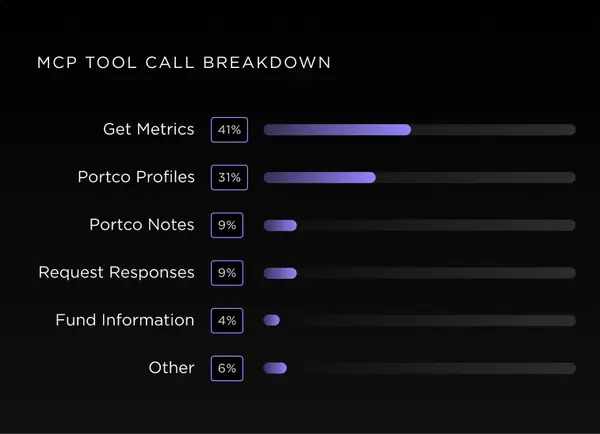
- 41% of all Visible MCP tool calls are metric retrieval, the single most common use of the connected data layer
Nearly half of VC firms in the Visible AI Sentiment Report say tool overload is one of their biggest barriers to AI adoption. That is a striking data point given that these are the same firms investing in AI companies and evaluating the space professionally. If anyone should be able to cut through noise, it should be them.
But the 49% figure reflects something real. The AI tooling market is expanding faster than any team can keep up with. New products targeting VC workflows appear constantly, each promising to solve a specific problem. And many do solve that problem, in isolation. The issue is what happens at the firm level when a collection of disconnected point solutions accumulates over time.
Fragmentation is the Hidden Cost
When deal notes live in one system, portfolio metrics in another, LP communications in a third, and meeting transcripts somewhere else, the intelligence a firm generates never compounds. Each tool is doing its job. But insights produced in one product do not surface in another. The team spends meaningful time navigating between systems rather than extracting value from any of them.
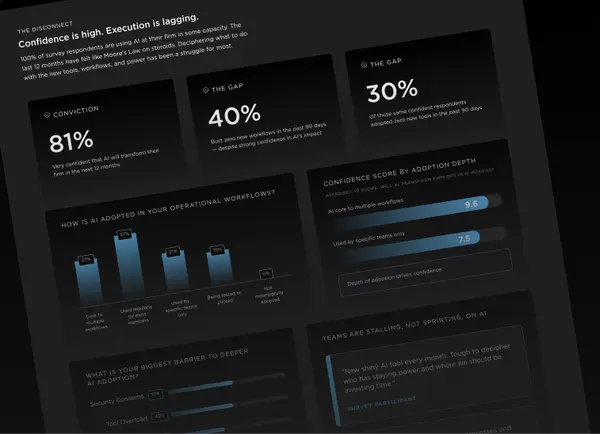
The Visible AI Sentiment Report shows that only 23% of firms have AI that is core to multiple workflows. Another 37% say it is used regularly by most team members. But 21% say it is limited to specific teams, and 19% are still in testing or piloting mode. Even among firms using AI broadly, the depth of integration, and the connections between tools, remain limited.
"New shiny AI tool every month. Tough to decipher who has staying power and where we should be investing time." Survey Participant, Visible AI Sentiment Report Vol. 1 2026
The Adoption Data Points Toward Infrastructure, Not Verticals
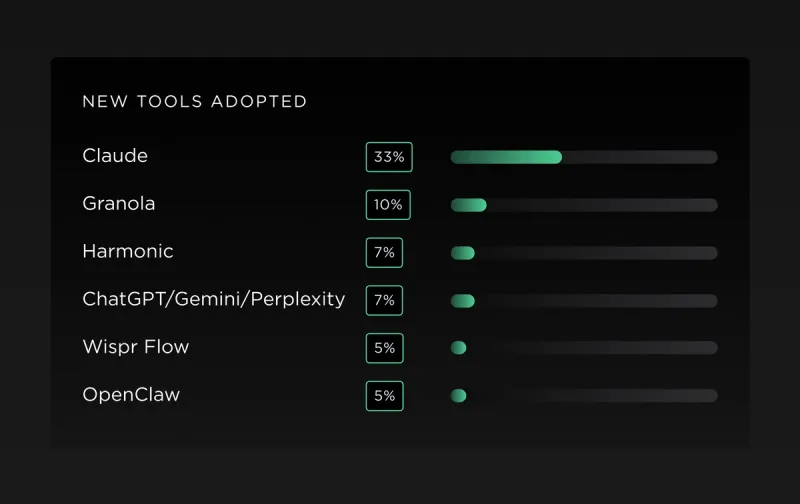
Among firms that adopted new AI tools in the last 90 days, Claude leads at 33% of respondents according to the Visible survey. Granola comes in second at 10%, followed by Harmonic and ChatGPT/Gemini/Perplexity, both at 7%. Wispr Flow and OpenClaw each at 5%.
The fact that a general-purpose model leads this list ahead of every purpose-built VC tool is notable. It suggests that the firms seeing the most value are prioritizing flexible infrastructure that can connect to multiple data sources, rather than adding more specialized products to an already complex stack.
This is consistent with what we have observed through Visible's MCP Server. Since launch, metric retrieval has been the most common use at 41% of all tool calls, followed by portfolio company profiles at 31%, company notes at 9%, request responses at 9%, and fund information at 4%. Teams want to query data they already have in a faster, more connected way. They are not looking for new data sources. They are looking for better access to existing ones.
What Connected Infrastructure Actually Changes
According to the Visible AI Sentiment Report, 49% of VC firms report that AI has reduced time on repetitive tasks. That is the headline efficiency gain. But the more meaningful shift is structural.
When portfolio data is connected and queryable through a central layer, the time around preparation changes entirely. A survey participant who integrated the Visible MCP Server reported reducing ad hoc internal pings by an estimated two to three hours per week. Not through a complex new workflow. Because anyone on the team can surface a portfolio answer in seconds rather than requesting it from someone with spreadsheet access.
That time savings is significant on its own. But the more durable benefit is what it enables downstream: more thorough board prep, more proactive LP communication, and faster identification of portfolio trends that would previously have required manual analysis across multiple data sources.
A Practical Lens for Evaluating What Belongs in Your Stack
The Visible data suggests a useful filter. Before adding a new AI tool, three questions are worth working through:
- Does this connect to your existing data layer, or does it create another place where information lives in isolation?
- Can you name a specific workflow this will change, not just a category it addresses?
- Given that tool overload is already a top-three barrier for 49% of firms, does this reduce that problem or add to it?
Firms that apply that kind of filter tend to end up with a better-integrated stack that compounds in value over time. The goal is not fewer tools for its own sake. It is connected tools that share data with each other.
As Justin Hilliard of Rebel Fund put it at our webinar, "How Rebel Fund Built Their Tech Stack:"
"Buy where you can. We're not in the business of building LinkedIn scrapers, they're a necessary part of our stack, but there are plenty of APIs out there that can help, and I would strongly recommend leaning into that."
The goal is not fewer tools for its own sake. It is connected tools that share data with each other.
Start Connecting What You Have
The data is clear: the firms seeing the strongest AI results are not the ones with the most tools. They are the ones who built toward a connected data foundation. Whether your portfolio data already lives in Visible or you are looking for a better home for it, you are closer than you think to that foundation.
See how Visible's MCP Server connects your portfolio data to the AI tools you're already using →
Want the full picture on how VC firms are approaching AI right now? Check out the AI Sentiment Report below: