
Every year, the Startup Benchmarks Report asks founders the same blunt question: what's actually keeping you up at night. One answer consistently rises to the top.
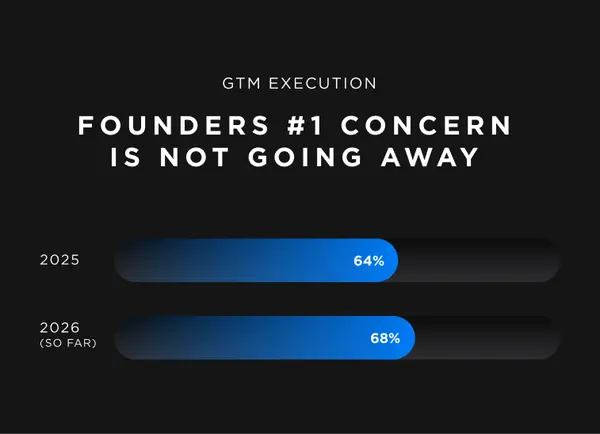
64% of founders named go-to-market execution as their top concern in last year's report, ahead of hiring, fundraising, and burning too much cash combined. Not AI. Not competition. Just the basic, stubborn challenge of getting the right product in front of the right buyer.
That's a striking number in a year defined almost entirely by AI headlines. Founders are being told to rethink their product, their org chart, and their pricing model around AI, and yet the thing they lose sleep over the most hasn't changed. It's still distribution.
What Actually Worked in 2025
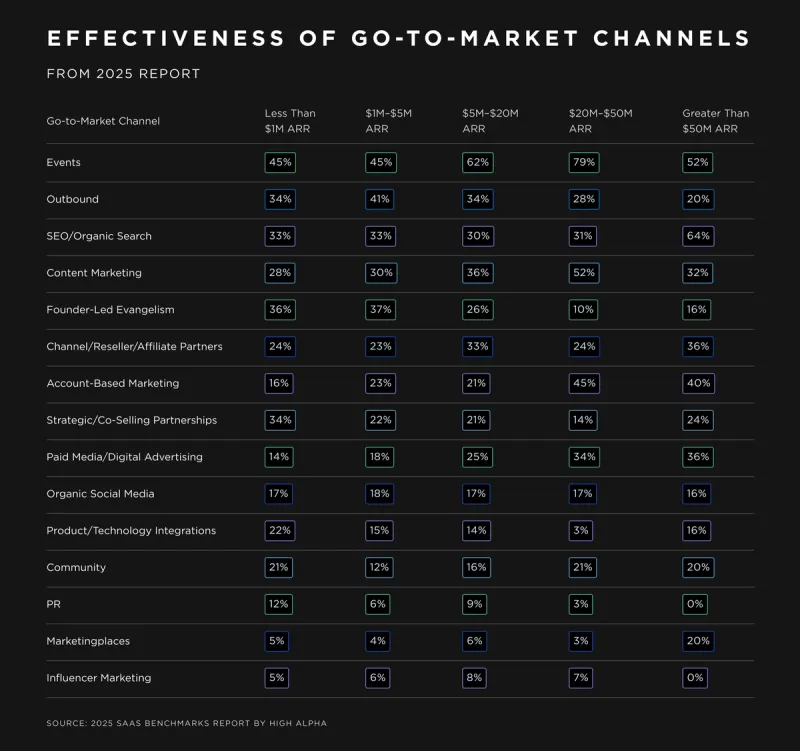
The channel data backed up the anxiety. Events and in-person relationship building consistently outperformed nearly every other channel across almost all company sizes, from early-stage startups to companies well past $50 million in ARR. Founder-led evangelism and word of mouth held up too.
Meanwhile, self-service and paid media quietly underdelivered. Companies leaning on those channels saw weaker growth and lower retention than peers building relationships the harder, slower way.
The takeaway from last year's data was simple, even if it wasn't especially comforting: efficiency doesn't fix a broken GTM motion. You can have the leanest team and the best AI tooling in your category, and none of it matters if you haven't figured out how to reach, close, and keep the right customers.
What We're Seeing So Far in 2026
We're currently in the field collecting responses for this year's report, and the early signal suggests this pattern isn't fading. If anything, it's intensifying.
Preliminary responses show GTM execution climbing to 68% as a top concern, even with AI strategy pulling more founder attention than it ever has before. We're also seeing founders split almost evenly across three different approaches: highly verticalized go-to-market strategies focused on one industry or persona, moderately focused strategies covering two or three segments, and horizontal strategies that sell to any company fitting a profile.
That even split is telling on its own. There's no consensus playbook right now for how to approach GTM in this market, and that lack of a clear answer is probably part of why the worry keeps showing up at the top of the list.
Why This Matters Right Now
If you're a founder trying to figure out whether your GTM motion is actually working, benchmarks are one of the few honest signals available. It's easy to feel like you're behind when you're only comparing yourself to the loudest voices on LinkedIn or the biggest outlier raises in TechCrunch. Real, anonymized data from hundreds of peers tells a very different story, and it's usually a more useful one.
This is exactly why we run the Startup Benchmarks Report each year with High Alpha. It's the longest-running and largest self-reported benchmarks dataset for startups, and it only works because founders like you take the twelve minutes to contribute.
If you want to see how your own GTM execution, growth, and retention compare to real peer data instead of guessing, take the survey below. You'll get the full results early, ahead of the public release.