
Key Takeaways
-
Seattle has solidified its rank as the fifth strongest startup ecosystem in the United States, recording an annual growth rate of 11% throughout 2025.
-
Navigating the 2026 tax landscape requires planning for a new tiered capital gains tax that applies a 9.9% rate to gains exceeding 1 million dollars.
-
High-growth startups in the Pacific Northwest benefit from specialized technical resources like the AI2 Incubator and high-intent angel syndicates such as the Alliance of Angels.
-
Competitive advantages remain strong in the region due to a zero percent personal state income tax and a dense talent flywheel powered by Amazon and Microsoft alumni.
-
Local founders can now target the top active venture capital firms actively investing in Seattle.
Seattle is the fifth-largest startup ecosystem in the United States, growing at an annual rate of 11% in 2025. This momentum has transformed the city from a satellite of Silicon Valley into a primary destination for founders who prioritize high-efficiency growth and deep technical moats.
The regional advantage is anchored by a dense concentration of former Amazon and Microsoft engineering talent, a factor that has helped Seattle lead the nation in SaaS and cloud infrastructure efficiency.
This guide provides a curated list of the top 15 most active venture capital firms in Seattle, currently leading rounds in the region, followed by an in-depth analysis of the local fundraising landscape. We also identify high-impact regional incentives that often go untapped, such as the expanded Seattle Shield B&O tax exemptions and specific aerospace and clean energy grant programs. By leveraging this local intelligence, founders can navigate the nuances of a technical powerhouse where every dollar of venture capital is engineered to go further.
Top Active VCs in Seattle
Trilogy Equity Partners

About: From seed to scale, Trilogy partners closely with Pacific Northwest founders, combining our operational experience with hands-on support to turn bold ideas into market-changing businesses.
Madrona Venture Group

About: Madrona Venture Group has been investing in early-stage technology companies in the Pacific Northwest since 1995.
Thesis: Early Stage through the long run
Pioneer Square Labs

About: A seed and pre-seed venture capital fund based in Seattle, Washington.
Thesis: Investing in market-defining companies at Pre-Seed, Seed, and Series A
Flying Fish Partners

About: We are an early-stage venture firm based in Seattle investing in high-potential AI and ML technology companies across the U.S. and Canada.
We believe artificial intelligence and machine learning will disrupt every industry and are looking for the next generation of leaders in every field who are building companies with machine learning at the heart of their strategy.
Frazier Healthcare Partners

About: Since 1991, Frazier Healthcare Partners leverages the experience of its team of investment professionals, Center of Excellence, Senior Advisors and Executives in Residence to identify broader industry trends, develop specific investment theses, and then partner with accomplished industry executives to identify, acquire, and optimize businesses across healthcare. Within its Growth Buyout strategy, Frazier has invested over $2.7 billion in 44 portfolio companies across 10 investment vehicles. Frazier’s core values are based in integrity, performance, perseverance, transparency, empowerment, and social impact, and all six values drive how Frazier operates as a firm.
Keeler Investments

About: We invest between $100,000 -250,000 into Founder, Pre-Seed and Seed rounds, with substantial reserve for follow on. We like to play a supportive and engaged role to help a company early in its life, with a particular focus on connecting our portfolio company's to leading later stage investors up and down the West Coast.
Our primary focus is on software and services, both Enterprise and Consumer. That said, we have invested in non-software opportunities when the team and market present a compelling opportunity. We have recently begun investing in companies at the forefront of the "Environmental Economy" who are bringing new, sustainable and compelling solutions to the table.
Voyager Capital
About: Voyager Capital is a leading Pacific Northwest venture firm providing entrepreneurs with the resources, experience and connections to build successful technology companies. Voyager leads first venture round investments in software, analytics and cloud infrastructure startups, deploying the firm's domain expertise, go-to-market and team building resources help build market leaders. The firm has offices in Seattle, Washington and Portland, Oregon."
Thesis: With a focus on investing in the modern economy through AI-driven business solutions, software-driven hardware, sustainable agriculture, and supply chain in the Pacific Northwest and Western Canada, we create a relationship with you early in your company’s lifecycle. We’re entrepreneur centric — so when we invest in your business, we invest in you. Our team is available, responsive and committed to you when and where you need it — from your very first venture round. The result is fast-tracked time to revenue with less capital.
Tola Capital

About: Tola Capital is a venture capital firm that invests globally in enterprise software companies across multiple stages.
Thesis: We look for software companies with essential products for enterprise customers, a solid existing customer base, a strong competitive position, and great talent and culture. Tola Capital invests predominantly in early stage enterprise software companies.
Ignition Partners

About: Ignition Partners, a dedicated early-stage enterprise software venture capital firm, invests based on decades of operating experience and enterprise relationships. We have lived through the transitions from mainframe to mini to PC to cloud. We are the only firm operating with significant footprints in both Seattle and Silicon Valley, and our network has a global reach.
Maveron
About: Maveron funds seed and Series A companies that empower consumers to live on their terms. Based in SF and Seattle and invest coast-to-coast.
Thesis: Maveron funds seed and Series A companies that empower consumers to live on their terms. Based in SF and Seattle and invest coast-to-coast.
Founders’ Co-op

About: Founders' Co-op is a seed-stage investment fund based in the Pacific Northwest.
Thesis: We are proud supporters of the unique innovation ecosystem that thrives across the entire region and are on a mission to power and enable founders with that pioneer mentality.
What are the core strengths of the Seattle ecosystem in 2026?
Seattle remains a premier destination for B2B SaaS and AI due to its unique alumni engine and engineering density.
- The Cloud and AI Talent Flywheel: The region is anchored by Amazon and Microsoft, creating a constant stream of highly technical founders. In 2025, AI and Machine Learning deals captured over 65% of all venture capital deal value.
- Capital Efficiency: Seattle startups often operate with leaner teams and higher revenue per employee ratios than their Bay Area counterparts. Local firms like Madrona and Founders’ Co-op prioritize durable growth over growth at all costs.
- Emerging Vertical Dominance: Beyond general SaaS, Seattle has become a global leader in Applied AI, particularly in maritime tech, aerospace, and biotech, leveraging the University of Washington’s research pipeline.
What are the primary challenges for Seattle founders right now?
The most pressing challenge in 2026 is the rapid evolution of the Washington state tax code, which has shifted the region from a low-tax haven to a high-tax jurisdiction for exits.
- The 9.9% Capital Gains Reality: Beginning in tax year 2025, Washington implemented a tiered capital gains tax. The first 1 million dollars in gains is taxed at 7%, while any amount exceeding that threshold is taxed at 9.9%.
- The "Millionaires Tax" Impact: Recent legislative moves in early 2026 have introduced a 9.9% tax on personal annual income exceeding 1 million dollars, creating new hurdles for attracting and retaining executive-level talent.
- Liquidity Crunch: While seed-stage funding remains resilient, the Series B Gap persists. Founders often travel to the Bay Area or New York to secure checks of more than $25 million, as local late-stage capital remains concentrated in a few hands.
How are 2026 venture trends impacting the region?
Seattle is at the forefront of the Chapter Two AI revolution, moving away from foundational models toward industry-specific autonomous agents.
- The Rise of Agentic AI: By 2026, 40% of enterprise applications in the Seattle corridor include AI agents designed to automate complex workflows.
- Secondary Market Adoption: With traditional IPO timelines remaining extended, Seattle founders and early employees are increasingly utilizing secondary markets to find liquidity before an exit.
- B&O Tax Surcharges: Large technology employers in the region now face increased Business and Occupation (B&O) tax surcharges, which can indirectly impact the acquisition appetite of local tech giants.
What are the top accelerators and incubators in Seattle for 2026?
The Seattle landscape is anchored by specialized institutes that prioritize technical depth over generalist business coaching.
- AI2 Incubator (Allen Institute for AI): This remains the gold standard for AI-first startups. It offers up to 600,000 dollars in SAFE funding and unparalleled access to world-class researchers to help founders build moat-driven AI products.
- Techstars Seattle: As one of the most successful branches in the global network, this program focuses heavily on B2B SaaS and technical infrastructure, leveraging a mentor pool largely comprised of former Amazon and Microsoft executives.
- Madrona Venture Labs (MVL): Unlike traditional cohort models, MVL acts as a "startup studio" that co-builds companies alongside founders, providing day-one funding and immediate validation from Madrona’s investment team.
- Pioneer Square Labs (PSL): A dominant startup studio that tests hundreds of ideas annually. PSL recruits experienced executive teams to lead the most promising concepts, providing a de-risked path for founders entering the ecosystem.
- Buerk Center for Entrepreneurship (UW): The primary hub for student and alumni founders. The Jones + Foster Accelerator provides up to 25,000 dollars in equity-free funding to help early-stage teams hit critical milestones.
Which AI labs and specialized resources are active in 2026?
For founders building at the frontier of technology, these specialized labs provide the hardware and technical mentorship necessary to scale.
- AI House: Launched in late 2025 as a partnership between the City of Seattle and AI2, this physical hub serves as the central meeting ground for the region's AI builders, offering hackathons and customized agent development workshops.
- CoMotion Labs: Operated by the University of Washington, this multi-industry incubator provides specialized wet-lab space for biotech startups and hardware prototyping facilities for robotics teams.
- 5G Open Innovation Lab: This Bellevue-based hub connects early-stage founders with enterprise partners like T-Mobile and Intel to test edge computing and IoT applications.
What are the essential 2026 events for Seattle founders?
Networking in Seattle is often "high-intent" and technical. These events are the best places to meet active investors and potential co-founders.
- Seattle Tech Week (July 27–31, 2026): Now in its fourth year, this city-wide series of nearly 200 decentralized events is the most important week for local fundraising and community building.
- Seattle Startup Summit (April 1, 2026): A specialized gathering for AI founders and deep-tech investors focused on deployment challenges like inference optimization and AI governance.
- New Tech Northwest: One of the largest persistent communities in the region, hosting monthly mixers and mastermind groups specifically designed to connect founders with Fortune 500 talent.
What are the top region-specific opportunities for Seattle founders?
- B&O Tax Relief for Small Businesses: Effective January 1, 2026, Washington has expanded relief for early-stage startups. Early-stage startups can often offset their entire Business and Occupation (B&O) tax liability through the small business tax credit. However, as of January 1, 2026, a new 0.5% surcharge applies to businesses with Washington taxable income exceeding 250 million dollars, which founders should monitor, as it may impact the valuation of local acquisition deals
- Washington R&D Tax Credit: Technical founders can claim a credit worth up to 3.5 percent of eligible research and development expenditures made within the state. This credit applies directly to wages and supply costs, providing a crucial cash-flow buffer during the product development phase.
- UW Global Innovation Fund (GIF): For founders emerging from academia or working on cross-border research, the University of Washington offers awards up to 20,000 dollars for Tier 2 research collaborations. The 2026 application cycle recently closed in late January, making this a key program to watch for 2027 planning.
- Aerospace and Clean Energy Grants: The Washington Department of Commerce has combined several funding streams into the 2025-2027 Clean Energy Grants Program. Founders in these sectors can access state-backed capital for research, development, and demonstration projects that align with state climate goals.
- 2026 Estate Tax Adjustment: For founders planning for long-term legacy, the Washington estate tax exclusion has increased to 3 million dollars for deaths occurring on or after July 1, 2025, with annual inflation adjustments beginning in 2026.
Which angel syndicates are most active in Seattle in 2026?
When venture capital firms are too large for your current round, these local angel groups provide the bridge capital and mentorship necessary to reach Series A.
- Alliance of Angels (AoA): The largest and most active group in the region, AoA invests over $ 10 million annually in more than 20 companies. Their 2026 Angel Investing 101 and Seattle Angel Conference 29 events are primary entry points for founders looking to pitch.
- Seattle Angel Conference (SAC): SAC is a recurring, investor-driven event where local angels pool funds to invest in a single finalist. The SAC 29 cycle is currently active, with a registration deadline of February 24, 2026, and a final demo day scheduled for May 20, 2026.
- SeaChange Fund: This group specializes in Pacific Northwest startups, providing early-stage funding and hands-on guidance. They have supported over 50 portfolio companies and remain a top choice for founders who want investors with deep local roots.
- Keiretsu Forum Northwest: Part of a global network, the Northwest chapter connects founders with hundreds of active investors. They are particularly effective for companies looking for co-investments to complete a larger seed round.
Is there a cost-of-living advantage in Seattle for 2026?
While Seattle is often compared to the Bay Area, it offers a specific advantage regarding state personal income tax that founders should factor into their hiring and retention strategies.
- Zero Personal State Income Tax: Washington remains one of the few states with no personal state income tax. This allows founders to offer competitive take-home pay to elite engineering talent from California or New York without the same overhead costs, though high earners must now plan for the 9.9% capital gains tax on exits exceeding 250,000 dollars.
Connect With Investors in Seattle Using Visible
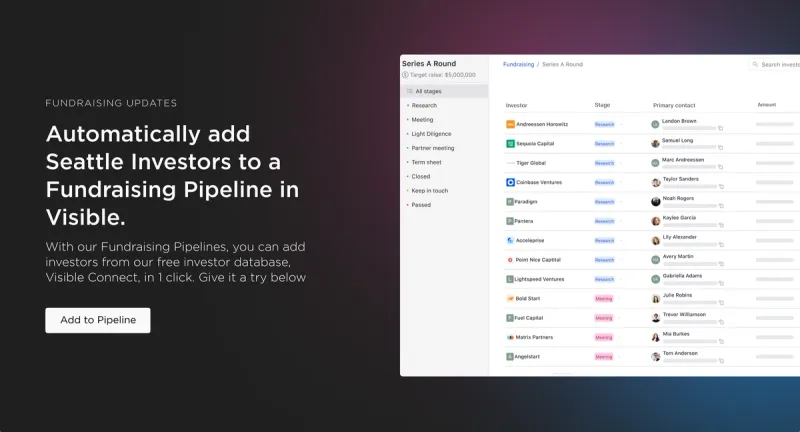
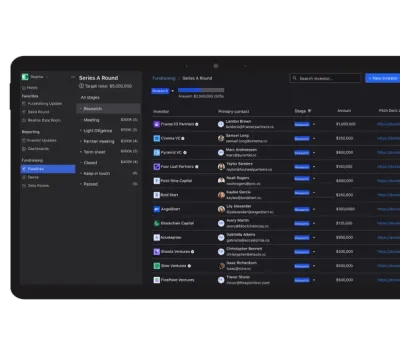
At Visible, we often times compare a fundraise to a B2B sales and marketing funnel. At the top of your funnel, you are finding new investors. In the middle, you are nurturing and pitching potential investors. At the bottom of the funnel, you are working through diligence and ideally closing new investors.
With the introduction of data rooms, you can now manage every aspect of your fundraising funnel with Visible.
- Find investors at the top of your funnel with our free investor database, Visible Connect and find a filtered list of Seattle investors here.
- Track your conversations and move them through your funnel with our Fundraising CRM
- Share your pitch deck and monthly updates with potential investors
- Organize and share your most vital fundraising documents with data rooms
Manage your fundraise from start to finish with Visible. Give it a free try for 14 days here.
Frequently Asked Questions
How much venture capital was raised in Seattle in 2025?
Seattle startups raised nearly 2 billion dollars in venture capital throughout 2025, maintaining its position as a top-five United States tech hub. The region saw an 11 percent annual growth rate, driven primarily by seed and Series A rounds in applied AI, cloud infrastructure, and B2B SaaS sectors.
What is the Washington capital gains tax rate for 2026?
For the 2026 tax season, Washington applies a 7 percent tax on long-term capital gains exceeding a 278,000 dollar standard deduction. Any portion of gains surpassing 1 million dollars is subject to a tiered 9.9 percent rate. This tax only applies to individuals and includes specific exemptions for qualified small business stock.
Which Seattle VC firms are currently leading seed rounds?
Madrona Venture Group and Founders Co-op remain the most active leads for Seattle seed rounds in 2026. Other significant early-stage investors include Flying Fish Partners, which focuses on applied AI, and Pioneer Square Labs, which operates a high-volume startup studio and venture fund model for technical founders.
Are there specific startup grants available in Seattle for 2026?
Seattle founders can access several non-dilutive funding sources, including the University of Washington’s Global Innovation Fund and the Washington State R&D tax credit. Additionally, the 2025-2027 Clean Energy Grants Program offers state-backed capital for startups focusing on sustainability, while small businesses may qualify for Business and Occupation tax credits.
How does the Seattle startup ecosystem compare to Silicon Valley?
Seattle offers higher capital efficiency and lower competition for lead investors compared to Silicon Valley. While the Bay Area leads in total volume, Seattle is the dominant global hub for cloud infrastructure and applied AI, benefiting from a dense talent flywheel of former Amazon and Microsoft engineering leadership.