
Key Takeaways
-
VDR pricing realities: Founders often overpay for enterprise tools, but startup-focused virtual data room providers should offer transparent pricing that aligns with a lean operating model. Utilizing a cost-effective platform ensures you protect the operational efficiency premium gained by building in the Midwest.
-
Targeted institutional investors: Securing early funding requires pitching regional funds that explicitly mandate investments in the Great Lakes and Great Plains. These partners prioritize sustainable revenue models and defensible unit economics over raw hypergrowth to scale companies toward their next major capital milestones.
-
Flawless due diligence: Mid-continent venture capital firms heavily scrutinize capital efficiency and paths to profitability during their evaluation process. Organizing your financial metrics and early customer contracts in a secure environment signals immediate operational maturity to top-tier funds.
-
Built-in customer bases: The massive concentration of Fortune 500 headquarters in the central United States provides immediate pilot program opportunities for enterprise software startups. Securing these corporate contracts yields the exact commercial validation that regional funds require before deploying capital.
-
Aggressive tax incentives: States like Ohio and Illinois have enacted major statutory tax credits for the 2026 fiscal year to reduce the risk of early-stage capital deployment. These policies directly incentivize local angel syndicates and coastal funds to back regional technology companies.
Raising venture capital in the Midwest isn't just a cost-saving measure anymore; it’s a deliberate strategy. While coastal markets continue to navigate wild valuation swings, cities like Chicago, Minneapolis, Indianapolis, and Detroit are quietly thriving as resilient hubs for venture activity.
Investors are flocking to the Great Lakes and Great Plains for an "efficiency premium." Simply put: the Midwest rewards sustainable growth over cash-burning hype. For founders building in B2B SaaS, industrial technology, and applied AI, this region offers a massive built-in advantage. You get direct proximity to Fortune 500 corporate partners and top-tier university research pipelines, all without the Silicon Valley burn rate.
If you are actively raising capital in 2026, this guide is your roadmap. Below, we break down the most active Top VCs in the Midwest, categorize them by stage and check size, and show you exactly how to tap into a regional network that too many founders still overlook.
Top Midwest Venture Capital Firms (Great Lakes & Great Plains)
To help you build a highly targeted investor CRM, we have categorized the most active Midwest funds by their primary investment stage. The following firms were selected based on their deployment velocity, historical track record within the region, and explicit mandates to fund companies in the Great Lakes and Great Plains.
Top Seed & Early-Stage Midwest Investors
Finding the right seed partner is about securing local operational support. These funds specialize in taking Midwest companies from the pre-revenue or early-traction phase to Series A readiness.
M25

- Thesis: M25 is arguably the most active seed-stage investor dedicated exclusively to the Midwest, utilizing a highly data-driven approach to map the ecosystem. They focus on funding pragmatic, capital-efficient startups across 14 states in the mid-continent.
- Stage & Check Size: Pre-Seed to Seed; $100k - $500k.
- Traction Requirements: They often invest pre-revenue but look for strong founder-market fit, early customer validation (e.g., pilot programs, LOIs), and a clear path to early monetization.
- Notable Portfolio Companies:
- Loop Returns
- Kin Insurance
- Astronomer
Chicago Ventures

- Thesis: Chicago Ventures focuses on overlooked, operationally intensive businesses in the central US that are solving complex problems in legacy industries. They act as heavily involved operational partners to help founders scale their initial go-to-market motions.
- Stage & Check Size: Seed; $1M - $2M.
- Traction Requirements: They typically expect early revenue signals ($10k–$50k MRR) with validated unit economics and a demonstration of capital-efficient operations.
- Notable Portfolio Companies:
- G2
- Cameo
- Project44
Dundee Venture Capital

- Thesis: Headquartered in Omaha, Dundee invests in high-growth B2B SaaS and consumer tech startups. They champion founders who are building category-defining companies outside of the traditional coastal tech bubbles.
- Stage & Check Size: Seed; $500k - $1M.
- Traction Requirements: They look for strong product engagement metrics and initial commercial traction, typically preferring companies with at least $15k-$20k in MRR.
- Notable Portfolio Companies:
- Myriad Sensors
- Bulkmatic
- PolicyGenius (early regional backer)
Matchstick Ventures

- Thesis: Operating out of Minneapolis and Boulder, Matchstick is a premier early-stage partner for founders in the North and Midwest. They act as a catalyst for tech-enabled startups, focusing heavily on community-building and network introductions.
- Stage & Check Size: Pre-Seed to Seed; $500k - $1.5M.
- Traction Requirements: They frequently back pre-product/pre-revenue teams, prioritizing the founder's unique insight, domain expertise, and the speed of their execution.
- Notable Portfolio Companies:
- Branch
- Inspectorio
- Soundbite
CincyTech

- Thesis: CincyTech is a major driver of the Ohio ecosystem, translating regional university research into scalable tech and life science companies. They focus heavily on deep tech, digital health, and enterprise software.
- Stage & Check Size: Seed to Early-Stage; $500k - $1.5M.
- Traction Requirements: Because they often fund research-based startups, traction is frequently measured by defensible IP, successful clinical or technical validation, and institutional partnerships rather than raw revenue.
- Notable Portfolio Companies:
- Astronomer
- Enable Injections
- Losant
Detroit Venture Partners

- Thesis: DVP is a key player in the revitalization of the Michigan tech scene, backed by Dan Gilbert. They back early-stage startups that are building B2B software, mobility tech, and solutions that can leverage Detroit's industrial base.
- Stage & Check Size: Early-Stage; $250k - $1M.
- Traction Requirements: They strongly prefer B2B startups with real revenue or direct pilot programs connected to automotive or manufacturing buyers. Consumer startups are rarely funded without significant early revenue.
- Notable Portfolio Companies:
- StockX
- Bloomscape
- May Mobility
Top Series A & Growth-Stage Midwest Investors
Once you have established product-market fit, these firms provide the heavy capital required to scale operations and expand your go-to-market teams.
Drive Capital

- Thesis: Founded by former Sequoia partners and based in Columbus, Drive Capital operates with the thesis that the next generation of world-class companies will be built in the Midwest. They manage massive assets and can fund companies from initial scaling through to IPO.
- Stage & Check Size: Series A to Growth; $5M - $20M+.
- Traction Requirements: For Series A, they look for $1.5M–$3M+ ARR, 100%+ YoY growth, and highly defensible unit economics (LTV:CAC > 3:1).
- Notable Portfolio Companies:
- Duolingo
- Olive
- Root Insurance
Jump Capital

- Thesis: Operating out of Chicago, Jump Capital provides growth-stage capital with a heavy emphasis on data-driven technologies. They are thesis-driven investors deeply focused on fintech, crypto, IT infrastructure, and vertical SaaS.
- Stage & Check Size: Series A to Series B; $2M - $15M.
- Traction Requirements: They look for "Default Alive" companies with clear product-market fit, typically requiring $2M+ ARR for Series A, with net revenue retention exceeding 100%.
- Notable Portfolio Companies:
- M1 Finance
- Personal Capital
- Tubi
Hyde Park Venture Partners
- Thesis: With offices in Chicago and Indianapolis, HPVP focuses on B2B software startups in the mid-continent. They aim to be the first institutional lead for scaling software companies, providing aggressive go-to-market support.
- Stage & Check Size: Seed to Series A; $1M - $5M.
- Traction Requirements: They back companies transitioning from early traction to a repeatable sales motion, generally looking for $1M–$5M in ARR and a clear understanding of customer acquisition costs.
- Notable Portfolio Companies:
- ShipBob
- G2
- Terminus
Arthur Ventures

- Thesis: Located in Minneapolis, Arthur Ventures invests exclusively in B2B software companies located outside of Silicon Valley. They are known for their intense focus on capital efficiency and sustainable, long-term growth over cash-burning hyper-growth.
- Stage & Check Size: Series A to Series B; $2M - $10M.
- Traction Requirements: They require proven, capital-efficient growth. Startups must show strong revenue (often $2M+ ARR) with low burn multiples and a clear, near-term path to profitability.
- Notable Portfolio Companies:
- Leadpages
- MacStadium
- Total Expert
Lewis and Clark Ventures
- Thesis: Based in St. Louis, this firm capitalizes on the deep agricultural and healthcare expertise of the region. They focus on Series A and B rounds for companies in the B2B SaaS, healthcare, and agrifood tech sectors.
- Stage & Check Size: Series A to Series B; $3M - $10M.
- Traction Requirements: They look for companies moving past early-adopter phases into mainstream commercialization, requiring solid ARR ($2M+) and proven scalability within their specific verticals.
- Notable Portfolio Companies:
- Benson Hill
- Adarza BioSystems
- OneSpace
Lightbank

- Thesis: Founded by the co-founders of Groupon, this Chicago-based firm invests in disruptive technology companies across multiple stages. They leverage their deep entrepreneurial roots to help founders navigate hyper-growth challenges.
- Stage & Check Size: Seed to Growth; $500k - $5M.
- Traction Requirements: They are opportunistic but generally look for explosive user adoption metrics (for consumer) or rapid ARR growth and strong net revenue retention (for enterprise).
- Notable Portfolio Companies:
- Sprout Social
- Udemy
- Clearcover
OCA Ventures
- Thesis: A long-standing pillar of the Chicago ecosystem, OCA Ventures invests in companies with highly differentiated technologies and exceptional management teams. They have deep roots in core technology, fintech, and healthcare.
- Stage & Check Size: Seed to Series A; $1M - $3M.
- Traction Requirements: They heavily weight the strength of the technology and the management team, looking for early revenue traction ($500k+ ARR) combined with highly defensible IP.
- Notable Portfolio Companies:
- Cleversafe
- Base CRM
- SpotHero
Allos Ventures

- Thesis: With a strong presence in Indianapolis and Cincinnati, Allos Ventures focuses on early-stage B2B software and technology-enabled business service companies. They act as active board members, helping founders refine their business models and recruit executive talent.
- Stage & Check Size: Early-Stage to Series A; $1M - $5M.
- Traction Requirements: They look for companies that have moved beyond the prototype phase, demonstrating real customer adoption, recurring revenue models, and the potential to dominate a specific niche.
- Notable Portfolio Companies:
- Assurex Health
- Lessonly
- Octiv
Top Midwest Venture Studios
For founders who have deep domain expertise but need an institutional co-founder to help build the product and establish the initial go-to-market motion, the venture studio model offers a powerful alternative to traditional fundraising.
High Alpha

- Thesis: Headquartered in Indianapolis, High Alpha pioneered the B2B SaaS venture studio model. They don't just invest; they co-found companies by providing a full suite of operational support, from design and HR to finance and go-to-market strategy.
- Stage & Check Size: Studio Creation to Seed; Co-founding resources + $1M+ initial capital.
- Traction Requirements: Since they build from scratch, traction is based on the founder's domain expertise and the validation of the problem during High Alpha's rigorous "Sprint Week" ideation phase.
- Notable Portfolio Companies:
- Zylo
- Terminus
- Lessonly
Top Startup Accelerators and Incubators in the Midwest
While venture capital provides the financial fuel, accelerators and incubators provide the operational blueprint. The regional accelerator landscape is anchored by a mix of national programs with local hubs and homegrown organizations offering deep vertical expertise. For early-stage founders, these programs are critical stepping stones to building traction and securing institutional Seed or Series A rounds.
Techstars Chicago
- Focus Area: Industry Agnostic (Early-Stage Tech)
- Standard Funding: $120,000
- Equity Taken: Typically 6% (common stock) for the first $20k, with an optional $100k convertible note.
- Program Highlight: One of the most established programs in the region, offering a three-month intensive in downtown Chicago with access to Techstars' massive global mentor network and downstream investor connections.
gener8tor (Great Lakes)
- Focus Area: Industry Agnostic (High-Growth Startups)
- Standard Funding: $100,000
- Equity Taken: Standardized equity stake (typically via a convertible instrument or SAFE, depending on the specific cohort).
- Program Highlight: Headquartered in Wisconsin but operating across the Midwest, this highly selective investment accelerator accepts only five companies per cohort. This ensures highly individualized coaching and guaranteed, warm introductions to over 100 potential investors.
mHUB (Chicago)
- Focus Area: HardTech, Industrial IoT, Medical Devices, and Smart Manufacturing
- Standard Funding: Varies by specific sector cohort (typically a mix of cash investment and high-value in-kind services).
- Equity Taken: Typically 5% for participating cohort members.
- Program Highlight: mHUB is the premier resource for founders building physical products. It provides unparalleled access to over $6 million in specialized prototyping equipment and direct partnerships with regional manufacturing hubs.
BETA Minnesota
- Focus Area: Minnesota-based Technology Startups
- Standard Funding: $0 (Non-dilutive program)
- Equity Taken: 0% (No equity required)
- Program Highlight: This Minneapolis-based nonprofit offers a free, highly respected accelerator designed to help early-stage teams build community, refine their go-to-market strategies, and prepare for their first institutional round without diluting their cap table.
MATTER (Chicago)
- Focus Area: Healthcare, HealthTech, and Life Sciences
- Standard Funding: N/A (Incubator/Membership Model)
- Equity Taken: 0%
- Program Highlight: Operating as a specialized incubator rather than a time-bound accelerator, MATTER provides office space, regulatory mentors, and a vital platform for startups to run early clinical or commercial pilot programs with major health systems and pharmaceutical companies.
Most Active Midwest Angel Investor Syndicates
Angel syndicates in the Midwest operate differently than standard coastal angel lists. Because the region is densely packed with Fortune 500 headquarters and legacy industries, these groups often consist of former operators, successful founders, and corporate executives. For early-stage founders, these syndicates provide not just the critical first $100k–$1M in capital, but also direct customer introductions and operational mentorship.
Hyde Park Angels
- Headquarters: Chicago, IL
- Focus Areas: B2B Software, Consumer Tech, Healthcare Tech, Industrial Tech.
- Typical Check Size: $250k - $1M+ (Often leading or co-leading Seed rounds).
- Ecosystem Role: HPA is one of the largest and most active angel networks in the United States. They are known for a highly structured, institutional-grade investment process. They provide immense value by embedding subject matter experts from their network directly into portfolio companies as board members or strategic advisors.
VisionTech Partners
- Headquarters: Indianapolis, IN
- Focus Areas: Life Sciences, B2B SaaS, Advanced Manufacturing, Digital Health.
- Typical Check Size: $200k - $500k.
- Ecosystem Role: VisionTech acts as the primary angel artery for Indiana and the surrounding states. Their network leans heavily on investors with deep clinical, technical, or industrial expertise, making them an ideal first partner for highly regulated or technically complex startups.
Great Lakes Angels
- Headquarters: Metro Detroit, MI
- Focus Areas: High-Growth Tech, Mobility, Advanced Manufacturing, B2B SaaS.
- Typical Check Size: $100k - $300k.
- Ecosystem Role: Focusing primarily on Michigan-based startups, this group targets early-stage companies seeking their first round of outside capital. They offer deep connections to the region's automotive, mobility, and industrial legacy networks, making them a strategic launchpad for HardTech and supply chain startups.
Why Raise Capital in the Midwest in 2026?
The Midwest ecosystem is currently defined by an "efficiency premium" that attracts both local and coastal investors. In the current high-interest-rate environment, startups in the region benefit from extending their runways without sacrificing access to top-tier technical talent.
The Efficiency Premium and Lower Burn Rates
Beyond favorable tax codes, the Midwest offers a structural economic advantage. Founders building in hubs like Minneapolis, Omaha, Detroit, and Indianapolis benefit from two critical factors:
- Sustainable Burn Rates: Operational expenses for a lean technology startup in the Midwest are typically 30% to 50% lower than in San Francisco or New York. This lower cost of living and commercial real estate allows founders to extend their runway, giving them more time to achieve product-market fit without the pressure of constant, highly dilutive fundraising.
- Corporate and Industrial Density: The Midwest boasts one of the highest concentrations of Fortune 500 headquarters globally. For B2B SaaS, AgTech, and industrial tech founders, this provides a built-in, local customer base and a rapid pipeline for enterprise pilot programs.
2026 State-Specific Tax Incentives for Startups
The 2026 tax year marks a significant turning point for Midwest policy. Several states have launched or expanded programs that provide immediate financial relief and de-risk early-stage capital deployment for investors:
- Ohio Venture Capital Gains Deduction: Effective for the 2026 tax year, Ohio offers a 100% deduction on capital gains derived from investments in Ohio-based startups. This effectively eliminates the state’s flat income tax on successful local exits for certified venture funds, driving massive coastal capital into the state.
- Illinois Angel Investment Tax Credit & EDGE: Illinois continues to support early-stage growth by offering a 25% to 35% tax credit for investments in qualified new business ventures. Additionally, the EDGE for Startups program provides annual withholding tax credits to newly formed businesses that commit to job creation, offsetting the costs of scaling a technical workforce.
- Michigan R&D Initiatives: Michigan has expanded its Refundable Research and Development (R&D) Tax Credit for the 2025-2026 tax years, aggressively targeting hardtech and applied AI businesses conducting qualifying research within the state.
- Indiana Venture Capital Investment (VCI) Credit: Indiana continues to leverage its VCI tax credit, providing a 20% to 25% credit to investors who provide debt or equity capital to qualified Indiana businesses, significantly reducing the risk profile for early-stage angel syndicates.
What are the must-attend networking events for Midwest founders?
Networking in the Midwest is often more focused on building long-term relationships than transactional exchanges. The following events are the primary gathering points for the ecosystem in 2026.
InvestMidwest Venture Capital Forum
Scheduled for April 21-22, 2026, in Kansas City, this is a premier event for connecting startups in AgriFood, MedTech, and Digital Technology with capital. It features pitches from over 50 of the region's best startups and attracts hundreds of investors.
This is one of the largest annual startup festivals in the nation. It serves as a decentralized celebration of innovation across Minneapolis and St. Paul, featuring hundreds of sessions, pitch competitions, and community-led events.
Taking place on March 5, 2026, in Chicago, this summit unites the brightest minds in hardtech. It includes the Fourth Revolution Awards, which celebrate outstanding entrepreneurs and manufacturers driving technological advancement in the Midwest.
Organized by the Midwest Founders Community, this is an exclusive two day experience designed for top-tier founders. It focuses on peer-to-peer growth and strategy exchange in a more relaxed environment than a typical conference.
The Efficiency Premium and Cost-of-Living Advantages
Beyond tax codes, the Midwest offers a structural efficiency premium. Founders in hubs like Minneapolis, Omaha, and Indianapolis benefit from significantly lower burn rates than their coastal peers.
- Sustainable burn rates: Operational expenses for a lean technology startup in the Midwest can be 30% to 50% lower than in San Francisco or New York. This lower cost of living and office space allows founders to extend their runway, giving them more time to achieve product-market fit without the pressure of constant dilutive fundraising.
- Corporate and industrial density: The Midwest is home to one of the highest concentrations of Fortune 500 headquarters in the world. For B2B SaaS and industrial tech founders, this provides a built-in customer base and a pipeline for pilot programs. 2026 is seeing a surge in industrial modernization, with local AgTech and logistics startups securing major contracts with legacy manufacturers seeking to automate their supply chains.
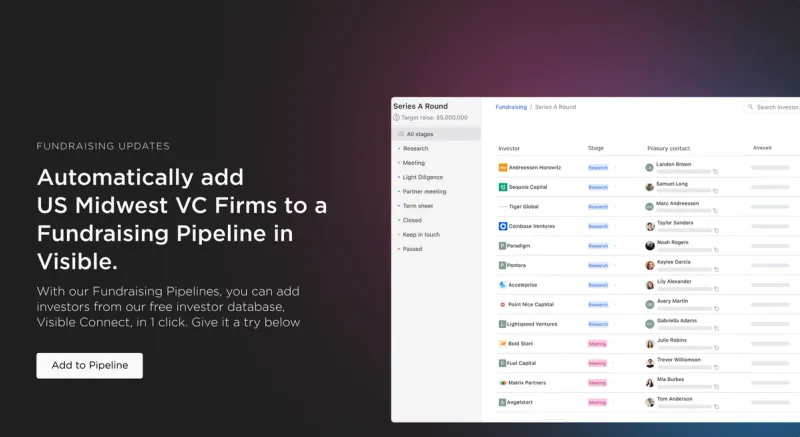
Connect With Investors in the US Midwest Using Visible
At Visible, we often times compare a fundraise to a B2B sales and marketing funnel. At the top of your funnel, you are finding new investors. In the middle, you are nurturing and pitching potential investors. At the bottom of the funnel, you are working through diligence and ideally closing new investors.
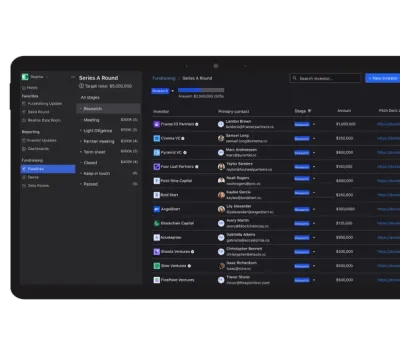
With the introduction of data rooms, you can now manage every aspect of your fundraising funnel with Visible.
- Find investors at the top of your funnel with our free investor database, Visible Connect and find a filtered list of investors.
- Track your conversations and move them through your funnel with our Fundraising CRM
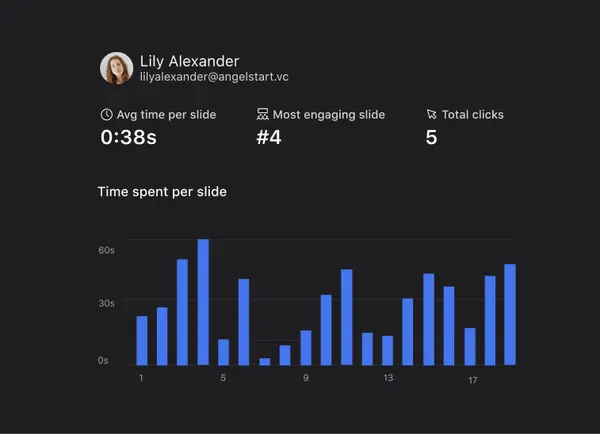
- Share your pitch deck and monthly updates with potential investors
- Organize and share your most vital fundraising documents with data rooms
Manage your fundraise from start to finish with Visible. Give it a free try here.
Frequently Asked Questions
Why are venture capital firms increasingly funding Midwest startups?
Investors are actively funding Midwest companies to capture an efficiency premium characterized by sustainable burn rates and much lower operational costs. Startups in this region achieve product-market fit faster by leveraging proximity to massive corporate customer bases.
- Operational expenses run typically 30% to 50% lower than in coastal tech hubs.
- Direct access to Fortune 500 headquarters accelerates enterprise pilot programs and early revenue.
- Regional investors heavily prioritize B2B SaaS, industrial technology, and applied AI over consumer hype.
What revenue metrics do Midwest Series A investors expect to see?
Midwest Series A investors require proven, capital-efficient growth, typically demanding between $1.5 million and $3 million in annual recurring revenue. Regional funds prioritize highly defensible unit economics and a clear, near-term path to profitability over raw hypergrowth.
- Firms like Drive Capital look for 100%+ YoY growth and strong LTV:CAC ratios.
- Growth-stage investors demand low burn multiples and repeatable go-to-market motions.
- Founders must demonstrate strong net revenue retention exceeding 100% to secure institutional term sheets.
How do virtual data room providers accelerate the due diligence process?
Startup-focused virtual data room providers centralize critical financial documents and cap tables into a secure, easily navigable platform for institutional investors. This strict organization signals operational maturity to venture funds and actively prevents deals from stalling during audits.
- Consolidates pitch decks, enterprise customer contracts, and IP documentation in one secure location.
- Allows founders to track investor engagement and document views directly within their fundraising CRM.
- Protects sensitive financial metrics while moving investors smoothly from the initial pitch to closing.
What 2026 tax incentives benefit investors funding Midwest tech companies?
Several Midwest states have enacted aggressive 2026 tax policies that significantly de-risk early-stage capital deployment for angel syndicates and venture funds. These regional incentives include massive capital gains deductions and immediate withholding tax credits for tech job creation.
- Ohio offers a 100% capital gains deduction on successful exits for certified local venture funds.
- Illinois provides 25% to 35% tax credits for direct investments in qualified new business ventures.
- Michigan aggressively targets applied AI and hardtech with highly expanded refundable R&D tax credits.
When should a founder utilize a Midwest venture studio instead of traditional VC?
Founders should partner with a venture studio if they possess deep domain expertise but lack the technical co-founders or initial capital required to build an MVP. Studios provide immediate institutional backing and extensive operational resources to launch.
- Studios like High Alpha co-found the business, providing integrated design, HR, and finance teams.
- Initial capital deployments often exceed $1 million alongside a highly structured operational blueprint.
- Early traction is measured by the founder's industry insight rather than historical commercial revenue.