
Key Takeaways
-
The Southeast venture capital ecosystem is a mature market that consistently captures up to twelve percent of total United States capital invested. Founders raising a Pre-Seed to Series B round no longer need to relocate to coastal hubs to secure meaningful funding.
-
Investors across interconnected networks in Atlanta, Miami, and Nashville prioritize long-term relationships and rational valuations over chasing industry hype. Average check sizes are experiencing a significant surge, meaning fewer deals are funded but successful pitches secure more capital for longer runways.
-
This guide details the top active VC firms and high-impact accelerators operating in the Southeast US in 2026. Readers will discover which sector-specific funds and incubators offer the strongest investor pipelines for B2B SaaS, fintech, and healthcare startups.
-
Founders can unlock hidden runway through overlooked region-specific advantages like state research and development tax credits and non-dilutive grant matching programs. States like Georgia and Florida offer highly lucrative financial incentives that directly offset operational costs and payroll taxes.
-
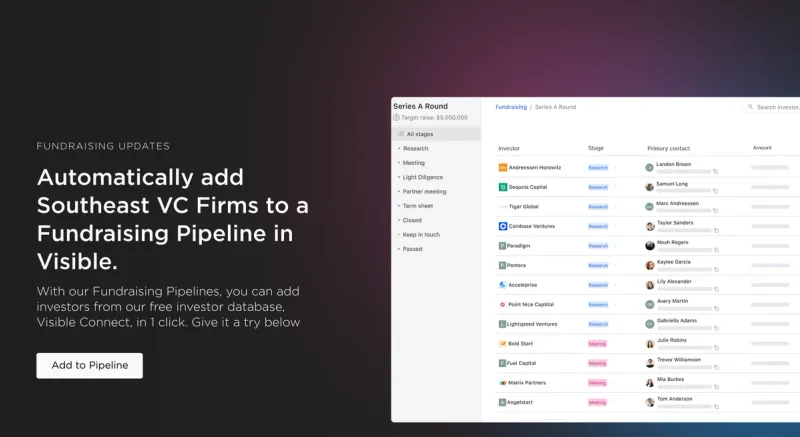
Major regional events like Venture Atlanta and the 3686 Festival are critical venues where actual deal flow begins for local entrepreneurs. You can build your target investor list and manage your entire fundraising funnel using our dedicated platform and data rooms.
The Southeast is one of the most active venture capital regions in the United States outside of the coastal hubs. Boasting nearly 600 active venture capital firms, the region consistently captures 10% to 12% of total U.S. capital invested and 9% to 10% of all deals. It is no longer an emerging market, it is a mature, founder-friendly ecosystem.
If you are a founder raising a Pre-Seed to Series B round, forget the outdated advice about needing to move to San Francisco. The Southeast's share of deal count is rising 30% faster than other non-hub regions. Networks spanning Atlanta, Miami, Nashville, Raleigh-Durham, Charlotte, and Tampa are highly interconnected, fueled by sophisticated, sector-specific funds with deep national ties.
What truly sets the Southeast apart is its measured, tranche-based funding style. Investors here aren't chasing hype; they prioritize long-term relationships and rational valuations, giving you the runway to prove traction and grow a capital-efficient company. Data shows a significant surge in average check sizes. The takeaway? Fewer deals are getting funded, but the ones that do are securing more capital, making your pitch preparation more critical than ever.
This guide covers everything you need to raise in the Southeast in 2026; the top active VC firms with offices or headquarters in the region, the state of the local fundraising landscape, the incubators and accelerators worth your time, and the region-specific advantages that most founders overlook entirely. Including state tax incentives, university grant programs, and active angel syndicates that do not make national headlines but do write meaningful checks.
Which Venture Capital Firms Are Actively Investing in the Southeast US in 2026?
Georgia
Location: Atlanta, GA
Stage: Seed through late-stage
Focus: B2B software and tech-enabled services
BIP Ventures is the North American-focused venture capital division of BIP Capital and one of the Southeast's largest and most active VC firms, with investments in the success of B2B software and tech-enabled service businesses at all stages of maturity since 2007. They also publish the annual State of Startups in the Southeast report, which makes them one of the most data-informed investors in the region. If you are building a B2B company with real traction in the Southeast, this is your most logical first call in Atlanta.

Location: Atlanta, GA
Stage: Seed Focus: B2B SaaSValor Ventures was founded in 2015 and focuses on B2B SaaS startups, with portfolio companies experiencing an average annual growth of 114 percent since inception. The firm is led by Lisa Calhoun and is well-regarded within the Southeast ecosystem for writing early conviction checks and supporting founders through a dense network of regional relationships. Seed-stage B2B SaaS founders building in the South should have Valor on their radar.

Location: Atlanta, GA
Stage: Early-stage
Focus: Fintech and financial services infrastructureTTV Capital is one of the earliest fintech-focused funds in the U.S., founded in Atlanta in 2000, and helped establish the region as a payments hub while continuing to back startups transforming financial infrastructure and consumer finance across North America. Their deep roots in Atlanta's Transaction Alley make them an essential conversation for any fintech founder, whether you are building payments infrastructure, lending technology, or insurance innovation.

Location: Atlanta, GA
Stage: Pre-seed and seed
Focus: Southeast-based founders across sectorsOverline is an Atlanta-based seed-stage venture capital firm that invests in founders building in the Southeast, leading and co-leading pre-seed and seed investments with checks ranging from $250K to $1.5M, with $60 million in assets under management currently investing out of its third fund. Their operator-led approach and deep local relationships make them one of the most accessible and founder-centric early-stage funds in the region.

Location: Atlanta, GA
Stage: Early-stage
Focus: Enterprise tech, corporate-connected startupsEngage Ventures, backed by a coalition of leading corporations including AT&T, Delta Air Lines, and The Home Depot, Engage invests in early-stage startups and connects them with its enterprise partners, giving founders direct access to the capital, expertise, and resources needed to scale within large markets. This is not just a check. It is direct customer access to some of the largest companies headquartered in the Southeast. If your product targets enterprise, this is one of the most strategically valuable partnerships in Atlanta.
Florida
Location: Tampa, FL
Stage: Seed through Series A
Focus: Florida and Southeast startups broadly
Florida Funders is a VC fund investing in startups in Florida and the Southeast. The firm combines institutional capital with a large network of individual investors across the state, giving portfolio companies a dual advantage of institutional backing and distributed angel relationships. For Florida-based founders who want investors that understand the local market, Florida Funders is consistently active and accessible.
Tennessee
Location: Nashville, TN
Stage: Early to growth-stage
Focus: B2B fintech for financial institutionsFINTOP Capital is a team of entrepreneurs that built the foundations of fintech, and the firm invests in the next generation of fintech operators changing the way financial institutions and their customers move, track, and interact with money. Nashville is an emerging fintech center, and FINTOP is the most specialized fund in the market for founders building B2B infrastructure for banks, credit unions, and insurers.
Location: Nashville, TN
Stage: Seed through Series C
Focus: Healthcare, technology, and business servicesClaritas Capital provides capital to entrepreneurs in healthcare, technology, and business services from seed to Series C. Nashville's reputation as the healthcare capital of the Southeast makes Claritas one of the most strategically positioned funds in the region for founders at the intersection of health services and technology. Their multi-stage model also means they can follow on as companies grow, which matters in a region known for measured, tranche-based deployment.
North Carolina

Location: Research Triangle, NC
Stage: Early-stage
Focus: Life sciences, biopharma, medical devices, healthcare technologyHatteras Venture Partners is one of the most established life sciences and healthcare investors in the Southeast, with deep roots in the Research Triangle, backing companies across biopharma, medical devices, diagnostics, and healthcare technology. For life sciences founders, proximity to UNC, Duke, and NC State gives Hatteras both the deal flow and the network to support spinout companies from the earliest stages of commercialization.

Location: Wilmington, NC
Stage: Early to growth-stage
Focus: B2B fintech for financial institutionsCanapi Ventures is the largest VC fund in the Southeast focused on B2B fintech solutions. The firm is backed by a consortium of community and regional banks, which gives portfolio companies something a standard VC cannot: a ready-made distribution network of financial institution customers. For B2B fintech founders, this is one of the highest-leverage investor relationships available in the entire region.
Alabama

Location: Birmingham, AL
Stage: Series A, Series B, Series C, Growth
Focus: High-growth businessesNew Capital Partners is a private equity firm dedicated to Building Great Companies by creating true partnerships with management teams and investing in high-growth businesses. By leveraging our extensive entrepreneurial and operational experience, we have realized significant value creation for our portfolio companies.
South Carolina
Location: Durham, NC (with Southeast coverage)
Stage: Early to growth-stage
Focus: Climate tech, sustainable energy, impact-driven B2BSJF Ventures doubled down on climate and energy as a core mandate, backing mobility, solar, and grid startups as part of their impact investment approach across the Southeast. For founders building in clean energy, sustainability infrastructure, or impact-driven technology, SJF fills a gap that most regional generalist funds leave open. Their presence in the Research Triangle gives them strong university deal flow and a tight LP base aligned to long-term, mission-driven returns.
High-Impact Accelerators & Incubators in the Southeast
Not every program is worth the equity. These accelerators are selected for their verifiable track records and active investor pipelines.
Georgia
- Advanced Technology Development Center (ATDC):
- Stage: Pre-seed through early growth
- Focus: Technology companies across sectors
- About: A rare zero-equity model. It provides coaching from entrepreneurs-in-residence and access to Georgia Tech’s corporate network. Recently celebrated its largest graduating class, with alumni having raised over $3 billion to date
- Techstars Atlanta (powered by Cox Enterprises)
- Stage: Seed
- Focus: Technology, with a social impact track
- About: Beyond the standard $120,000 Techstars investment and access to a 4,000+ global alumni network, the Cox partnership provides a unique strategic advantage. Cohort companies get direct access to one of the largest privately held media, telecommunications, and automotive companies in the U.S.
- Atlanta Ventures Studio
- Stage: Pre-seed
- Focus: Tech-enabled subscription and SaaS companies
- About: This is a hands-on studio, not a traditional cohort accelerator. They have strict entry criteria (less than $1M ARR, less than $1M raised, and at least 10 paying customers) and require founders to be based in Georgia. In exchange, they typically lead or fill your entire first round with checks ranging from $250K to $1 million. Notable alumni include Pardot and SalesLoft.
Florida
- Embarc Collective
- Location: Tampa, FL
- Stage: Pre-seed and seed
- Focus: Florida and Southeast tech startups
- About: Operating as a massive founder-community infrastructure, Embarc boasts a 96% member survival rate. They have helped startups raise over $600 million in capital and create 1,200 tech jobs. Crucially, they also publish the widely cited Southeast Capital Landscape Report, making them one of the most connected data hubs in the state.
Tennessee
- Nashville Entrepreneur Center (NEC)
- Location: Nashville, TN
- Stage: Idea through early growth
- Focus: Sector-agnostic, with healthcare and SaaS emphasis
- About: The NEC is the connective tissue of Tennessee tech. They host the TakeOff accelerator, the Periscope program, and Nashville Entrepreneur Day, an event that draws over 1,000 investors and business leaders. Their deal volume has recently outpaced the state's top ten angels combined.
- Launch Tennessee (LaunchTN)
- Location: Statewide, Tennessee
- Stage: All stages
- Focus: Tennessee-based technology companies
- About: This public-private partnership is a foundational resource for TN founders. They organize the flagship 3686 Festival, provide access to state grant matching programs, and offer research funding through the Tennessee Technology Advancement Consortium.
North Carolina
- Research Triangle Park (RTP)
- Location: Research Triangle, NC
- Stage: All stages
- Focus: Life sciences, technology, advanced manufacturing
- About: Proximity to Duke, UNC, and NC State creates one of the most talent-dense and IP-rich environments in the Southeast. Housing over 300 companies, RTP provides emerging founders with direct programming that connects them to massive corporate tenants and university research networks.
- South Carolina Research Authority (SCRA)
- Location: South Carolina (statewide)
- Stage: Early-stage
- Focus: Technology companies in South Carolina
- About: Operating since 1983, SCRA has helped attract billions in follow-on funding to the state. They provide highly sought-after non-dilutive funding and act as the primary entry point for founders trying to access South Carolina's angel and institutional investor networks.
Alabama
- Bronze Valley
- Location: Birmingham, AL
- Stage: Pre-seed through seed
- Focus: Tech startups led by underrepresented founders
- About: Operating as a non-profit at the intersection of inclusion and commercialization, Bronze Valley is the most active and well-connected program in Alabama for diverse founders, providing direct capital, mentorship, and regional investor introductions.
- Prosper HealthTech Accelerator
- Location: Birmingham, AL
- Stage: Early-stage
- Focus: Healthcare founders
- About: Designed for founders building clinical, workflow, or patient-facing healthcare products. It allows startups to tap into Birmingham’s growing healthcare cluster and establish Alabama-rooted investor relationships to complement Nashville's massive health services market.
Top Events in the Southeast for Founders in 2026
Events in the Southeast serve a different function than they do in coastal markets. In San Francisco, investor dinners happen year-round because the density is constant. In the Southeast, the annual conference circuit is where the deals actually start. Missing the major regional events is not just a missed networking opportunity. It is a missed pipeline-building opportunity.
- Venture Atlanta
- Location: Atlanta
- Timing: October annually
- The region's flagship event, drawing 300+ national investors and 400+ fund representatives. You do not need to pitch on stage to benefit; hallway conversations, investor dinners, and side events generate just as much deal flow. If you attend one event as a Southeast founder, make it this one.
- Sloss.Tech
- Location: Birmingham, AL
- Timing: June 24 to 26, 2026
- Brings together founders and funders while hosting the Sloss.Tech Ideas pitch competition. Crucially, it is one of the few events that explicitly draws investors from outside the Atlanta and Miami corridors, making it a powerful venue for founders in the broader mid-South.
- 3686 Festival (Powered by LaunchTN)
- Location: Nashville, TN
- Timing: Traditionally September
- LaunchTN's flagship entrepreneur festival featuring leading tech founders and VCs. For anyone raising a round in Tennessee or targeting Nashville-based investors, this is the most direct path to in-person conversations with the funds that matter.
- Nashville Entrepreneur Day
- Location: Nashville, TN
- Timing: Annual, hosted by the NEC
- Drawing over 1,000 attendees, this is a structured networking event rather than a traditional pitch competition. It is specifically designed to connect investor-ready founders with capital networks. It is a must-attend for Seed to Series A founders targeting healthcare or fintech investors.
Southeast Founder Communities and Research Resources
- Hypepotamus
- A Southeast-focused startup news and community platform that curates investor lists, accelerator databases, and ecosystem news. Their Southeast investor directory is one of the most comprehensive free-access tools available to founders doing initial investor research.
- The Southern Startups Organization
- The Southern Startup Report is a bi-weekly publication with curated news and information to support the southern startup ecosystem, covering new funds, accelerator cohorts, and ecosystem investments across the Southeast. Subscribing to this newsletter gives founders a consistent view of what is moving in the regional market, which is useful both for investor research and for timing your outreach around new fund announcements.
- BIP Ventures State of Startups
- Published annually each October, this is the most data-rich free resource on the Southeast venture ecosystem. It covers deal counts, capital deployment, sector trends, and state-by-state breakdowns using PitchBook data. Use it to benchmark your raise size and timing against regional norms before you start pitching.
- Embarc Collective Southeast Capital Landscape
- Updated annually, this database tracks nearly 600 venture capital firms and capital providers in the Southeast with searchable filters by state and sector. It is the fastest way to build a region-specific investor target list without paying for a PitchBook subscription.
- RAISE Forum (Atlanta)
- The RAISE Forum is a vehicle for bringing together startups and investors from across the Southeast. Startups that are in-revenue and seeking to raise between $500,000 and $5 million can apply twice a year, with events held at Emory's Goizueta Business School. This is a curated event, not an open-door pitch night, which means the investor quality and attention level is significantly higher than most free networking events in the region.
Region-Specific Advantages and Opportunities for Southeast Founders
Which States in the Southeast Offer R&D Tax Credits for Startups?
State R&D tax credits are one of the most overlooked sources of cash-equivalent savings for early-stage companies. They are not grants, but they reduce your tax liability directly based on what you are already spending on qualified research and development activities. For a pre-Series B company managing burn carefully, they function as a real runway extension.
In the Southeast, Florida, Georgia, Louisiana, and South Carolina offer state R&D tax credits, while Alabama, Mississippi, and Tennessee do not currently provide them, and North Carolina has repealed its program in 2016. Here are the active programs:
- Georgia offers an R&D tax credit equal to 10 percent of qualified research expenses exceeding a base amount, limiting the credit to 50 percent of your corporate income tax liability for the year. Unused credits carry forward for up to 10 years. Most notably, businesses with excess credits can use them to offset Georgia payroll withholding taxes. For Atlanta-based tech startups with payroll but limited early-stage income tax liability, this payroll offset is a highly meaningful mechanism.
- Florida restricts its R&D credit to C-corporations subject to the state's corporate income tax. Startups can apply for either 10 percent of their increased R&D expenses over the prior year or 50 percent of Florida's share of their federal R&D credit using the Alternative Simplified Credit method. Unused amounts carry forward, but because the state caps the credit at $9 million annually across all applicants, early submissions in each cycle gain a massive advantage before funds are prorated.
- South Carolina provides a simpler calculation, offering a credit equal to 5 percent of expenses that meet federal R&D tax credit requirements and occur within the state. This credit is capped at 50 percent of the business's tax liability and features a 10-year carryforward. While less generous than Georgia's program, it is highly straightforward to claim across various corporate structures.
- Virginia features an R&D tax credit with a strict per-company cap. However, this cap increases when research is conducted in partnership with a Virginia higher education institution. This specific incentive makes the credit particularly relevant for university-adjacent startups operating in the Research Triangle corridor or Northern Virginia.
- Kentucky offers a 5 percent state R&D tax credit on qualified expenses conducted entirely within its borders. Accompanied by a 10-year carryforward, it strictly offsets Kentucky corporate income tax liability but remains highly accessible and worth stacking with the federal credit for local operators.
Filing Note: the rules on what qualifies as a research expense, which entity structures are eligible, and how the base amount is calculated differ by state and can change without wide public notice. Work with a tax advisor who specifically handles R&D credits before filing. Missing the nuances costs more than the advisory fee.
Non-Dilutive Grant Programs Available to Southeast Founders
Non-dilutive capital is the category most equity-focused founders ignore until they are managing a tight runway and wish they had started earlier. The Southeast has more access to this type of funding than most founders realize, and in several states the programs are specifically designed to stack on top of federal grants.
Federal SBIR and STTR Programs represent the most substantial source of non-dilutive funding available to U.S. startups. The NSF awards $200 million or more in R&D funding annually across the country. Phase I awards provide up to $305,000 in non-dilutive funding over six to 18 months, while Phase II awards provide up to $2 million with zero equity taken. Eleven federal agencies participate, including the NIH, DOD, DOE, and NSF, each with different topic areas. (Note: as of late 2025, NSF submissions were temporarily paused pending reauthorization). For founders building deep technology or leveraging university research, this is an underused capital source that opens immediate access to lucrative state matching programs.
Innovate Alabama SBIR/STTR Supplemental Grant Program provides non-dilutive matching funds to local companies that have received a federal grant. The state matches up to 50 percent of a Phase I award (up to $100,000) and up to 50 percent of a Phase II award (up to $250,000). Having awarded more than $17 million to date, it is one of the most direct and well-structured state matching programs in the region. If you are an Alabama-based company with federal funding, applying for this match is essential.
Georgia FAST Grant (UGA) is designed to increase both the quantity and quality of federal grants originating from the state. It provides vital preparation support and supplemental funding for Georgia-based companies applying to federal programs. For early-stage Georgia founders with a research-intensive product, this is a direct pathway to building the SBIR-ready application that ultimately unlocks federal capital.
Florida SBDC Network provides no-cost consulting, market research, and grant application support across the state, with offices in every major metro. For Florida founders who have never navigated a federal grant before, the SBDC is the most accessible entry point to building that capability internally without having to hire an expensive external grant writer.
The Louisiana R&D Tax Credit while technically a tax incentive rather than a direct grant, operates as a vital non-dilutive financial lever for founders. The credit percentage is based on the number of Louisiana employees, ranging from 5 to 30 percent of excess qualifying expenses. Louisiana allows a five-year carryforward for unused amounts, and C-Corporations, S-Corporations, LLCs, and Partnerships are all eligible. Because it scales with employee count, growing local teams can access credits at the higher end of the range, making it unusually generous compared to most regional programs.
Most Active Angel Syndicates in the Southeast
Atlanta Technology Angels (ATA)
The Draw: Recognized as Georgia's angel investment leader in the 2025 BIP Ventures State of Startups report. ATA offers top-tier due diligence support and deal quality.
Investment Criteria: Typically writes checks between $100,000 and $300,000, often using convertible notes with valuation caps between $2 million and $6 million. First-time guest applications are accepted through their website for their monthly meetings at Atlanta Tech Village.
The Draw: One of the most active groups in the region, offering selected companies access to capital and student-supported due diligence through their partnership with Emory University's Goizueta Business School (via the Venture Atlanta Angel Edition).
Investment Criteria: Strict entry requirements. Companies must show a minimum of nine months of revenue traction and have at least 50 percent of their current round already committed before applying.
The Draw: A massive network of 550 angel investors operating across the Carolinas, Georgia, and Tennessee. Having backed over 100 companies, it is one of the best options for founders outside the Atlanta core who are seeking highly structured angel capital.
Keiretsu Forum (Southeast Chapters)
The Draw: A dominant player in the regional angel landscape with active chapters in Atlanta and West Palm Beach. The network screens deals collectively but invests individually. Clearing their application process delivers powerful, multi-city exposure simultaneously.
Nashville Capital Network (NCN)
The Draw: Operates at the highly effective intersection of an early-stage VC firm and an angel network. NCN reflects Nashville's primary sector strengths, leaning heavily into healthcare technology and enterprise software. It is the most direct path to local capital for healthcare-adjacent founders raising sub-$2 million rounds in Tennessee.
Structural Cost Advantages for the Southeast
The operational cost advantages in the Southeast directly impact how far your capital stretches. Talent costs in Atlanta are approximately 30 percent lower than in San Francisco, and office space is nearly 50 percent cheaper. For a ten-person team, this differential can add six or more months of runway to a seed round. A Southeast venture capital check intrinsically comes with a structurally longer runway attached.
Founders and early employees also benefit heavily from regional state tax policies. Florida, Tennessee, and Texas have no personal state income tax, providing a significant financial advantage at exit and acting as a powerful recruiting tool for equity-compensated talent. While Georgia does levy a state income tax, its aggressive R&D tax credit programs and substantially lower baseline operational costs effectively offset this burden.
Tennessee offers a highly unique blend of startup tax incentives and infrastructure advantages. The absence of a wage income tax, combined with targeted state credits for job creation, makes it ideal for founders building e-commerce, consumer brands, and B2B SaaS platforms. Furthermore, Nashville and Memphis anchor one of the nation's strongest logistics corridors, providing a durable, built-in customer base for startups developing supply chain or fulfillment technology.
Sector-Specific Opportunities Unique to the Southeast Region
Three sector-specific opportunities in the Southeast are meaningfully different from what you would find in a coastal market, and each one represents a genuine competitive advantage for founders building in the right vertical.
- Defense & Aerospace (Huntsville, AL): A high-density, low-cost hub for deep tech and national security. Anchored by NASA's Marshall Space Flight Center and the Army's Redstone Arsenal, it offers founders unparalleled proximity to government contracts and defense primes, bolstered by local grant programs like Innovate Alabama.
- Healthcare Tech (Nashville, TN): A structural stronghold offering irreplaceable customer access for health tech founders. Home to major players like HCA Healthcare and Cigna, the ecosystem remains highly robust, with total venture capital deployed in the state projected to rebound to $1.5 billion in 2025.
- Fintech (Atlanta, GA): Known as "Transaction Alley," Atlanta houses payment infrastructure giants like Fiserv and Global Payments. For B2B fintech founders, this direct geographic proximity can shrink enterprise sales cycles from months to weeks, accelerating vital early traction.
What Government-Backed Venture Programs Exist for Southeast Founders?
Several state governments have deployed direct venture capital programs that operate either as standalone funds or co-investment vehicles alongside private capital.
Virginia Venture Partners (VVP)
- Funding: $173 million state-supported program.
- Structure: Co-invests alongside private VCs; does not lead rounds.
- Founder Benefits: Adds cap table credibility and unlocks additional state resources, including SBIR and commercialization support.
- Partnerships: Invests through gener8tor Alabama, Measured Capital, and a venture studio with Harmony Venture Labs to close the early-stage funding gap.
- Structure: Requires a 1:1 private co-investment match.
- Impact: High startup demand has successfully shifted more state funding from loans to equity. It is the primary gateway to Alabama's broader investor network.
Florida Venture Capital Program
- Funding: $100 million state program established in 2023 to stimulate tech startup growth.
- Structure: Designed to catalyze private co-investment.
- Next Steps: Funds are deployed in phases; founders should contact the Florida SBDC Network for the latest program details and application windows.
Connect With Investors in the Southeast US Using Visible
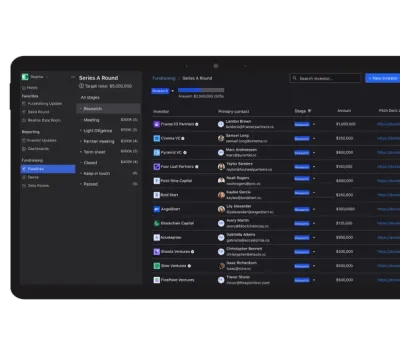
At Visible, we often times compare a fundraise to a B2B sales and marketing funnel. At the top of your funnel, you are finding new investors. In the middle, you are nurturing and pitching potential investors. At the bottom of the funnel, you are working through diligence and ideally closing new investors.
With the introduction of data rooms, you can now manage every aspect of your fundraising funnel with Visible.
- Find investors at the top of your funnel with our free investor database, Visible Connect and find a filtered list of investors.
- Track your conversations and move them through your funnel with our Fundraising CRM
- Share your pitch deck and monthly updates with potential investors
- Organize and share your most vital fundraising documents with data rooms
Manage your fundraise from start to finish with Visible. Give it a free try here.
Frequently Asked Questions
What are the top venture capital firms actively investing in the Southeast?
There are nearly 600 active venture capital firms in the Southeast. Some of the most notable funds include BIP Ventures and Valor Ventures in Georgia, Florida Funders in Florida, and FINTOP Capital in Tennessee. These firms provide crucial early stage funding and offer deep regional networks for growing startups.
Can founders raise venture capital in the Southeast without moving to coastal hubs?
Founders no longer need to relocate to coastal hubs to secure significant funding. The Southeast venture capital ecosystem is highly mature and consistently captures ten to twelve percent of all United States capital invested. Investors in this region prioritize sustainable growth and long term relationships over chasing industry hype.
Which Southeast states offer research and development tax credits for startups?
States like Georgia, Florida, Louisiana, and South Carolina offer robust research and development tax credits. These incentives allow startups to offset corporate income or payroll tax liabilities based on their qualified research expenses. Utilizing these state specific tax advantages can significantly extend your financial runway before raising another round.
What are the best events for connecting with Southeast venture capital investors?
The annual conference circuit is the primary starting point for deal flow in this region. Founders raising capital should prioritize attending major events like Venture Atlanta, the 3686 Festival in Nashville, and Sloss Tech in Birmingham. These gatherings attract hundreds of national funds and regional angel syndicates looking for deals.
How can Southeast startups secure non dilutive funding and grants?
Southeast startups can access substantial non dilutive funding through federal programs like SBIR and STTR grants. Many states offer lucrative matching programs to supplement these federal awards. For example, Innovate Alabama and the Georgia FAST Grant provide critical financial support and application assistance to help founders scale without sacrificing equity.