

Key Takeaways
-
Latin American venture capital rebounded to $4.1 billion last year, but funding is now highly concentrated in larger checks, with a smaller pool of qualified companies.
-
Brazil and Mexico captured nearly 80% of all regional venture capital deployed, cementing their status as the dominant markets for scaling startups.
-
Fintech dominates regional capital, but fifteen newly launched venture funds provide fresh funding opportunities for early stage startups across expanding sectors like software and logistics.
-
Top startup accelerators and government programs offer equity-free capital and global networking opportunities that help compress a typical six to twelve-month fundraising timeline.
-
Securing an investor term sheet relies heavily on relationship-building at premier regional events and on managing your outreach like a structured sales pipeline.
Latin America raised $4.1 billion in venture capital across 681 rounds in the last year, marking the first meaningful rebound after three consecutive years of correction. Investors are back at the table, but the rules have changed. Capital is concentrating into fewer, better-qualified companies, and founders who understand the new dynamics will have a decisive advantage over those who do not.
Whether you are raising your first Pre-Seed round or preparing for a Series B, this guide provides the full picture of the fundraising landscape in Latin America. From a curated list of the most active VC firms in the region, to an honest analysis of the ecosystem's strengths and structural gaps, to the accelerators, grants, and local advantages that most founders overlook, everything here is designed to help you walk into your next investor meeting better prepared than the founder who came before you.
Current Fundraising Landscape in Latin America in 2026
The recovery is real, but it is not broad-based. The average deal size grew 16% to $6.1 million, while deal volume fell to its lowest level since 2017. Investors are writing larger checks to fewer companies. If your fundamentals are strong, this market rewards you. If they are not, the days of raising on narrative alone are over.
The early-stage picture deserves particular attention. Pre-seed funding fell 40% in capital deployed, hitting its lowest level since 2018. For founders at the earliest stages, this means standing out from a thinner but more competitive pipeline. Traction signals, even modest ones, now carry more weight than they have in years.
On the other side of that equation, 15 new VC funds launched in the region in this last year, raising a combined $761 million. Fresh funds mean fresh deployment mandates. Founders who get in front of the right managers early in a fund cycle tend to benefit from more flexible diligence and more engaged post-investment support.
Where Is the Capital in Latin America Concentrated?
Brazil and Mexico together captured 78.5% of all venture capital deployed in the region in tht last year, with Brazil at $2.03 billion and Mexico at $980 million. But concentration at the top does not close the door for founders elsewhere. Colombia recorded more deals than Chile, Argentina maintained competitive average ticket sizes, and Montevideo emerged as one of the region's fastest-growing startup cities. The ecosystem is maturing across more markets than the headline numbers suggest.
Fintech still commands the most capital, taking 61% of total funding while representing only 29% of deals, a ratio that reflects investor confidence in the sector's unit economics. SaaS consolidated as the second-largest sector, and logistics and energy are attracting larger infrastructure-scale tickets. For founders outside fintech, the opportunity is real, but the bar for proof points is higher.
Who Are the Top Venture Capital Firms Actively Investing in Latin America?
NXTP
HQ: Buenos Aires, Argentina (offices in Brazil, Mexico, Uruguay)
Investment Geography: Pan-Latin America and global
About: Founded in 2011, NXTP is Latin America's premier B2B-focused early-stage VC, having backed over 275 founders and logged over $2 billion in total capital raised across its portfolio. The fund focuses exclusively on four B2B verticals: Cloud & SaaS, FinTech, E-Commerce Enablers, and B2B Marketplaces, with a global network of 400+ enterprise customer contacts to support portfolio growth.
Stage & Check Size: Pre-Seed to Series A; $500K–$5M
Traction Requirements: B2B revenue model with initial enterprise traction; companies must demonstrate product-market fit in at least one of the four verticals.
Notable Portfolio Companies:
- Auth0 (Argentina, identity SaaS, acquired by Okta)
- Mural (Argentina, collaboration SaaS)
- Betterfly (Chile, insurtech)
Canary

HQ: São Paulo, Brazil
Investment Geography: Brazil and broader Latin America
About: Founded in 2017 by former founders and operators, including creators of a Latin American unicorn, Canary operates as an operator-first fund that partners with startups from the earliest stage through Series A. The firm is sector and business-model agnostic, looking for exceptional teams in large markets with transformational product potential.
Stage & Check Size: Pre-Seed to Series A; $250K–$15M+, typically leads the first institutional round.
Notable Portfolio Companies:
- Nuvemshop (Brazil/Argentina, e-commerce platform)
- Lastro (Brazil, AI proptech)
- Lastlink (Brazil, creator economy, Seed backed 2021)
Kaszek

HQ: São Paulo, Brazil / Buenos Aires, Argentina
Investment Geography: Pan-Latin America
About: Founded in 2011 by Hernan Kazah and Nicolas Szekasy, both co-founders of MercadoLibre, Kaszek is the most established institutional VC in Latin America with over $2.5 billion raised across 11 funds. The firm is industry and stage-agnostic, backing exceptional founding teams using technology to gain competitive advantage across any sector.
Stage & Check Size: Seed to Series B (primary fund: $500K–$25M); late-stage Opportunity Fund: $10M–$50M.
Notable Portfolio Companies:
- Nubank (Brazil, fintech)
- QuintoAndar (Brazil, proptech)
- Arvo (Brazil, healthtech AI)
Monashees

HQ: São Paulo, Brazil
Investment Geography: Pan-Latin America, US presence
About: Founded in 2005, Monashees is the longest-running early-stage VC firm in Latin America, backing founders from pre-seed through early growth with a human-values-first approach. The firm prioritizes companies with the potential to improve people's lives through technology at scale, with a community of 150+ portfolio companies and 300+ founders.
Stage & Check Size: Pre-Seed to Series A
Notable Portfolio Companies:
MAYA Capital
HQ: São Paulo, Brazil
Investment Geography: Pan-Latin America (Brazil + Spanish-speaking LatAm)
About: MAYA is a female-founded seed fund and the first pan-Latin America venture firm built to operate across Brazil and Spanish-speaking LatAm from day one, rather than treating them as separate markets. The firm runs like a startup itself, delivering 400+ hiring introductions and 200+ commercial introductions per year to portfolio companies.
Stage & Check Size: Seed (first institutional round); leads rounds with initial checks calibrated to own the first venture round. Fund II closed at $100M.
Notable Portfolio Companies:
- Belvo (Brazil/Mexico, open banking API)
- Solfácil (Brazil, solar fintech)
- Nexa Finance (Brazil, fintech)
Astella Investimentos
HQ: São Paulo, Brazil
Investment Geography: Brazil
About: Astella is a thesis-driven value investor focused on early-stage SaaS, e-commerce, marketplaces, and AI/data-driven businesses in Brazil, applying a business-fundamentals lens to every investment decision rather than chasing sector trends. The firm typically targets a 15–20% ownership stake, leading rounds from pre-seed through Series A and doubling down through Series B.
Stage & Check Size: Pre-Seed to Series A; typical deal range $5M–$10M.
Notable Portfolio Companies:
- RD Station (Brazil, marketing SaaS, largest SaaS exit in LatAm history)
- Omie (Brazil, SME ERP SaaS)
- BotCity (Brazil, RPA/AI)
Valor Capital Group

HQ: New York / São Paulo / Rio de Janeiro
Investment Geography: Brazil and US-Brazil cross-border
About: Valor Capital Group is a cross-border investment firm operating at the intersection of Brazil and the US, backing technology companies that can scale across both markets with a growth equity and venture capital mandate. The firm has made 215+ investments and actively co-invests with global funds including QED and Quona.
Stage & Check Size: Seed to Series B
Notable Portfolio Companies:
- Kanastra (Brazil, capital markets infrastructure, $13M Seed co-led with Quona)
- Cobli (Brazil, fleet management SaaS)
- Revelo (Brazil, HR tech)
QED Investors

HQ: Alexandria, VA (investment team in Mexico City and Brazil)
Investment Geography: Global, active in Latin America since 2014
About: QED is one of the world's premier fintech-focused VCs, investing exclusively in companies that disrupt financial services, from credit and lending to insurance, embedded finance, and banking infrastructure. The firm has investment team members based in Mexico and Brazil and brings deep operator experience from Capital One founders.
Stage & Check Size: Early-stage fund initial checks $3M–$10M; growth fund average $15M–$20M.
Notable Portfolio Companies:
Quona Capital

HQ: Washington, DC (team in Mexico City, São Paulo, and other global hubs)
Investment Geography: Latin America, South/Southeast Asia, Sub-Saharan Africa
About: Quona is a fintech-for-inclusion specialist, backing companies that expand access to financial services for underserved consumers and small businesses across emerging markets, with a significant portion of its portfolio in Latin America. The firm maintains active event programming in the region and recently co-hosted the LatAm Fintech Forum during Mexico Tech Week.
Stage & Check Size: Seed to Series B
Notable Portfolio Companies:
- Kanastra (Brazil, capital markets fintech, Series B $30M)
- Belvo (Brazil/Mexico, open finance)
- Solvento (Mexico, logistics payments)
Nazca
HQ: Miami, FL / Mexico City (offices across LatAm)
Investment Geography: Mexico and Spanish-speaking Latin America
About: Nazca is one of the most active Mexican VC firms in Latin America, founded in 2014 with IFC (World Bank Group) as a recurring institutional lead LP, and merged with Bridge LatAm last year to create a broader pan-regional platform with Nazca Fund IV in the pipeline. The firm backs bold, tech-enabled entrepreneurs in fintech, enterprise applications, mobility, health, and education across the region.
Stage & Check Size: Seed to Series A; average seed round size $4.8M, average Series A $11.5M.
Notable Portfolio Companies:
- Kavak (Mexico, used-car marketplace)
- Xepelin (Chile, B2B financial services)
- Vambe (Argentina/Mexico, AI for mid-market companies)
COMETA

HQ: Mexico City, Mexico
Investment Geography: Spanish-speaking Latin America, Spain, and US
About: Founded in 2012, Cometa backs early-stage technology startups where data is critical, human interaction is high, and proprietary insights can compound into defensible businesses, with strong emphasis on AI readiness and digital transformation across fintech, marketplaces, and enterprise software. The firm has 4 new investments in the last 12 months and actively co-invests with global institutions including Goldman Sachs and FinTech Collective.
Stage & Check Size: Seed to Series A
Notable Portfolio Companies:
- Simetrik (Colombia, financial reconciliation SaaS, $55M Series B led by Goldman Sachs)
- R2 (Mexico, merchant financing, backed by Google)
- Solvento (Mexico, logistics fintech)
Magma Partners

HQ: Santiago, Chile (team distributed across Mexico, Colombia, Argentina, and the US) Investment Geography: Pan-Latin America
About: Magma Partners focuses on Latin American founders solving the region's biggest structural problems, with particular strength in fintech, insurtech, and marketplace models, while remaining sector-open to any scalable tech startup. The firm has deployed $80M+ across 125+ startups since founding, including 2 unicorns, and provides deep operational support through teams in five countries.
Stage & Check Size: Pre-Seed to Series A
Notable Portfolio Companies:
- Kushki (Ecuador/Mexico, payments infrastructure)
- Nuvocargo (US/Mexico, logistics)
- Frete (Brazil, freight marketplace)
Angel Ventures

HQ: Mexico City, Mexico
Investment Geography: Latin America and US Hispanic market
About: Founded in 2008, Angel Ventures is one of the oldest active VC firms in Latin America, with a dedicated US Latinx fund alongside its core LatAm fund, backing cross-border founders addressing the US-LatAm corridor in logistics, fintech, proptech, food, and HR tech. The firm has a track record of 76 investments, 10 exits, 3 IPOs, and 2 unicorns.
Stage & Check Size: Pre-Seed to Series A; $250K–$1M initial checks
Notable Portfolio Companies:
- Clip (Mexico, payments infrastructure)
- Nowports (Mexico, digital freight forwarder)
- Digitt (Mexico, credit card debt refinancing)
Fen Ventures

HQ: Santiago, Chile
Investment Geography: Spanish-speaking Latin America (excludes Brazil)
About: Fen Ventures is an early-stage fund with a specific and underserved focus: Spanish-speaking Latin America outside of Brazil, backing founders in fintech, SaaS, and sustainability who are building with a global mindset from day one. The firm provides hands-on support and access to a co-investor and mentor network built specifically for the Chilean and broader Spanish-speaking ecosystem.
Stage & Check Size: Pre-Seed to Series A
Notable Portfolio Companies:
- Fintual (Chile, digital wealth management)
- Bsale (Chile, retail SaaS)
- Destacame (Chile, credit access platform)
500 LatAm

HQ: Mexico City, Mexico
Investment Geography: Spanish-speaking Latin America
About: 500 LatAm is the dedicated Latin America vehicle of 500 Global, one of the world's most active early-stage funds, and has deployed $34M+ across 300+ regional startups since 2012 with a specific focus on Spanish-speaking founders building scalable technology businesses with global potential. The fund combines investment capital with structured access to Silicon Valley networks, mentorship, and the 500 Global portfolio community across 80+ countries.
Stage & Check Size: Pre-Seed; $300K initial investment
Traction Requirements: Early revenue or strong user growth; founders must demonstrate execution capability and an addressable market that extends beyond the home country.
Notable Portfolio Companies:
Top Accelerators and Startup Programs for Founders in Latin America
Accelerators are not just a source of early capital. In a region where the fundraising process now takes between six and twelve months for the majority of founders, the network, signal, and investor introductions that an accelerator provides can significantly compress that timeline.
The programs listed here range from government-funded grants with no equity attached to global platforms with direct lines into Silicon Valley. Choosing the right one depends on your stage, geography, and your customers' location.
Start-Up Chile (CORFO): The Largest State-Backed Program in the Region
Start-Up Chile is the flagship government accelerator for Latin America and the world's first public business accelerator when it launched in 2010. Run by CORFO, Chile's economic development agency, the program has supported over 1,960 startups from more than 85 countries, with a combined portfolio valuation of over $2.1 billion.
The program runs three distinct tracks, each matched to a different development stage:
- Build: A 4-month pre-acceleration program providing approximately $15,000 USD in equity-free co-financing for teams moving from a validated idea to an MVP.
- Ignite: A 4-month track providing approximately $30,000 USD for startups with a product seeking product-market fit, with the possibility of a follow-on extension.
- Growth: An 8-month program providing up to approximately $80,000 USD for companies ready to enter international markets and build a scalable model.
All three tracks are equity-free. International founders receive a two-year Chilean work visa and relocation support. Female-led startups qualify for higher co-financing percentages across the Ignite and Growth tracks. For early-stage founders seeking non-dilutive capital alongside access to a global alumni network, this is the highest-value program in the region at that stage.
Google for Startups Accelerator: Equity-Free, AI-First
Google runs two active accelerator tracks for Latin America. The Spanish-speaking Latin America program is a 10-week equity-free program for Seed-to-Series A startups based in or with significant operations in Spanish-speaking LatAm. The AI First program is a 12-week equity-free track for startups building with machine learning and AI.
Each cohort runs 10 to 15 companies. Participants receive up to $350,000 in Google Cloud credits, one-on-one technical mentorship from Google engineers, access to Google's network of industry experts, and dedicated support from the Google for Startups team. Neither program takes equity or charges fees. Note that Google also runs a separate Brazil-specific track focused on AI for Portuguese-speaking founders.
For technical founders building AI-native products, the combination of cloud infrastructure credits and direct Google engineering support at zero dilution cost makes this one of the most underutilized programs in the region.
500 Startups LATAM: Global Network With a Regional Engine
500 Startups LATAM is the dedicated Latin America vehicle of 500 Global, one of the world's most active early-stage funds. Based in Mexico City, the program has deployed over $34 million across 300+ regional startups since 2012, with a focus on Spanish-speaking founders building scalable technology businesses with international potential.
The 16-week accelerator program invests $60,000 per startup and provides structured access to the 500 Global portfolio community across 80+ countries. Cohorts skew toward fintech, SaaS, marketplaces, and logistics, though the fund is sector-agnostic. IDB Lab, the Inter-American Development Bank's innovation arm, has made multiple strategic investments into 500 LatAm funds, including a $2 million anchor in the current Seed Fund IV, which is targeting approximately 40 early-stage startups across the region including emerging ecosystems such as Costa Rica, Ecuador, Peru, and Uruguay.
The program's demo day model and Silicon Valley network give regional founders a credible signal for follow-on rounds from US-based funds.
Wayra by Telefónica: Corporate Acceleration With Enterprise Access
Wayra is the corporate venture and accelerator arm of Telefónica, founded in 2011, with hubs in Argentina, Brazil, Colombia, Chile, Mexico, and Peru across Latin America. It has accelerated over 400 startups globally, with approximately half coming from Latin America.
Wayra invests up to $150,000 to $2,000,000 per company depending on program and stage, and takes an equity stake in exchange.
Its focus sectors reflect Telefónica's strategic interests: IoT, AI, cybersecurity, fintech, big data, and connectivity infrastructure. The key distinction here is commercial access rather than financial return. Startups that can embed their solution into Telefónica's enterprise and consumer client base gain an immediate distribution channel that no pure-financial investor can replicate. Founders outside those strategic verticals should be realistic about fit before applying.
Endeavor: The Scale-Up Network for Growth-Stage Founders
Endeavor operates differently from every other program on this list. It does not run a cohort-based accelerator and it does not take equity. Instead, it selects a small number of high-impact entrepreneurs through a rigorous International Selection Panel and provides ongoing mentorship, peer access, and co-investment through its Endeavor Catalyst fund.
Endeavor's network spans 40+ countries and currently supports over 2,500 entrepreneurs whose companies collectively generate more than $28 billion in annual revenues. Its Latin America presence includes dedicated offices in Argentina, Brazil, Chile, Colombia, Ecuador, Mexico, Peru, Puerto Rico, and Uruguay. Endeavor Catalyst, its co-investment fund with over $250 million AUM, has backed over 200 companies and currently holds 29 companies valued at $1 billion or more in its portfolio, including Rappi, Globant, and Creditas.
The Scale Up by Endeavor program is the entry point for founders not yet at the Endeavor Entrepreneur selection stage. It is a five-month program designed for founders with proven revenue and growth who are navigating the transition from early startup to regional scale, providing customized mentorship, peer-to-peer community, and direct access to Endeavor's investor and executive network.
Where to Meet Investors: The 2026 Latin America Event and Networking Calendar
Fundraising in Latin America is a relationship business before it is a process business. Most of the introductions that lead to term sheets come through shared rooms, not cold emails. The five events below represent the highest-signal opportunities in the region for 2026, covering deal flow, pitch access, and warm introductions that compress the investor pipeline from months to weeks.
South Summit Brazil
March 25 to 27, 2026, Porto Alegre
The fifth edition of South Summit Brazil takes place at Cais Mauá in Porto Alegre and is the region's single most concentrated investor gathering. Last year’s edition brought 23,000 attendees from 62 countries, 900 investors managing a combined $215 billion in assets, and 130 investment funds, 38 of which were international.
The startup competition selects 50 finalists who pitch on the main stage in front of investors. Selected startups also participate in pre-scheduled, exclusive investor meetings built directly into the program.
Confirmed speakers for 2026 include Kaszek co-founder Hernan Kazah and Nubank's former marketing director Arturo Núñez.
If you attend one event in Latin America this year, this is the one. Applications for the startup competition have already closed for 2026, so file this for your 2027 calendar if you missed the window.
Fintech Americas
March 24 to 26, 2026, Miami Beach
Fintech Americas is the primary conference connecting Latin American fintech founders with the decision-makers at the banks, institutions, and investment funds they need access to.
It takes place at the Fontainebleau Hotel in Miami Beach and is not a startup competition. It is a deal-making conference. The last edition drew over 1,400 senior leaders from 36 countries, with 44% of attendees at the C-suite level.
For fintech founders at the Seed to Series B stage who need to build relationships with bank innovation teams, corporate VCs, and the institutional investors who back them, this conference offers a density of relevant counterparties that no regional event can match. Non-fintech founders will find less direct value here.
Web Summit Rio
June 8 to 11, 2026, Rio de Janeiro
Web Summit Rio is the Latin American edition of the world's largest tech conference series and the highest-profile international platform a LatAm founder can access without leaving the region.
The 2026 edition is confirmed at Riocentro in Rio de Janeiro and is expected to draw over 30,000 attendees, 500+ investors, and 1,500+ startups.
The startup program includes structured PITCH competitions, pre-scheduled 15-minute investor-to-startup meetings, and Mentor Hours with sector-specific experts.
The event runs across four days with content tracks covering AI, fintech, sustainability, and digital media. The primary advantage for founders here is international signal: media coverage, global investor access, and the cross-border visibility that regional-only events cannot generate. Apply to the startup program early, as spots are limited.
FINNOSUMMIT
September 23, 2026, Mexico City
Now in its 10th edition, FINNOSUMMIT is the flagship annual event of the Latin American fintech ecosystem, organized by Finnovista and held at Expo Santa Fe in Mexico City.
It brings together fintech startups, banking leaders, regulators, and investors to discuss cross-sector financial innovation, and the 2026 edition is explicitly positioning itself as a broader convergence point for financial innovation across retail, healthcare, logistics, and embedded finance.
For the 10th edition, the organizing team has signaled a deliberate evolution beyond the traditional fintech conference format, reflecting the view that financial infrastructure is now horizontal across industries. This makes it increasingly relevant for founders outside pure fintech who are building with financial tooling as part of a broader B2B product. Over 3,000 attendees are expected.
Mexico Tech Week
October 26 to November 1, 2026, Mexico City
Mexico Tech Week is the region's most accessible and decentralized networking week, built on a community-event model where founders, investors, and operators self-organize individual events across Mexico City throughout the week.
There is no single venue, no single ticket, and no application process. Most events are free. The format generates a kind of high-density serendipity that curated conferences cannot replicate: informal dinners, roundtables, and pitch nights where QED, Quona, Nazca, and other Mexico-active funds have their own parallel programming.
For founders based in Mexico or raising from Mexico-focused funds, Tech Week is where the most productive informal relationship-building happens each year. Registration is event-by-event through the official website.
Which Countries in Latin America Are Attracting the Most Venture Capital in 2026?
Brazil: The Anchor Market with World-Class Infrastructure
Brazil remains the dominant destination for regional VC, attracting $2.032 billion across 363 deals in the last year, representing 52.9% of all regional funding. The country's structural advantages are unique globally.
Pix, Brazil's instant payment system, reached roughly $5 trillion in total value. Brazil's Open Finance framework recorded more than 102 billion API calls in 2024 across 800+ participating institutions, with nearly 62 million active data-sharing consents, a 96% increase in API call volume year-over-year. No other emerging market has built digital financial infrastructure at this scale, and the business model implications for founders are enormous. The data rails are live, the consent frameworks are in place, and the opportunity to build on top of them is immediate.
Key sectors in Brazil beyond fintech include enterprise SaaS, agtech, and healthtech. Omie, an SME cloud software platform, closed a $160 million Series D at the end of last year, at a $700 million valuation, the largest startup financing in Brazil that year.
Healthtech investment in Latin America rose 37.6%, reaching $253.7 million, with Brazil accounting for the region's largest share.
Mexico: The Nearshoring Magnet and US-Corridor Play
Mexico secured $980 million in 86 rounds in 2025, recording the region's highest average ticket at $11.4 million per deal, driven by megadeals in fintechs such as Plata (a $250M Series B and $160M Series A) and Klar (a $170M Series C), all three of the region's largest rounds of the year.
Mexico's proximity to the United States, combined with nearshoring-driven investment in manufacturing and logistics technology, gives Mexican founders a structural access advantage to US investors that no other Latin American market can match at the same scale.
Mexico has increasingly consolidated itself as a regional operating hub. Last year Mexico-based startups actually surpassed Brazil in venture dollars raised, the first time that had happened since Q2 2012.
For founders building B2B infrastructure, logistics software, or cross-border financial tools, Mexico is the strongest launchpad in the region outside Brazil.
Colombia: The Rising Hub With Regional Ambitions
Colombia recorded more deals than Chile in 2025 (62 vs. 53) and continues to punch above its weight relative to total capital deployed. The public Medellín tech park, Ruta N, and the government accelerator, apps.co, actively support local founders, and key sectors include fintech, logistics, and agtech.
Bogotá-based Rappi remains the region's most prominent super-app and has produced a generation of operators who are now founding and funding new companies.
Colombia is also frequently used as a regional expansion beachhead by founders launching in Spanish-speaking markets before moving into Brazil.
Chile: The Regulatory Safe Haven and Deep Tech Leader
Chile ranked first in the region on the VC Efficiency Index with the highest VC per capita at $12.51 and strong deal breadth at 2.66 deals per million inhabitants.
Chile's regulatory stability and CORFO grant infrastructure make it the most founder-friendly government environment in the region.
Chilean startups have raised funding across fintech, agtech, and green tech, and the country's stable regulatory environment attracts international investors and corporates seeking a testbed for the wider Spanish-speaking market.
Argentina: High Talent, High Volatility
Argentina produced some of the region's most technically sophisticated founders and retains one of the strongest developer talent pools globally. Despite macroeconomic challenges, Argentina maintained an average round size of $5.1 million, competitive with Brazil's $5.6 million average round size. However, fewer rounds were completed overall due to macroeconomic constraints.
The ecosystem has produced companies such as Mercado Libre, Despegar, and the digital bank Ualá.
Founders based in Argentina should expect investors to probe macroeconomic risk directly; a clear answer on how your business manages currency exposure will be a prerequisite, not a bonus, in any serious diligence process.
Emerging Hubs: Uruguay, Peru, and Central America
Uruguay ranked second on the VC Efficiency Index with the highest deal breadth in the region at 3.53 deals per million inhabitants.
Countries like Peru and Colombia are nurturing new clusters in Lima and Medellín. Uruguay's tech-friendly regulation and English-language capability make it a base for founders serving global markets.
Peru ranked third from the bottom on the efficiency index (VEI score of 10.3), signaling it remains an early-stage ecosystem with significant room to grow.
Connect With Investors in Latin America Using Visible
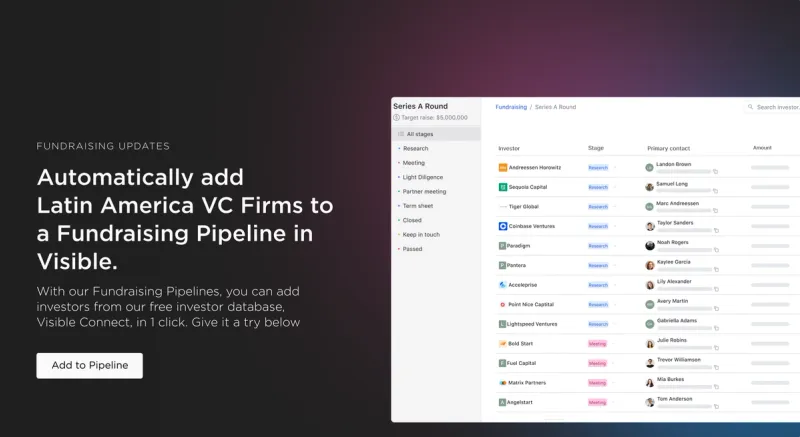
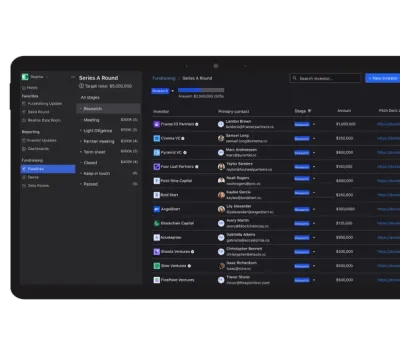
At Visible, we often times compare a fundraise to a B2B sales and marketing funnel. At the top of your funnel, you are finding new investors. In the middle, you are nurturing and pitching potential investors. At the bottom of the funnel, you are working through diligence and ideally closing new investors.
With the introduction of data rooms, you can now manage every aspect of your fundraising funnel with Visible.
- Find investors at the top of your funnel with our free investor database, Visible Connect and find a filtered list of investors.
- Track your conversations and move them through your funnel with our Fundraising CRM
- Share your pitch deck and monthly updates with potential investors
- Organize and share your most vital fundraising documents with data rooms
Manage your fundraise from start to finish with Visible. Give it a free try here.
Frequently Asked Questions
How do I raise venture capital in Latin America in 2026?
Raising venture capital in Latin America requires a focus on strong fundamentals rather than just narrative. Investors are writing larger checks to fewer companies, so founders must demonstrate clear traction, early product-market fit, and efficient unit economics before pitching top LatAm VC firms.
Which countries in Latin America get the most venture capital?
Brazil and Mexico attract the vast majority of Latin American venture capital, capturing nearly 80% of regional funding. Brazil leads with mature digital infrastructure like Pix, while Mexico serves as a prime nearshoring and US-corridor hub for cross-border startups and logistics.
Who are the top venture capital firms in Latin America?
The most active Latin American VC firms include Kaszek, Monashees, Canary, and NXTP. Global funds like QED Investors and Quona Capital also heavily back regional startups. Connecting with these investors early in their fund cycle can give your startup a competitive advantage.
What are the best startup accelerators in Latin America?
Top startup accelerators in Latin America include Start-Up Chile for equity-free grants, 500 Startups LATAM for early-stage capital, and Google for Startups. These programs are highly valuable, compressing your fundraising timeline by providing crucial non-dilutive funding, global networking, and warm investor introductions.
What startup sectors get the most funding in Latin America?
Fintech remains the dominant sector for startup funding in Latin America, securing the majority of venture capital deployed. However, investors are increasingly funding enterprise SaaS, logistics, agtech, and healthtech, rewarding founders who can build scalable infrastructure and prove sustainable unit economics.
How long does it take to raise startup funding in LatAm?
The fundraising process in Latin America typically takes between six and twelve months. Because venture capital in LatAm relies heavily on relationship-building, founders should treat their fundraise like a B2B sales funnel, starting early and using targeted networking events to secure warm introductions.