


Key Takeaways
-
The Asia Pacific venture capital market is estimated at $296.78 billion in 2026, spanning distinct ecosystems across Singapore, India, Japan, Australia, and Southeast Asia, making it one of the most structurally complex and opportunity-rich regions for startup founders raising institutional capital.
-
Total Asian VC funding reached $73.6 billion across 4,308 transactions in the past year, but capital is chasing maturity signals over early promise, and founders who understand how regional investors deploy will raise faster than those who treat APAC as a single uniform market.
-
AI, autonomous vehicles, robotics, and industrial enablement are the primary drivers of venture capital investment heading into 2026, giving founders building in these verticals a structural tailwind that founders in adjacent categories will need to work harder to replicate.
-
This guide covers more than 15 active VC firms investing across Singapore, India, Japan, and Australia, with check size ranges, stage focus, and founder-specific notes to help founders prioritize outreach before they start their raise.
-
Most APAC founders leave non-dilutive capital on the table by overlooking government grants and tax programs, including Singapore's Startup SG Tech Grant of up to S$1.2 million, India's Section 80-IAC tax holiday, and Australia's R&D Tax Incentive refund of up to 43.5% of eligible expenditure.
Raising venture capital in the Asia Pacific means navigating one of the world's largest and most structurally complex funding markets. In 2026, the APAC VC market is estimated at $296.78 billion, spanning distinct ecosystems across Singapore, India, Japan, Australia, Southeast Asia, and beyond.
There are a total of 999,000 startups and 486 unicorns in APAC, with startups having collectively raised $2.28 trillion across all funding rounds. That scale is both an opportunity and a signal; competition for institutional capital is real, and investors have more options than ever.
The funding environment has stabilized, but the allocation has shifted. Total Asian VC funding reached $73.6 billion across 4,308 transactions within the last year, with late-stage and technology-growth rounds carrying meaningful weight. Capital has returned to the region, but it is chasing maturity signals, not early promise. Uninvested capital in Asia Pacific fell to $240 billion by the end of 2025, down from a 2023 peak of $315 billion. Fund managers are selective about when and where they deploy it.
AI is expected to remain the primary driver of venture capital investment across Asia, with capital flowing into autonomous vehicles, robotics, industrial enablement, and AI infrastructure heading into 2026. Founders building in these verticals have a structural tailwind that founders in adjacent categories will need to work harder to replicate.
In this guide, we will cover the top active VC firms across the region, a breakdown of each major market, the accelerators and programs worth your time, and the region-specific grants, tax incentives, and funding mechanisms that most founders overlook.
Top Venture Capital Firms Actively Investing in Asia Pacific in 2026
The firms below were selected based on active deployment status, a verified APAC office or headquarters, and investment activity. The list spans Singapore, India, Indonesia, Malaysia, Hong Kong, Japan, and Australia.
Singapore and Southeast Asia
- Headquarters: Singapore (with offices across 30+ cities globally)
- Stage Focus: Pre-Idea to Pre-Seed and Seed Sector
- Focus: Sector-agnostic; active in enterprise tech, fintech, AI, and consumer Typical
- Check Size: Up to $125,000 at entry; up to $600,000 through its ARC (Agreement for Rolling Capital) structure
- Notable Portfolio: Airalo, Lovable
- Antler is based in Singapore and, as of March 2026, has made investments in 1,490 companies, with 130 investments made in 2025 alone. It is one of the most accessible entry points for early-stage founders in the region. The firm's Southeast Asian portfolio companies have collectively secured more than $350 million in follow-on funding since Antler's inception.

- Headquarters: Singapore and Indonesia
- Stage Focus: Seed to Growth Sector
- Focus: Technology, across consumer, fintech, and enterprise
- Notable Portfolio: Tokopedia, Traveloka, Xendit
- East Ventures has been consistently ranked among the top-performing global VC funds by Preqin and named the most active investor in Southeast Asia and Indonesia. The firm has backed over 200 companies across Southeast Asia and has a particularly deep presence in the Indonesian market.

- Headquarters: Singapore Stage
- Focus: Early-stage to Growth Sector
- Focus: Enterprise tech, fintech, and healthcare
- Typical Check Size: $2 million to $10 million
- Notable Portfolio: Grab, Nium, Patsnap
- Vertex Holdings is a Singapore-based venture capital investment holding company backed by Temasek Holdings, operating a global network of funds including Vertex Ventures SEA and India, Vertex Ventures China, Vertex Ventures Japan, and Vertex Growth. The SEA and India fund is one of the most established multi-stage investors in the region, offering founders access to a global network while retaining local operational expertise.

- Headquarters: Singapore (with dual presence in Los Angeles)
- Stage Focus: Pre-Seed to Series A Sector
- Focus: Enterprise, deep tech, and sustainability
- AUM: Over $300 million across four funds
- Notable Portfolio: Coins.ph, Blaize
- Wavemaker Partners operates a dual-headquartered model bridging Los Angeles and Singapore tech ecosystems, deliberately focusing on enterprise and deep tech sectors in Southeast Asia when most regional capital chased consumer and fintech. The firm has made more than 400 investments and built one of the highest deal volumes for a regional early-stage fund.
- Founder Note: Wavemaker is the right call if you are building B2B, deep tech, or climate tech in Southeast Asia. They are not a generalist fund, so founders in consumer categories should look elsewhere first.

- Headquarters: Singapore
- Stage Focus: Early to Growth Sector
- Focus: Consumer tech, fintech, and enterprise SaaS
- AUM: Approximately $600 million
- Typical Check Size: $2 million to $10 million
- Notable Portfolio: Kredivo, Livspace, RedDoorz
- Jungle Ventures manages approximately $600 million and supports startups from early to growth stages in consumer tech, fintech, and enterprise SaaS, offering hands-on scaling assistance and a region-wide presence. The firm has a strong track record backing cross-border scalable companies across Singapore, Indonesia, and India.
- Founder Note: Jungle Ventures operates as a true platform investor, meaning they stay involved post-check. Founders who want a hands-on board partner will find this firm more engaged than most regional alternatives.

- Headquarters: Singapore
- Stage Focus: Series A to Series B Sector
- Focus: B2C and B2B technology, fintech, digital health, consumer internet
- Typical Check Size: $3 million to $10 million
- Total Capital Deployed: Over $800 million
- Notable Portfolio: Gojek, Carousell, Ninja Van
- Openspace Ventures is a leading venture capital firm in Southeast Asia that leverages deep operational expertise and regional insights to identify and support companies driving transformative impact at the intersection of technology and life, actively partnering with over 45 portfolio companies.
- Founder Note: Openspace writes larger checks and takes a concentrated approach to their portfolio. They are not a spray-and-pray fund. Come with strong unit economics and a clear regional expansion thesis.

- Headquarters: Singapore
- Stage Focus: Seed to Series A
- Sector Focus: Fintech, consumer, and marketplaces with a strong Indonesia focus
- Notable Portfolio: Carro, Payfazz, Ajaib, GoTo Group (early)
- Insignia Venture Partners is an early-stage technology VC firm that has invested in over 70 emerging tech startup companies across Southeast Asia since 2017, with a major focus on the Indonesian market. The firm has built notable category leaders across fintech and automotive marketplaces and maintains one of the more active publishing and data analysis programs of any APAC fund, which gives founders useful market intelligence before they even make contact.
- Founder Note: Insignia publishes detailed investment memos and market theses. Reading them before you pitch is basic preparation that a surprising number of founders skip.

- Headquarters: Singapore
- Stage Focus: Seed to Series A
- Sector Focus: Fintech, consumer internet, and enterprise applications
- Typical Check Size: $1.75 million average at Seed; $7.32 million average at Series A
- Notable Portfolio: Carousell, Xendit, AngelList
- Golden Gate Ventures has invested in 104 companies over 14 years, with 6 unicorns, 3 IPOs, and 14 acquisitions in its portfolio, and made 6 new investments in 2025. The firm focuses on Indonesia-based Series A opportunities while maintaining a broader Southeast Asian mandate across consumer and fintech categories.
- Founder Note: Golden Gate is more selective than its early-stage positioning implies. They back fewer deals per year than many peers, which means their attention per portfolio company is higher.

- Headquarters: Global (with active operations across Southeast Asia and the broader APAC region)
- Stage Focus: Pre-Seed to Series A
- Sector Focus: Sector-agnostic; broad technology coverage
- Typical Check Size: $50,000 to $300,000 at entry
- Notable Portfolio: Grab, Canva, Udemy, Credit Karma
- 500 Global is distinguished by its accelerator programs and diverse portfolio, investing between $50,000 and $300,000 primarily in early-stage tech startups across a variety of sectors in Southeast Asia. The firm invests in over 75 countries globally, making it one of the most geographically accessible institutional investors for first-time founders in APAC.
- Founder Note: 500 Global offers a well-structured program with a global network, but the initial check sizes are small. Most founders use 500 as a pre-Seed bridge, with the expectation of raising a larger institutional round within 12 to 18 months.
Pan-Asia

- Headquarters: Kuala Lumpur and Hong Kong (with 15 offices across key APAC markets)
- Stage Focus: Early to Growth
- Sector Focus: Early-stage startups in underrepresented APAC markets
- AUM: Over $1.5 billion across North, South, and Southeast Asia Typical Check Size: $2 million to $8 million
- Notable Portfolio: Carsome, TechStorm
- Gobi Partners describes itself as the most interconnected pan-Asian VC firm, with $1.5 billion in AUM across North, South, and Southeast Asia and 15 locations across key markets including Jakarta, Singapore, Bangkok, and Ho Chi Minh City. The firm is one of the few genuine pan-regional investors that actively backs founders outside of Singapore and India's primary startup corridors.
- Founder Note: If you are building in Malaysia, Vietnam, Pakistan, or another underserved APAC market, Gobi has a structural mandate to back you where most regional funds will not.
India

- Headquarters: Bengaluru, India (with offices across India and Southeast Asia)
- Stage Focus: Seed to Growth (all stages)
- Sector Focus: Sector-agnostic; strong in SaaS, fintech, consumer, and deep tech
- AUM: Over $9 billion under management
- Notable Portfolio: Meesho, Razorpay, Groww, Cred, Byju's (early)
- Peak XV Partners has backed over 450 companies, with 60-plus portfolio companies generating over $100 million in revenues and 50-plus unicorns as of December 2025, across 14 nationalities and 5 offices. The firm, formerly operating as Sequoia Capital India and SEA, is the dominant multi-stage investor across India and Southeast Asia by deal count and portfolio depth.
- Founder Note: Peak XV runs a dedicated early-stage program called Surge for pre-Series A companies. If you are building in India or Southeast Asia and have early traction, applying to Surge is one of the most direct ways to access the firm's network without a cold outreach.

- Headquarters: Bengaluru, India (with global presence)
- Stage Focus: Early to Growth Sector
- Focus: SaaS, consumer, fintech, and marketplaces
- Notable Portfolio: Flipkart, Freshworks, BrowserStack, Swiggy
- Accel came in at the second position in India's top investor rankings, having made investments in 25 companies poised to become the next generation of unicorns, according to the ASK Private Wealth Hurun India Future Unicorn Index. Accel is one of the most established early-stage investors in India, with a track record in enterprise SaaS that is difficult to match in the region.
- Founder Note: Accel operates the Accel Atoms program for pre-seed and pre-product founders. This is worth knowing before you assume their only entry point is a fully formed Series A.

- Headquarters: Bengaluru, India
- Stage Focus: Pre-Seed to Series A
- Sector Focus: Deep tech, SaaS, consumer, and climate
- Notable Portfolio: Unacademy, Dunzo, Purplle, Slice
- Blume Ventures made it to the top five most active investors in India's startup ecosystem, alongside Peak XV, Accel, Tiger Global, and Trifecta. Blume is known as one of India's most founder-friendly institutional funds, with a focus on the earliest institutional check in a company's lifecycle. They back founders before most larger funds are willing to engage.
- Founder Note: Blume has published an annual Indus Valley report on the state of India's tech ecosystem. It is one of the better free research resources available for founders building in India and worth reading before you approach any India-focused investor.
Japan
- Headquarters: Tokyo, Japan (with offices in London and San Francisco)
- Stage Focus: Late Seed to Growth (primarily Series B and beyond)
- Sector Focus: AI, mobility, fintech, logistics, and enterprise tech
- Notable Portfolio: ByteDance, Coupang, Grab, Paytm, Ola Electric
- SoftBank Vision Fund made a $2.1 billion Series C investment in Indian AI company Ola Electric, marking the largest venture capital deployment in Asia Pacific's mobility sector and signaling renewed confidence in India's electric vehicle ecosystem. While Vision Fund primarily backs later-stage companies, it has demonstrated a willingness to lead large rounds for founders with established revenue and a credible path to market leadership in strategically important sectors.
- Founder Note: SoftBank Vision Fund is not a realistic target for most early-stage founders, but understanding their thesis matters. Companies they back often set the category benchmarks that other regional VCs then use to evaluate adjacent opportunities at earlier stages.
Australia

- Headquarters: Melbourne, Australia (with presence in Tel Aviv and Singapore)
- Stage Focus: Seed to Series B
- Sector Focus: SaaS, fintech, marketplaces, and consumer technology
- Notable Portfolio: Canva, Fiverr, Invoice2go, HoneyBook
- Square Peg is the most prominent homegrown VC firm in the Australian market, with a portfolio that spans Australia, Israel, and Southeast Asia. They have backed Canva from the early rounds and are widely regarded as the benchmark institutional investor for Australian founders moving to their first or second institutional raise. The firm invests across geographies but maintains a particular focus on founders with global product ambitions rather than purely domestic market plays.
- Founder Note: Square Peg does not invest in every sector, and their bar for market size is high. They are looking for founders building for global or at least regional scale, not local services businesses with limited expansion paths.
Which Accelerators Should Early-Stage Founders in APAC Apply To?
Peak XV Surge
Location: India and Southeast Asia (culminates in a US immersion trip)
Stage: Pre-Series A Investment: Up to $3 million in seed capital
Launched in 2019, Surge is Peak XV Partners' rapid-scale-up program for early-stage founders that combines up to $3 million of seed capital with hands-on guidance from Peak XV's investment and operating teams alongside structured programming focused on product, engineering, sales, marketing, fundraising, and other foundational elements of building enduring companies.
Since its inception, Surge companies have raised over $3 billion in follow-on funding, with the top ten startups generating more than $1 billion in cumulative annual revenues, and the Surge community has grown to 170-plus startups and 400-plus founders spanning 17-plus nationalities and 18-plus sectors.
The Surge program has become a coveted launchpad for young startups in India and Southeast Asia, with its favorable terms and extensive resources somewhat eclipsing the appeal of Y Combinator's offering for regionally-focused founders.
BLOCK71 AI Accelerate (Singapore)
Location: Singapore
Stage: Post-MVP to Series A
Grant Available: Up to S$1.2 million (non-dilutive, with small equity option)
BLOCK71 is powered by NUS Enterprise and backed by industry and government partners, and has supported the growth of 1,600-plus startups since its establishment in 2011, with presence across Singapore, the US, China, Japan, Indonesia, and Vietnam.
Microsoft, Enterprise Singapore, and NUS Enterprise announced a collaboration in October 2025 to fast-track growth for 150 AI startups over three years, building on the AI Accelerate program jointly run by BLOCK71 and Microsoft, with participating startups gaining access to the Startup SG Tech grant and a 10-week sprint culminating in an Investor Day.
Selected startups may qualify for up to S$1.2 million in grant funding, structured as S$400,000 for proof of concept with the opportunity to unlock a further S$800,000 for proof of value, with NUS Enterprise retaining an option to take up to S$50,000 worth of equity upon a qualifying financing round.
Antler (Singapore, India, Australia, and beyond)
Location: 30-plus cities globally, with strong presence across Singapore, India, and Australia
Stage: Pre-Idea to Pre-Seed
Investment: Up to $125,000 at entry; up to $600,000 through the ARC structure
Antler, the global early-stage venture capital firm headquartered in Singapore, closed 96 deals worth over $12.5 million across Southeast Asia in 2024, maintaining investment pace comparable to the prior year despite challenging market conditions, with the firm's Southeast Asian portfolio companies collectively securing more than $350 million in follow-on funding.
As of March 2026, Antler has made investments in 1,490 companies and made 130 investments in 2025, with a team of 181 people including 80 partners located across Singapore, Australia, and 20 additional locations.
Founder Note: Antler is one of the few institutional investors in APAC that will back you before you have a co-founder, a product, or even a fully defined idea. If you are a technical founder without a business partner, or vice versa, the co-founder matching infrastructure is genuinely useful. The trade-off is that their initial check is small and the program is competitive. Come in with a strong personal track record.
Iterative (Singapore)
Location: Singapore
Stage: Seed to early Series A, focused on Southeast Asia
Investment: $150,000 to $500,000 for approximately 10 to 15% equity
Format: Two cohorts per year, three months each
Iterative runs twice-yearly cohorts with investment made upfront upon admission, offering an intensive three-month program focused on idea validation, product development, and growth, with personalized mentorship from founders who have built and exited multiple companies, plus a Demo Day where startups present to a curated group of investors.
Founder Note: Iterative is modeled explicitly on Y Combinator and run by founders who went through YC themselves. For Southeast Asia-based companies that want a rigorous, founder-first program without relocating to the US, this is the closest regional equivalent. The fund's investor network spans both Southeast Asia and Silicon Valley, which makes it particularly useful if you want to run a dual-track fundraise.
Accelerating Asia (Singapore)
Location: Singapore (with portfolio companies across South and Southeast Asia)
Stage: Pre-Series A
Investment: Up to $250,000
Accelerating Asia targets pre-Series A startups in South and Southeast Asia, providing mentorship, investment up to $250,000, and access to a network of investors across the region. The program functions as both an accelerator and an early-stage fund, meaning it maintains an ongoing relationship with its portfolio companies rather than treating graduation as a clean handoff.
Founder Note: Accelerating Asia is a strong choice if you are building in a market that is not Singapore, such as Vietnam, the Philippines, or Sri Lanka, and want a program that understands those ecosystems without requiring you to have a Singapore holding company at the point of application.
Plug and Play APAC (Singapore)
Location: Singapore (with programs across APAC)
Stage: Sector-specific, from early to growth stage
Investment: $50,000 to $250,000 (varies by program)
Format: Industry-specific cohorts with corporate sponsor introductions
Plug and Play APAC connects startups with corporations across various industries, offering mentorship, networking opportunities, and potential funding between $50,000 and $250,000, with the accelerator program lasting three months and focused on helping startups generate business development opportunities and deal flows.
Founder Note: The main value here is corporate access rather than investor access. Plug and Play has deep relationships with large Asian enterprises across fintech, logistics, and supply chain. If you need enterprise pilots or distribution partnerships to prove your model before your next round, this program's corporate network can shorten that timeline significantly.
500 Global Accelerator
Location: Global with active cohorts across Southeast Asia, Japan, and India
Stage: Pre-Seed to early Series A
Investment: $150,000 for 6% equity
Format: Accelerator program with ongoing fund support
500 Global is distinguished by its accelerator programs and diverse portfolio, investing between $50,000 and $300,000 primarily in early-stage tech startups across a variety of sectors in Southeast Asia. The firm invests across more than 75 countries, and its APAC programs have produced graduates who have gone on to raise from institutional funds across Southeast Asia, South Asia, and global markets.
Founder Note: 500 Global's initial check is small, but the program alumni network is one of the broadest available in APAC. If you are at the earliest stage and need structured access to a regional investor network, this is a legitimate entry point. The real value compounds through introductions over the 12 to 24 months after the program ends.
University-Linked and Sector-Specific Programs
NUS Enterprise (Singapore)
NUS Enterprise is the entrepreneurial arm of the National University of Singapore and serves as the foundation for BLOCK71's global network. Beyond BLOCK71, it runs the NUS Overseas Colleges program, which places founder-students in startup hubs across more than 25 countries, and operates an extensive mentor and investor network for technology spinouts and IP commercialization projects. For deep tech founders with an academic or research angle, NUS Enterprise offers a pathway to government grant funding through Enterprise Singapore that is more accessible than a direct application.
JLABS (Singapore and Asia-Pacific)
JLABS is the world's largest no-equity life sciences incubator, having incubated 826-plus companies globally without taking ownership, including 185-plus companies in APAC alone, with locations in Shanghai, Singapore, and Korea. For biotech, medtech, and life sciences founders, JLABS offers lab infrastructure, a global pharma network through Johnson and Johnson, and access to the kind of clinical and regulatory expertise that is nearly impossible to access through conventional startup accelerators.
Founder Note: The no-equity structure is genuinely unusual in APAC and makes JLABS a strong option if you are pre-revenue and need lab access and pharma network introductions without giving up early-stage ownership.
Top Events in APAC for Founders in 2026
SWITCH (Singapore Week of Innovation and Technology)
Typically held: October, Singapore
SWITCH assembles a diverse mix of global leaders, entrepreneurs, creators, accelerators, and investors from the global-Asia innovation network, and features a dynamic mix of exhibitions, pitch stages, global market access programs, and deep tech showcases in fields like health, sustainability, and AI. SWITCH is the single most important annual event for founders in Southeast Asia who want to access the regional investor community in a concentrated format. The 2025 edition hosted the announcement of the BLOCK71 AI Accelerate program, illustrating its role as a venue for major program launches.
Founder Tip: Apply for a pitch slot well in advance. Investor meetings at SWITCH fill up faster than the speaking program. Come with a pre-prepared shortlist of the 10 investors you most want to meet and request meetings before the event begins, not on the floor.
Asia PE-VC Summit (DealStreetAsia)
Typically held: Singapore
The Asia PE-VC Summit brings together 4,000-plus GPs, LPs, founders, and family offices shaping the future of private capital in Asia, with founders who have raised at least a Series A round based in Southeast Asia, India, or Greater China invited to apply for complimentary access.
Founder Tip: This is a capital markets event, not a startup showcase. The conversations here are more substantive and more directly investment-oriented than most public tech conferences. If you have Series A traction and want to be in the room with LPs and GPs making allocation decisions, this is the right venue.
GITEX AI Asia (Singapore)
Dates: April 9 to 10, 2026, Marina Bay Sands, Singapore
GITEX AI Asia, Asia's largest and most global tech, startup, and digital investments event, brings together 23,000-plus tech leaders and decision-makers, 750-plus enterprises and startups, 250-plus investors, and participants from over 110 countries, with co-located platforms covering AI, fintech, health tech, digital infrastructure, cybersecurity, and quantum computing.
Founder Tip: Scale matters here. GITEX is large enough that showing up without a plan for who you want to meet is a waste of two days. Use the pre-event matchmaking tools, book meetings before you land, and focus your floor time on corporate partnerships and pilot conversations rather than trying to pitch investors cold.
Tech in Asia Conference
Typically held: Singapore and Jakarta
The Tech in Asia Conference unites the Asia-Pacific startup and tech communities with attendees including founders, investors, decision-makers, regulators, and talent, with dedicated segments tailored to specific interests and needs. This is the most founder-accessible major conference in Southeast Asia, with a lower barrier to entry than the PE-VC Summit and broader geographic representation than SWITCH.
Techsauce Global Summit (Bangkok)
Typically held: Mid-year, Bangkok, Thailand
Techsauce Global Summit is a leading technology conference in Southeast Asia, focusing on innovation and digital transformation, gathering startups, investors, corporates, and thought leaders to discuss emerging technologies and business strategies. For founders building with Thailand, Vietnam, or broader Southeast Asian exposure, Techsauce is the most relevant regional conference outside Singapore.
SusHi Tech Tokyo (Japan)
Typically held: May, Tokyo, Japan
SusHi Tech Tokyo is a global innovation conference that aims to forge new connections within the global and domestic startup ecosystems to tackle shared urban challenges, convening startups, investors, corporates, and student entrepreneurs over two days to address key urban issues through sustainable and innovative solutions, with a major pitch contest and sessions focused on infrastructure, environment, living, culture, and impact.
Founder Tip: SusHi Tech is government-backed and has strong attendance from Japanese corporate CVC arms. If your startup has a hardware, climate tech, or urban technology angle, this is one of the better venues for accessing Japanese corporate partners and co-investors.
COMEUP (Seoul, South Korea)
Typically held: Q4, Seoul, South Korea
COMEUP is South Korea's leading global startup festival designed to connect entrepreneurs, investors, and industry experts to drive innovation and collaboration, featuring pitch programs and exhibitions centered on deep tech and sustainable innovation, serving as a launchpad for both Korean and international startups seeking global exposure and entry into Asian markets.
Founder Tip: South Korea's corporate VC ecosystem is significantly underutilized by non-Korean founders. COMEUP is one of the most accessible entry points for founders who want pilot partnerships or co-investment interest from Korean chaebols including Samsung, LG, and Hyundai, all of which maintain active CVC programs targeting foreign companies with relevant technology.
Founder Communities and Networks in APAC
Beyond formal programs and events, the quality of your investor relationships in APAC often comes down to the informal networks you are part of before you start raising. The following communities are worth your time as a resource for warm introductions, founder-to-founder knowledge sharing, and staying close to current investor sentiment in the region.
- Startup Grind Singapore operates across more than 120 countries with one of the oldest chapters in Asia, regularly hosting fireside chats with regional founders and investors.
- Founder Institute runs structured pre-seed cohorts across multiple APAC cities including Japan, Singapore, and India, with a particular focus on helping idea-stage founders develop into fundable companies.
- Tech in Asia's founder community operates year-round alongside its conference, with editorial coverage, investor databases, and deal tracking that is particularly strong for Southeast Asian markets.
- e27 is Singapore's leading startup media and community platform, with regular events, deal announcements, and editorial coverage of the APAC ecosystem that is useful for staying current on which investors are deploying capital and in which sectors.
- DealStreetAsia operates as the most data-driven media platform covering private capital in Asia, with deal tracking, fund announcements, and ecosystem analysis that gives founders a real-time picture of where institutional capital is moving.
What Government Grants, Tax Incentives, and Non-Dilutive Programs Can APAC Founders Access in 2026?
Most founders in APAC leave non-dilutive capital on the table because they start looking for it after they have already begun their equity raise. The programs below should be evaluated before you approach investors, not after, because winning a government grant or tax incentive reduces your perceived risk, extends your runway without dilution, and signals institutional validation to the VCs you approach next.
Non-Dilutive Funding in Singapore
Singapore runs one of the most integrated government funding stacks for startups of any market in the world. The programs below are administered primarily by Enterprise Singapore and NUS Enterprise, and most applications are submitted through the Business Grants Portal at gobusiness.gov.sg.
Startup SG Founder Grant
The Startup SG Founder Grant offers mentorship and financial support of S$20,000 to S$50,000 to first-time entrepreneurs launching businesses in Singapore. The grant is administered through an Accredited Mentor Partner (AMP) rather than through a direct application to Enterprise Singapore, which means your first step is to find and be accepted by an AMP. The matching structure requires founders to contribute their own capital first, which Enterprise Singapore matches at a 5:1 ratio, up to the S$50,000 cap.
Eligibility requirements include being a first-time founder, holding at least 30% equity in the company, having a Singapore-registered private limited company less than six months old at the time of application, and committing full-time to the venture. This grant is not available to founders currently employed elsewhere.
The Startup SG Tech grant funds proof-of-concept and proof-of-value work for early-stage companies developing proprietary technology, with increased budget support flowing into deep tech sectors in 2026, and requires a Singapore-registered entity with at least 30% local shareholding developing a proprietary, differentiated technology solution.
The Startup SG Tech Grant offers up to S$400,000 for proof-of-concept work and up to S$800,000 for proof-of-value work, structured as capital matching with milestones attached to each disbursement tranche. Enterprise Singapore retains a small equity option upon the startup's next financing round, which is the trade-off for a non-dilutive grant of this size.
This is the most valuable single grant available to AI, medtech, fintech, and deep tech founders building in Singapore. If your company qualifies, it should be your first application. The BLOCK71 AI Accelerate program is partly built around this grant, which is why applying to the program can significantly streamline your Startup SG Tech application.
The Startup SG Equity Programme is a co-investment scheme whereby the Singapore government, along with SEEDS Capital and SGInnovate, co-invests in high-potential startups, with deep tech startups receiving a co-investment ratio of 7:3 (up to S$500,000) or a 1:1 co-investment ratio for funding up to S$4 million, and other tech startups receiving a 7:3 ratio for up to S$250,000 or 1:1 for up to S$2 million.
This is not a grant in the traditional sense. It is a government co-investment that sits alongside a qualified private lead investor, reducing that investor's downside exposure. The practical effect for founders is that it makes your round more attractive to VCs and angels who know their risk is partially backstopped by the state. If you are raising a seed or early Series A from a qualifying investor in Singapore, ask them whether they are accredited under the Startup SG Equity Programme before you close.
Market Readiness Assistance (MRA) Grant
Singapore's Budget 2025 introduced the Double Tax Deduction for Internationalization (DTDi) extended to December 31, 2030, letting qualifying firms claim a 200% tax deduction on eligible overseas expansion expenses, alongside the enhanced Market Readiness Assistance Grant cap of S$100,000 per new market.
The MRA Grant reimburses eligible expenses for international market expansion, including overseas market assessments, business matching, and participation in overseas business development activities. For Singapore-based founders expanding into Indonesia, Vietnam, India, or other regional markets, this grant can fund the exploratory work that most founders pay out of pocket.
Enterprise Compute Initiative (ECI)
Budget 2025 introduced the S$150 million Enterprise Compute Initiative to help eligible startups gain access to AI tools, computing power, and expert consultancy services by partnering with leading cloud service providers, lowering the barriers to AI integration by providing technical resources and guidance.
For AI-native founders who are spending a material percentage of their burn on compute costs, the ECI is worth investigating before your next infrastructure bill arrives. Cloud credits through government-backed channels often come with no strings attached beyond eligibility verification.
S$1 Billion Private Credit Growth Fund
Singapore's Budget 2025 introduced a S$1 billion Private Credit Growth Fund to give high-growth local enterprises, especially in tech, access to financing options beyond traditional bank loans, with the Enterprise Financing Scheme Trade Loan maximum permanently raised from S$5 million to S$10 million.
This fund targets the gap between early-stage equity and traditional bank debt for companies with revenue but not yet at the scale required for institutional growth equity. For founders between Series A and B looking to extend runway without a dilutive round, private credit from this fund is worth exploring as a bridge mechanism.
Government Programs and Tax Incentives for India-Based Founders
India's policy environment for startups has changed more in the past 18 months than in the preceding decade. The programs below represent a genuinely improved landscape for founders, particularly those building in deep tech.
DPIIT Startup Recognition and Section 80-IAC Tax Holiday
The starting point for every India-based founder is getting DPIIT recognition through the Startup India portal at startupindia.gov.in. Recognition unlocks the full stack of government benefits including tax exemptions, simplified compliance, and access to the Fund of Funds scheme.
The Section 80-IAC tax holiday remains one of the most powerful tax benefits for Indian startups in 2026, providing a 100% profit deduction for any three consecutive years within a startup's first ten years of operations, with the incorporation deadline for eligible startups recently extended to March 31, 2030. For a startup generating ₹3 crore in profit in an eligible year, that is approximately ₹77 lakh in tax savings that goes directly back into operations.
Startup India Fund of Funds 2.0
India's Union Cabinet approved the Startup India Fund of Funds 2.0 with a corpus of ₹10,000 crore in February 2026, building on a successful 2016 program and operating as a fund of funds that channels government capital to private Alternative Investment Funds that invest in startups, targeting early-stage founders outside major cities and smaller VC firms.
The first phase of the program committed the entire ₹10,000 crore corpus to 145 Alternative Investment Funds, which together invested more than ₹25,500 crore in over 1,370 startups spanning AI, robotics, clean tech, fintech, healthcare, manufacturing, biotech, and space technology. The second phase has an explicit mandate to reach founders in Tier 2 and Tier 3 cities, which is meaningful given that more than 48% of DPIIT-recognized startups have now emerged from Tier 2 and 3 cities.
India launched a ₹1 trillion Research, Development and Innovation Fund intended to expand patient financing for science-led and R&D-driven companies, designed to take direct positions and provide credit and grants to deep tech startups rather than operating solely as a traditional fund of funds.
For founders in AI, biotech, semiconductors, quantum computing, or advanced manufacturing, the RDI Fund represents the most significant change to India's deep tech capital landscape in a generation. The fund is specifically structured to address the valley-of-death problem between laboratory validation and commercial viability where most Indian deep tech companies have historically run out of runway.
Deep Tech Startup Rule Changes
India updated its startup framework, doubling the period for which deep tech companies are treated as startups to 20 years and raising the revenue threshold for startup-specific tax, grant, and regulatory benefits to approximately $33 million, up from $11 million previously, with the change aimed at aligning policy timelines with the long development cycles typical of science-led businesses.
Deep tech startups can now also access loans up to ₹1 crore from the Council of Scientific and Industrial Research without proving three years of operational history, addressing what venture capitalists call the valley of death where promising technologies typically die before reaching commercial scale.
Administered by NITI Aayog, the Atal Innovation Mission funds Atal Incubation Centers across India and operates Atal Tinkering Labs in schools. For deep tech founders who came through academic research pathways, AIM-backed incubation centers offer lab access, mentorship, and seed capital that is often available earlier than private VC will engage. Information is available at aim.gov.in.
Grants and Incentives Available to Australian Founders
The R&D Tax Incentive is the single most valuable and most underused program for Australian tech founders. Startups can benefit from significant cash refunds up to 43.5% of their total R&D expenses, and loss-making businesses can also benefit from the tax credit even though they have no corporate taxes to offset, as the program provides a cash refund rather than simply a tax reduction.
The R&D Tax Incentive offers tax offsets of up to 43.5% for eligible R&D expenditure, providing critical cash flow support for early-stage companies, and the program totals more than $3 billion in funding for Australian businesses annually.
The mechanism is straightforward: you register your eligible R&D activities with AusIndustry each income year, track your qualifying expenditure, and claim the offset in your company tax return. For a pre-revenue startup spending $500,000 on eligible R&D, that is up to $217,500 in cash back from the government. Working with an R&D tax specialist is strongly recommended, as eligible activities are defined specifically and claiming ineligible expenses creates compliance risk. The government grant portal is the starting point for all federal program discovery.
Export Market Development Grants (EMDG)
Export Market Development Grants reimburse up to 50% of export promotion expenses, helping startups access international markets, and are run by Austrade. For Australian founders expanding into Southeast Asia, India, or Northeast Asia, EMDG covers eligible expenses including international travel, promotional materials, trade show participation, and overseas market research. Given that Australian founders typically need to demonstrate international expansion potential to attract institutional capital, EMDG is a logical tool for funding the market validation that investors will want to see before a Series A.
The NSW MVP Ventures Program supports NSW startups and scaleups to develop and commercialize minimum viable products, with grants ranging from $20,000 to $75,000 and up to $3 million allocated annually. For founders based in New South Wales, this is an accessible, non-dilutive early-stage program that pairs well with the RDTI.
State-Level Programs
State governments provide additional support through Advance Queensland with $650 million in available funding, NSW MVP Ventures, and Startup Victoria, providing supplementary support layers for founders beyond the federal programs. Queensland's Advance Queensland program in particular has a strong track record in agritech, cleantech, and resources technology, which maps well to where Australian founders have natural sector advantages.
Japanese Grants and Programs for Founders
Japan's government support system for startups is substantial but requires navigation. Most programs are administered in Japanese, and working with JETRO, the Japan External Trade Organization, significantly improves your access to both information and introductions. JETRO's website is the most reliable starting point for foreign founders.
Effective January 2025, Japan's Startup Visa program was extended nationwide, granting foreign entrepreneurs more flexibility as they establish businesses anywhere in Japan, with up to two years of residency to prepare business operations. The Startup Visa is specifically designed for foreign founders who need time inside Japan to incorporate their company, build investor relationships, and find local partners before they can meet the full Business Manager visa requirements.
Japan simultaneously tightened the Business Manager visa criteria in October 2025, raising the required investment from ¥5 million to ¥30 million and adding new conditions on hiring, experience, and business plan scrutiny, shifting expectations from earlier years when a modest capital requirement and a solo venture could suffice. The Startup Visa is now the more practical entry route for founders who do not already have substantial capital committed.
JETRO runs dedicated support for foreign companies entering Japan, including subsidized office space, bilingual business concierge services, and facilitated introductions to local investors and corporate partners. The Tokyo Metropolitan Government's Invest Tokyo initiative offers subsidies for foreign companies setting up in Tokyo covering office rent, initial costs, and sometimes staff costs, alongside GX-related subsidies for green-tech startups entering the Tokyo market.
Japan Investment Corporation (JIC)
The Japanese government makes LP investments in both domestic and international VC funds through the Japan Investment Corporation, with the JIC having announced 49 investments in VC funds since 2020, and in 2024 made nine investments with amounts ranging from approximately ¥1.5 billion to ¥4.5 billion. Understanding the JIC matters for founders because many of the Japanese VC funds that invest in startups are themselves backed by JIC capital, which makes JIC's thematic priorities a useful indicator of where Japanese institutional capital is likely to flow at the company level.
Tokyo Metropolitan Government Subsidies
The Tokyo Metropolitan Government offers subsidies to businesses less than five years old within the Tokyo area, covering up to 66% of eligible expenses with a maximum payout of ¥3 million, applicable to labor costs, rent, advertising, and other operational expenses. For foreign founders using the Startup Visa and establishing their initial Tokyo presence, these subsidies can meaningfully reduce the cost of your first 12 to 18 months of operation.
What Angel Networks and Syndicates Are Most Active Across APAC?
Most of the APAC fundraising conversation focuses on institutional VC, but angel networks and syndicates play a critical role at the pre-seed and seed stages, particularly in markets where institutional early-stage capital is thin.
In India, IAN Group is the country's largest early-stage investment platform, continuing to make active investments across deep tech, drone delivery, space, and consumer categories as recently as March 2026. The Indian Angel Network operates one of the most structured deal-sharing mechanisms in the country, connecting founders with a network of over 500 angel investors across sectors. IAN Group is the starting point for founders seeking angel capital in India.
The IVCA counts over 250 active micro VC and early-stage funds in India as of early 2026, with average fund sizes having matured from $10 to $12 million in 2021 to closer to $25 to $30 million today, as managers raise larger second and third funds on the back of early proof points. This proliferation means India's pre-seed landscape has more options than most founders realize, though selectivity has increased alongside fund maturity.
In Singapore and Southeast Asia, Angel Central is one of the most active and organized angel communities, facilitating syndicated deals across the region. In Australia, the Australian Investment Network and Sydney Angels both run structured processes for early-stage founders seeking angel capital before a formal VC raise.
Other Region-Specific Advantages for APAC Founders
Cost Arbitrage in Emerging APAC Hubs
Early-stage startup deals in South Asia are still 30 to 50% cheaper than in the US or Europe, making them attractive to investors seeking valuation arbitrage alongside founders who can build credible businesses at a fraction of the cost of equivalent companies in Western markets. For founders who can operate from Bengaluru, Hyderabad, Ho Chi Minh City, or Kuala Lumpur rather than Singapore or Sydney, the cost advantage is real and can be explicitly positioned as a competitive moat in investor conversations. Longer runway on the same capital is a fundability argument, not just an operational one.
Singapore's Talent Pass and EntrePass
Singapore's EntrePass is a visa category specifically for foreign founders who want to incorporate and operate a startup in Singapore without meeting the requirements of standard employment visas. It requires a business plan, evidence of innovative technology or a scalable business model, and endorsement from an accredited organization. For founders who want to use Singapore as their regional headquarters without the capital requirements of Japan's Business Manager visa, the EntrePass is the cleanest path.
Qualcomm AI Program for Innovators (QAIPI) 2026
Qualcomm launched the QAIPI 2026 APAC program supporting startups across Japan, Singapore, and South Korea in advancing the development and commercialization of edge AI solutions, with participating startups receiving a shortlist grant of up to $10,000 and eligibility for a patent filing incentive of up to $5,000, with applications open until April 30, 2026. The capital amounts are modest, but the program's value is primarily in access to Qualcomm's hardware platforms, technical mentorship, and the Demo Day at the end of the year which connects graduates to regional investors and enterprise partners.
India's Reverse Flip Advantage
One of the least discussed structural shifts in the India ecosystem is the growing number of founders choosing to reverse-incorporate in India rather than Delaware or Singapore. India rolling back the angel tax makes it easier for investors to get in early and ride the wave as the region's digital economy takes off. Combined with the extended startup classification window and the maturing IPO market, India's domestic capital markets are becoming a more credible exit pathway. Founders who incorporate in Delaware or Singapore primarily to access US or global VC should now pressure-test that assumption, as the differential advantages of offshore incorporation are narrowing for India-focused businesses.
Connect With Investors in the Asia Pacific (APAC) Using Visible
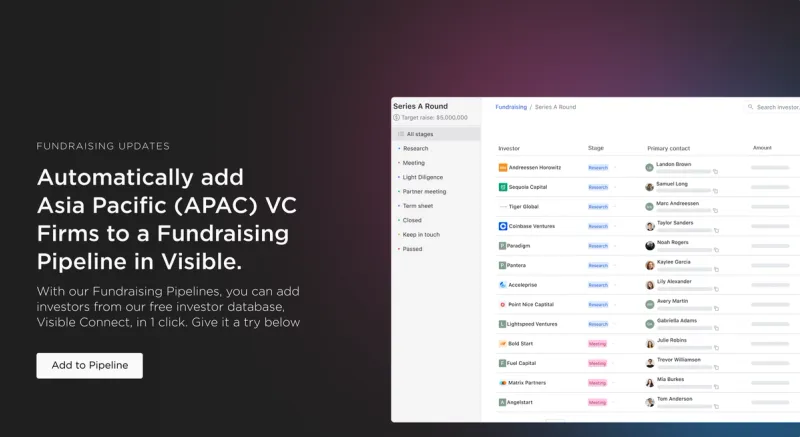
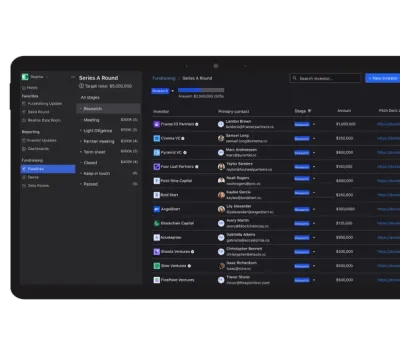
At Visible, we often times compare a fundraise to a B2B sales and marketing funnel. At the top of your funnel, you are finding new investors. In the middle, you are nurturing and pitching potential investors. At the bottom of the funnel, you are working through diligence and ideally closing new investors.
With the introduction of data rooms, you can now manage every aspect of your fundraising funnel with Visible.
- Find investors at the top of your funnel with our free investor database, Visible Connect and find a filtered list of investors.
- Track your conversations and move them through your funnel with our Fundraising CRM
- Share your pitch deck and monthly updates with potential investors
- Organize and share your most vital fundraising documents with data rooms
Manage your fundraise from start to finish with Visible. Give it a free try here.
Frequently Asked Questions
Which countries have the most active venture capital ecosystems in Asia Pacific?
Singapore, India, and Australia are the most active venture capital markets in Asia Pacific for startup founders. Singapore functions as the primary regional hub for Southeast Asian deals, India has the largest volume of early-stage activity by deal count, and Australia has a maturing institutional landscape anchored by firms like Square Peg Capital.
How much venture capital funding is available in Asia Pacific in 2026?
The Asia Pacific venture capital market is estimated at $296.78 billion in 2026, with total Asian VC funding reaching $73.6 billion across 4,308 transactions in the past year. Uninvested capital in the region stands at $240 billion, meaning dry powder exists but fund managers are deploying it selectively toward companies with clear maturity signals.
What sectors are Asia Pacific venture capital firms investing in right now?
AI, autonomous vehicles, robotics, industrial enablement, and AI infrastructure are the primary focus areas for Asia Pacific venture capital investment heading into 2026. Fintech, enterprise SaaS, and deep tech continue to attract consistent capital across Singapore, India, and Southeast Asia, while climate tech and medtech are gaining traction in Australia and Japan.
What accelerators should early-stage founders in Asia Pacific apply to?
Peak XV Surge, Antler, Iterative, and 500 Global are among the strongest accelerator options for early-stage founders in Asia Pacific. Surge offers up to $3 million in seed capital for India and Southeast Asia-based companies. Antler backs founders at the pre-idea stage. Iterative is the closest regional equivalent to Y Combinator for Southeast Asian startups.
Are there government grants available to startup founders in Asia Pacific?
Yes. Singapore offers the Startup SG Tech Grant of up to S$1.2 million for proprietary technology development, and the Startup SG Founder Grant of up to S$50,000 for first-time entrepreneurs. Indian founders can access the Section 80-IAC tax holiday and the new Fund of Funds 2.0. Australian founders can claim up to 43.5% of eligible R&D expenses through the R&D Tax Incentive.
How do I find venture capital investors in Asia Pacific for my startup?
Start by identifying which investors are actively deploying capital in your stage, sector, and geography. Platforms like Visible Connect offer a free, searchable investor database filtered by these criteria. DealStreetAsia and Tech in Asia both track active deals and fund announcements. Attending events like SWITCH and the Asia PE-VC Summit accelerates warm introductions significantly.