

Key Takeaways
-
Founders raising capital in the Northeast United States venture market in 2026 must navigate a bifurcated landscape where artificial intelligence and deep tech startups command valuation premiums up to 193%.
-
This comprehensive guide details fifteen active venture capital firms across New York and Boston providing exact check sizes and investment theses to help you target the right institutional partners.
-
Startups can significantly extend their operational runway by leveraging local angel networks and capitalizing on a median software engineering salary arbitrage of nearly $30,000 in secondary markets like Philadelphia.
-
Readers will uncover overlooked regional opportunities including state-level tax incentives in Pennsylvania and direct grant programs in Maryland that provide critical non-dilutive capital.
-
You will learn how to align your fundraising strategy with current macroeconomic shifts such as the record 901 billion dollar federal defense budget actively driving hardware investments in Washington D.C. and Boston.
Fundraising in the Northeast United States requires navigating a bifurcated venture market in 2026. Founders face an environment where artificial intelligence and deep tech command premium valuations while traditional software faces strict profitability mandates. This guide details the active regional investors and provides the frameworks needed to secure capital across these startup hubs.
New York and Boston anchor the region due to their concentration of enterprise buyers and technical talent. New York startups raised over two billion dollars in the last year with artificial intelligence capturing over a third of those deployments. Boston continues to lead life sciences with over ten billion dollars raised while secondary markets like Philadelphia and Washington D.C. are actively capturing specialized defense and healthcare rounds. The physical proximity to legacy financial and academic institutions gives regional founders a structural advantage over competitors in other markets.
Securing these funds requires understanding how local investors evaluate risk and traction this year. We detail the specific venture capital firms writing checks and the ecosystem resources available to accelerate your round. You will also learn the geographic incentives and regulatory advantages that make building in this region an operational asset.
To navigate this concentrated venture market you need actionable intelligence rather than generic directories. The following sections break down the exact components required to execute a localized fundraising strategy this year. We begin with an investor list detailing fifteen active venture capital firms along with a curated list of founder resources surfacing the exact accelerators and angel syndicates that provide direct introductions to institutional capital. You will also find region specific opportunities like state tax incentives and commercialization hubs that extend your operational runway.
Active VC Firms and Investors in New York and Boston
Lerer Hippeau

- Stage Focus: Pre Seed and Seed
- Check Size: One million to three million dollars
- Notable Portfolio: Guideline, K Health, Zipline
- Thesis: They back inclusive founders building transformative companies across enterprise and consumer sectors.
- Local Impact: They are the most active early stage fund in New York and act as the primary gateway to subsequent capital.
Primary Venture Partners

- Stage Focus: Pre Seed and Seed
- Check Size: One million to four million dollars
- Notable Portfolio: Alloy, Chief, Vestwell
- Thesis: They invest strictly in New York City founders and provide intensive operational support to accelerate early growth.
- Local Impact: Their concentrated geographic focus means they have unmatched proprietary networks within the five boroughs.
Union Square Ventures

- Stage Focus: Seed to Series B
- Check Size: One million to five million dollars
- Notable Portfolio: Coinbase, Duolingo, Stripe
- Thesis: They fund applications that leverage network effects to create massive decentralized platforms and infrastructure.
- Local Impact: Securing their backing immediately validates a market thesis and draws follow on capital from global mega funds.
FirstMark Capital
- Stage Focus: Seed to Series B
- Check Size: Two million to ten million dollars
- Notable Portfolio: Pinterest, Shopify, Ro
- Thesis: They focus on deeply technical founders building the next generation of enterprise software and artificial intelligence infrastructure.
- Local Impact: They host the largest tech community events in New York which provides founders with direct recruiting pipelines.
Greycroft

- Stage Focus: Seed to Series B
- Check Size: One million to ten million dollars
- Notable Portfolio: Venmo, Braintree, Fetch
- Thesis: They target founders building category defining companies in consumer internet, healthcare, and enterprise software.
- Local Impact: They bridge the gap between New York media networks and enterprise scale operating models.
AlleyCorp
- Stage Focus: Incubation and Pre Seed
- Check Size: One million to two million dollars
- Notable Portfolio: MongoDB, Business Insider, Nomad Health
- Thesis: They incubate core ideas internally and fund technical teams solving complex problems in digital health and robotics.
- Local Impact: They physically anchor the New York tech ecosystem and often serve as the first check for highly technical spinouts.
FJ Labs

- Stage Focus: Pre Seed to Series B
- Check Size: Five hundred thousand to five million dollars
- Notable Portfolio: Flexport, Rappi, Delivery Hero
- Thesis: They operate as a high volume venture firm specifically backing network effects and marketplace businesses globally.
- Local Impact: Their massive local presence gives New York founders direct access to an unparalleled network of marketplace operators.
General Catalyst

- Stage Focus: Seed to Growth
- Check Size: One million to fifty million dollars
- Notable Portfolio: Stripe, Hubspot, Gusto
- Thesis: They partner with founders focused on long term resilience and systemic change across healthcare and fintech.
- Local Impact: Their deep Boston roots provide immediate credibility and operational access to legacy enterprise customers across New England.
Bain Capital Ventures
- Stage Focus: Seed to Growth
- Check Size: One million to over fifty million dollars
- Notable Portfolio: DocuSign, LinkedIn, Redis
- Thesis: They invest in highly technical founders disrupting legacy infrastructure across fintech, commerce, and software.
- Local Impact: They offer unmatched access to the global Bain network which accelerates enterprise sales motions for regional startups.
Battery Ventures

- Stage Focus: Seed to Buyout
- Check Size: One million to over fifty million dollars
- Notable Portfolio: Amplitude, Braze, Coinbase
- Thesis: They focus exclusively on category defining software and industrial technology companies driven by rigorous financial metrics.
- Local Impact: They remain the definitive Boston anchor for enterprise software founders aiming for public market scale.
Pillar VC
- Stage Focus: Pre Seed and Seed
- Check Size: Five hundred thousand to two million dollars
- Notable Portfolio: PillPack, Desktop Metal, Algorand
- Thesis: They back technical founders spinning out of universities to build foundational deep tech and life science platforms.
- Local Impact: They provide founders with direct access to a network of local executives who serve as mentors and co investors.
Flybridge Capital Partners

- Stage Focus: Pre Seed and Seed
- Check Size: Five hundred thousand to three million dollars
- Notable Portfolio: MongoDB, Codecademy, Chief
- Thesis: They leverage community driven syndicates to identify and fund founders building the next wave of artificial intelligence tools.
- Local Impact: They actively manage university specific funds in Boston which captures top technical talent before graduation.
Underscore VC

- Stage Focus: Pre Seed and Seed
- Check Size: One million to four million dollars
- Notable Portfolio: Mautic, Coda, SoWork
- Thesis: They focus entirely on cloud intelligence and enterprise software founders building highly scalable infrastructure.
- Local Impact: Their core community model directly connects Boston founders with experienced operators for immediate tactical support.
NextView Ventures

- Stage Focus: Pre Seed and Seed
- Check Size: One million to three million dollars
- Notable Portfolio: Attentive, Devoted Health, Whoop
- Thesis: They invest in founders redesigning the everyday economy through applied artificial intelligence and consumer platforms.
- Local Impact: Their dual presence in New York and Boston creates a critical bridge between the two largest regional startup ecosystems.
The Engine

- Stage Focus: Pre Seed and Seed
- Check Size: One million to three million dollars
- Notable Portfolio: Commonwealth Fusion Systems, Form Energy, Boston Metal
- Thesis: They fund tough tech founders solving massive global challenges across climate, human health, and advanced systems.
- Local Impact: They operate highly specialized lab space in Cambridge which eliminates the largest barrier for regional hardware founders.
Region Specific Opportunities Across the Northeast
State Level Tax Incentives and Non Dilutive Capital
Founders often leave non dilutive capital on the table by ignoring state incentive programs designed to keep high growth companies in the region.
Pennsylvania offers the Keystone Innovation Zone Tax Credit which provides up to $100,000 annually to companies under eight years old operating in designated geographic zones. These credits are transferable and can be sold for a cash infusion if your startup does not yet have state tax liability.
The Maryland legislature advanced a 2026 bill to convert the Biotechnology Investment Incentive Tax Credit into a direct grant program. This structural shift requires the Department of Commerce to disburse grant funds directly to qualified biotechnology companies. This removes the friction of tax credit monetization for early stage founders.
Connecticut has structured direct state backed capital for hard tech founders that operates more like a venture fund. Connecticut Innovations actively deploys a $50 million AI and Quantum Fund alongside a $100 million ClimateTech Fund. In the second quarter of their 2026 fiscal year alone they invested $16.2 million across 23 companies and banked $41 million in venture proceeds.
University Tech Transfer and Commercialization Hubs
The Northeast density of elite research institutions creates specialized venture ecosystems that operate entirely outside traditional software funding cycles. In Pittsburgh Carnegie Foundry functions as an artificial intelligence and robotics venture studio to commercialize intellectual property developed at Carnegie Mellon University. They backed multiple spinouts including Freespace Robotics and Thryve Labs to bridge the gap between academic research and deployable industrial products.
Yale University drives a massive commercialization engine in New Haven through the Yale Ventures platform. Their faculty accelerator programs include targeted capital pools like the Blavatnik Fund for life sciences and the Roberts Innovation Fund for engineering. The state of Connecticut recently pledged $121 million to establish a quantum technology innovation hub surrounding this university infrastructure.
Talent Arbitrage and Cost Efficiency
Raising capital in the Northeast allows founders to leverage significant talent arbitrage if they headquarter outside of New York City or Boston. The median salary for a software engineer in Philadelphia is $120,000. This represents a direct operational saving compared to New York where median engineering salaries sit at $149,500. This substantial delta extends runway and improves the capital efficiency metrics that investors demand this year.
The Northeast Startup Ecosystem
Market Maturation and Capital Concentration
The Northeast venture ecosystem is operating at a high level of capital concentration entering 2026. The region captured 33.1% of all United States venture cash in the fourth quarter of 2025 to reach a three year high in market share. Capital is flowing heavily toward specialized sectors rather than broad consumer applications. Founders in artificial intelligence and life sciences are experiencing a highly accessible market while generalist software founders face steep competition for a shrinking pool of generalist dollars.
This environment has created a bifurcated fundraising reality for founders. The median valuation for artificial intelligence startups at the Series A stage was 38% higher than non artificial intelligence companies. This valuation premium reached 193% for late stage rounds. You must enter pitch meetings understanding that investors are benchmarking your capital efficiency against these specialized peers.
Structural Advantages and Disadvantages
The primary structural advantage of the Northeast is its unmatched density of elite research institutions and specialized talent. Cities like Boston, New York, and Pittsburgh provide direct access to the talent pools required to build complex technical products. This proximity to technical talent allows founders to scale engineering teams faster than teams based in emerging markets outside the coastal hubs.
The main disadvantage is the severely elevated revenue benchmarks required to graduate from early stage rounds. Silicon Valley Bank reported in their 2026 State of the Markets analysis that companies are facing higher revenue requirements to fundraise while overall revenue growth rates have slowed. This structural reality forces Northeast founders to extend their runway through bridge rounds or alternative financing rather than raising a traditional Series A on historical timelines.
Recently Funded Regional Deals
Venture deployment in the first quarter of 2026 demonstrates clear investor appetite for applied technology and healthcare platforms in the Northeast. These specific transactions highlight the exact check sizes and lead investors currently active in the ecosystem.
- Crosby based in New York secured a $60 million Series B in March 2026 led by Lux Capital and Index Ventures to scale its legal technology platform.
- Create Wellness headquartered in New York raised a $20 million Series B in March 2026 led by Alliance Consumer Growth for its health technology consumer products.
- Qodo operating out of New York closed a $70 million Series B in March 2026 to expand its code review governance software.
Macroeconomic Factors and Fundraising Roadblocks
Federal regulatory shifts and macroeconomic policy directly impact Northeast deal flow in 2026. The National Defense Authorization Act authorized a record $901 billion in national security spending. This massive federal capital injection is actively driving venture deployment into dual use technologies and hardware companies clustering near defense hubs in Washington D.C. and Boston.
Local Versus Regional Fundraising Strategy
Your fundraising geography strategy must align strictly with your current company stage. If you are raising a Pre Seed or Seed round in a secondary market like Baltimore or Providence you should prioritize local capital. These smaller rounds are efficiently filled by regional angel networks and state backed innovation funds that mandate local job creation.
Companies preparing for a Series A or Series B must adopt a broader regional or cross border strategy. The capital required for these rounds is concentrated in New York and Boston based funds. You must build relationships with these tier one hub investors at least six months before you need their capital to bridge the geographic gap.
Founder Resources and Ecosystem Infrastructure
Accelerators With Verified Investor Networks
- Entrepreneurs Roundtable Accelerator operates in New York and offers a $150,000 investment on a post money SAFE for 6% equity. The program is designed for software and technology companies ready to scale within the local market. Applications for the Summer 2026 program close May 4 2026 and the cohort begins June 15 2026. Founders should prioritize this program because it maintains an exceptionally dense mentor network that actively facilitates warm introductions to downstream regional investors.
- Techstars New York City Accelerator connects early stage founders to a massive global network of operators and alumni. The program targets founders building in artificial intelligence infrastructure biotech fintech and government technology. Their Spring 2026 cohort runs from March 16 through May 22 2026. The accelerator provides immediate credibility and forces founders into a rigorous framework for rapid customer acquisition and product development.
- Yes Boston Innovation Challenge is managed by MassChallenge and the World Economic Forum to scale regional solutions. This program supports founders building technology for food production logistics and biotechnology. Applications for the 2026 challenge close April 6 2026 with the final cohort announced June 25 2026. Accepted founders receive targeted operational development support and direct exposure to industry leaders committed to deploying pilot programs in Boston.
- AlphaLab in Pittsburgh provides startups with up to $100,000 in direct investment alongside structured support for customer acquisition. The accelerator targets companies building artificial intelligence and robotics products. They announced their twenty company 2026 cohort in February but accept rolling applications for specific industry tracks. Backed by Innovation Works this program serves as a direct pipeline into Pennsylvania state funding and the Carnegie Mellon university network.
Active Angel Networks and Syndicates
- Robin Hood Ventures in Philadelphia writes initial checks ranging from $250,000 to $500,000. They fund early stage startups located in the Greater Philadelphia area and the broader Mid Atlantic corridor. The syndicate accepts applications daily through Gust and meets monthly to evaluate new deals. These angels explicitly syndicate with institutional venture capitalists to help founders close out larger Seed rounds faster.
- HBS Alumni Angels operates a global syndication network with highly active chapters in New York and Boston. The group targets companies raising Seed or Series A rounds with minimum individual member investments set at $25,000. Local chapters commit at least $50,000 before forwarding a deal to the global syndicate for broader funding. Founders gain access to an investor base composed entirely of Harvard Business School alumni who provide significant strategic guidance and enterprise customer introductions.
- Dingman Center Angels operates out of Maryland and requires companies to demonstrate early evidence of traction and defensible market differentiation. They are sector agnostic but target companies in high growth markets capable of maintaining a 20% minimum compound annual growth rate. Founders must submit a one page executive summary and a pitch deck on a rolling basis to be considered for monthly investment meetings. The group frequently participates in syndicates with other local venture capitalists for capital raises up to two million dollars.
- TEDCO Builder Fund provides Pre Seed capital and hands on operational support to early stage technology and life sciences companies in Maryland. The fund is intentionally designed to engage and invest in economically underserved founders and communities. They actively deployed capital in early 2026 including a $200,000 investment in an agricultural technology platform. Portfolio companies gain access to a statewide network that helps founders navigate early growth and prepare for subsequent institutional funding rounds.
High Signal Founder Communities and Events
- NY Tech Week 2026 provides a concentrated week of investor breakfasts and thematic pitch events hosted by tier one venture firms. The event is critical for founders actively raising or planning to raise capital in the second half of 2026. The primary festival runs from June 1 through June 7 2026. Northeast venture funds index heavily on this specific week to build their deal pipeline for the third quarter.
- Philly Tech Week 2026 brings together startups established companies and institutions across the Philadelphia innovation ecosystem. The event focuses on product releases major announcements and strategic networking. The sixteenth annual festival runs from May 4 through May 8 2026. This is a primary venue for founders to establish visibility with local angel investors and regional institutional funds.
- Startup Boston Week 2026 brings together founders and regional ecosystem builders for a dedicated week of tactical learning and direct investor networking. The event programming covers the entire Northeast footprint but indexes heavily toward founders raising Pre Seed and Seed capital. The conference runs from September 14 through September 18 2026. Founders gain access to specific tracks on go to market strategy and can book dedicated office hours with local venture capitalists.
- Venture Forward Defense Tech Conference operates as a curated summit connecting founders directly with government stakeholders and specialized national security investors. The summit targets founders building dual use technologies aerospace infrastructure cybersecurity platforms and defense hardware. The East Coast edition takes place in Washington D.C. on June 10 2026. Founders should attend to navigate complex procurement cycles and secure capital following recent federal defense spending authorizations.
- TechCrunch Early Stage Boston provides a concentrated venue for founders to bypass traditional introduction requirements and pitch directly to regional check writers. The event caters specifically to Pre Series A founders needing fundamental guidance on term sheet structuring and early customer acquisition. The 2026 Boston edition takes place in April 2026. Founders participate in structured pitch competitions and roundtable sessions led by active investors to establish the groundwork for future deal flow.
Connect With Investors in the Northeast US Using Visible
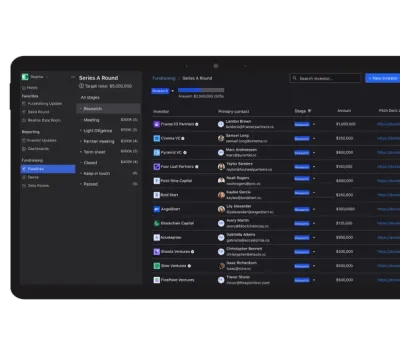
At Visible, we often times compare a fundraise to a B2B sales and marketing funnel. At the top of your funnel, you are finding new investors. In the middle, you are nurturing and pitching potential investors. At the bottom of the funnel, you are working through diligence and ideally closing new investors.
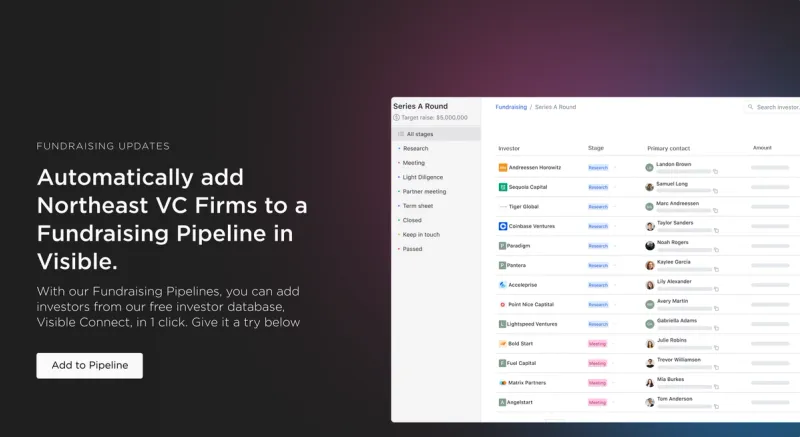
With the introduction of data rooms, you can now manage every aspect of your fundraising funnel with Visible.
- Find investors at the top of your funnel with our free investor database, Visible Connect and find a filtered list of investors.
- Track your conversations and move them through your funnel with our Fundraising CRM
- Share your pitch deck and monthly updates with potential investors
- Organize and share your most vital fundraising documents with data rooms
Manage your fundraise from start to finish with Visible. Give it a free try here.
Frequently Asked Questions
What are the best cities for startup fundraising in the Northeast?
New York and Boston remain the primary hubs due to their massive concentration of enterprise buyers and technical talent. However founders can leverage secondary markets like Philadelphia and Washington D.C. to capture specialized defense and healthcare rounds while benefiting from significant operational cost savings and lower engineering salaries.
How can Northeast startups access non dilutive capital?
Founders can secure non-dilutive capital by leveraging state-specific incentive programs designed to retain high-growth companies. Pennsylvania offers transferable tax credits for young startups, while Maryland has converted its biotechnology tax credit into a direct grant program. Connecticut also deploys direct, state-backed capital for hard-tech founders.
How does federal defense spending impact Northeast venture capital?
Recent federal regulatory shifts and national security authorizations have injected massive capital into the regional ecosystem. Record defense spending budgets are actively driving aggressive venture deployment into dual-use technologies and hardware companies. These investments heavily favor startups clustering near established defense and political hubs like Washington D.C. and Boston.
Which accelerators provide the best investor networks in the Northeast?
The region hosts several high signal accelerators that facilitate warm introductions to institutional capital. Entrepreneurs Roundtable Accelerator and Techstars New York City offer intensive operational support and massive global networks. In secondary markets programs like AlphaLab in Pittsburgh serve as direct pipelines into state funding and university resources.
What are the most important Northeast tech events for founders raising capital?
Founders should prioritize concentrated networking events to build their deal pipeline. NY Tech Week in June and Startup Boston Week in September are critical venues for early-stage capital. For specialized defense and aerospace startups, the Venture Forward Defense Tech Conference provides direct access to government stakeholders.