
Key Takeaways
-
No extra login: Portfolio data collection works best when a request lands in a founder's email as a secure link, because a separate login adds friction to every submission.
-
Founder data control: Founders decline to give investors direct access to underlying data sources, preferring to control what gets shared and when, so collection should run on submissions rather than connections.
-
Beyond financial reporting: Custom metrics, qualitative questions, and multiple choice fields let a fund run impact reporting, diversity reporting, and year-end audit preparation through the same collection process.
-
Three analysis levels: Portfolio data supports company-level dashboards for internal review meetings, portfolio-level dashboards that rank performers against companies needing support, and fund-level dashboards for fund performance.
-
LP appetite for insight: Limited partners track financial returns but also want sector trends and portfolio-level performance context, and firms supplying both become long-term partners rather than quarterly reporters.
Many Venture Capital firms struggle to efficiently collect updates from their portfolio companies and turn the data into meaningful insights for their firm and Limited Partners. It’s usually a painful process consisting of messy Google Sheets or Excel file templates being sent to companies. Then, someone at the VC firm is responsible for the painful task of tracking down companies and convincing them to send the metric template back to the investor. The end result is typically an unreliable master sheet that isn’t accessible or easy to digest for the rest of the firm.
Visible has helped over 350+ VC firms streamline the way they collect, analyze, and report on their portfolio and fund performance. Keep reading to learn how.
Streamlining Portfolio Data Collection
To set up a more efficient portfolio data collection process at your firm make sure you:
- Don't require companies to manage another login
- Visible’s data Requests are delivered directly to your companies’ email inboxes and the secure-linked base form ensures there is no friction in the data-sharing process.
- Maintain founder privacy
- Visible supports over 3.5k founders on our platform and the consistent feedback we hear is founders do not want their investors to have direct access to their data sources. Founders prefer to have control over what and when their data is shared with investors.
- Customize which information you request from companies
- Visible allows investors to create any custom metric, qualitative question, yes/no response, multiple choice, and more. This provides investors with the flexibility to use Visible for more than just financial reporting but also impact or diversity reporting and end-of-year audit preparation.
Related resource: Portfolio Monitoring Tips for Venture Capital Investors
Related resource: Which Metrics Should I Collect from My Portfolio Companies
Easy Ways to Analyze VC Portfolio Data
While having up-to-date, accurate investment data is important, being able to extract and communicate insights about your portfolio data is when it really becomes valuable. Visible supports three different types of dashboards to help you analyze your portfolio data more easily.
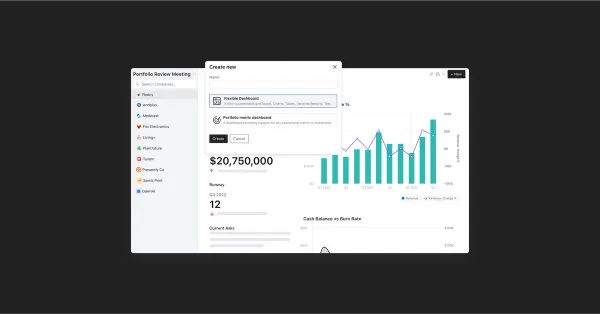
Flexible portfolio company dashboards — Visualize KPI’s by choosing from 9 different chart types and combine with rich text and company properties. These dashboards are a great fit to help facilitate more robust internal portfolio review meetings.
Portfolio metric dashboards — This dashboard allows you to compare performance across your entire portfolio and easily identify your top performers and the companies who may need additional support.
Fund analytics dashboards — This flexible dashboard lets investors control how they want to visualize and analyze their fund performance metrics. Choose from over 30+ fund metrics and auto calculated insights and easily add them to your shareable dashboard.
View an example of all three types of dashboards by downloading the resource below.
Sharing Portfolio Updates with Limited Partners
It’s important to remember that while Limited Partners are primarily focused on financial returns they also care about insights. VC firms who empower their Limited Partners with updates about sector trends and high-level insight into portfolio company performance are setting themselves up to be both trusted and valuable long-term partners to their investors.
LP Update Template Library — Visible makes it easy for firms to make engaging communication with Limited Partners a habit by providing free and open-source Update templates. Want to feature your LP Update template in out library? Get in touch!
Tear Sheets — Tear Sheets or One Pagers can be a great way to provide high-level updates about portfolio companies to your LPs. Visible’s tear sheet template solution helps VC firms create reporting with ease by merging information and data into beautiful charts that are automatically kept up to date.
View Tear Sheet examples to inspire your next reporting.
Related resource: Tear Sheets 101 (and how to build one in Visible)
Visible supports 400+ funds around the world streamline the portfolio data collection, analysis, and reporting process.
Frequently Asked Questions
What is the difference between collecting portfolio data by submission and connecting to a company's systems?
A submission process asks each company to send agreed figures on a set cycle, while a connection gives the investor standing access to the source system behind those figures. Founders on Visible's platform consistently tell the team they do not want investors reading their data sources directly. Submission leaves the company deciding what is shared and when.
Do portfolio companies need to create a login to send data to an investor?
Portfolio companies can report without creating an account when the form arrives as a secure link in the founder's email inbox. Keeping the form inside email removes the friction a separate account adds to every reporting cycle.
Can a fund use the same portfolio data collection process for impact or diversity reporting?
A fund can run impact and diversity reporting through the same collection process by adding custom metrics and qualitative fields to the form it already sends. Yes or no answers, multiple choice options and written questions sit alongside financial metrics, and the same setup covers end of year audit preparation.
Why does a portfolio data master spreadsheet fail the rest of the firm?
A master spreadsheet built from returned templates ends up unreliable and hard for the rest of the firm to read. Collection that runs on emailed templates leaves one person chasing companies for the file, and the data never reaches colleagues in a form they can digest.
Why is collecting portfolio data not enough on its own?
Portfolio data becomes valuable at the point where someone extracts an insight from it and communicates that insight inside the firm. Accurate, current investment data is the input, and a fund that stops at collection holds a record of the portfolio rather than a read on it.