
Key Takeaways
- MCP server purpose: Visible's MCP server connects an AI tool to live portfolio data, so a fund asks a question in plain language instead of building a report first.
- Layered queries: A fund narrows a runway list by fundraising status in a second question, which separates founders needing an introduction from founders needing an urgent call.
- LP update drafting: A fund pulls ARR growth for recently funded companies and generates the per-company bullets for an LP update in one query, then edits the draft rather than writing from scratch.
- Reporting gaps as signal: A company that is actively fundraising and has stopped filing updates warrants outreach, and the two facts together are what make the gap meaningful.
- Data dependency: An answer is only as good as what founders submitted, so a fund that lets reporting lapse gets fast answers built on stale numbers.
The best VC firms are not the ones that have the most data. They are the ones who take action swiftly.
When a founder is two months from running out of runway, that is not a data problem. When your LP update takes a week to pull together, that is not a capacity problem. These are access problems. The insight exists. Getting to it is just too slow.
Visible's MCP server closes that gap. It connects your AI tool directly to your live Visible data so you can ask questions in plain language and get answers in seconds. No exports. No formulas. No tracking down a teammate. Just ask.
Evan Walden, CEO of Getro, sees the same shift across the funds his company works with: "teams can scale their impact without necessarily having to scale headcount by leveraging some of the tools that are out there."
Check out our video and step-by-step guide walking you through how to surface insights with our MCP server below:
Surfacing Portfolio Insights With Our MCP Server
If you need help setting up the Visible MCP Server, head here or reach out to your account manager.
Step 1: Identify at-risk companies by runway
Start with the most time-sensitive signal: which companies are running low on cash.
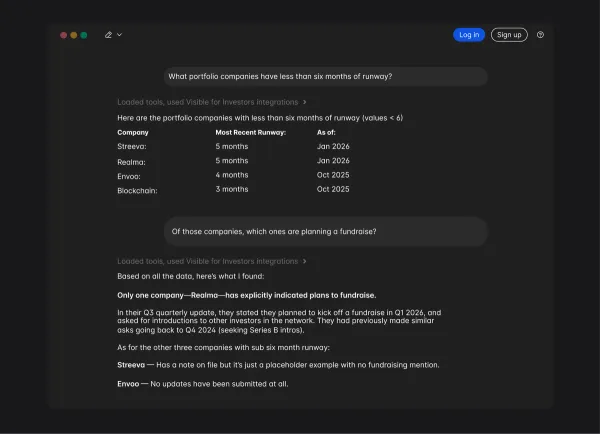
Try this prompt: What portfolio companies have less than six months of runway?
The MCP server pulls the latest portfolio company data submitted in your Visible requests or AI Inbox, so the answer reflects current data, rather than a stale export. You'll see a list of companies that need attention right now.
Step 2: Layer in fundraising status
A list of at-risk companies is useful. A list split by whether they're actively fundraising is actionable.
Follow up on your Step 1 results without starting a new query: Of those companies, which ones are planning a fundraise?
This splits your at-risk list into two distinct groups: founders who have a plan in motion (and may need warm introductions) and founders who are burning runway with no raise in sight (and need a call this week). That's the difference between a check-in and an intervention.
Step 3: Generate LP update narratives from ARR data
LP updates are one of the most time-consuming deliverables in portfolio management.
This query does the heavy lifting in one shot: Show me ARR growth for companies that raised in the last 12 months, then generate two bullet points per company for an LP update.
The MCP server identifies a strong cohort (recently funded companies are a natural fit for LP reporting), pulls their ARR growth, and drafts two narrative bullet points per company. Each one is headlined by a performance metric and framed with context, so your LPs see a story, not just a number.
What used to take hours across 10–15 companies is now a single query. You'll still refine the copy, but the data retrieval and first draft are done.
Step 4: Find fundraising companies with lapsed updates
Founders in the middle of a fundraise are busy. Investor meetings, due diligence requests, roadshows, and updating their VCs can slip down the list.
This query surfaces exactly that combination: Which companies are actively fundraising but haven't submitted an update in the last 60 days?
These are often your highest-stakes companies at any given moment. A 60-day gap is not automatically a red flag, but combined with active fundraising activity, it is a clear signal about who to prioritize reaching out to before you find out the hard way that something has changed.
Tips for Better MCP Queries
- Use specific time windows. "Last 60 days" or "raised in the last 12 months" returns more useful results than open-ended queries.
- Combine signals in one prompt. Cross-referencing two data points (runway + fundraising status, ARR + raise date) surfaces insights you would otherwise miss.
- Build iteratively. Start broad, then narrow with follow-up questions in the same session rather than starting from scratch each time.
- Ask for the output format you need. If you want LP-ready bullet points or a board deck summary, say so.
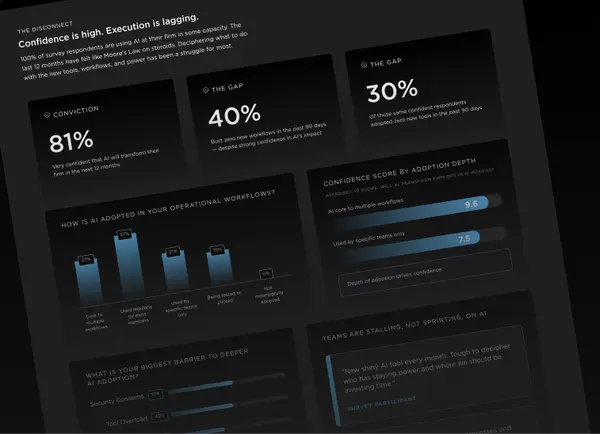
The pattern shows in the usage. Across 6,841 MCP tool calls in the Visible AI Sentiment Report, pulling metrics was the single largest use at 41%, ahead of portfolio company profiles at 31%.
How Haatch Surfaces Insights With Our MCP Server
Haatch is a UK-based pre-seed and seed investor managing 180+ B2B SaaS companies.
After connecting Visible to their AI tools via the MCP server, they recovered roughly 10 hours per week in coordination time and used years of consistently collected Visible data to build a graduation benchmark report tracking what strong performance looks like at each funding stage. It is the kind of insight that simply would not have been possible without structured data collected over time.
Your Answers Are Only As Good As Your Data
The MCP server is powerful because it queries live data. But live data is only valuable if founders are actually submitting it.
That is where Visible's data collection tools do the work. Visible's request feature lets you send structured update requests directly to founders on a set cadence, so ARR, burn, runway, and fundraising status come in consistently and on time. The AI inbox makes it easy for founders to submit updates in whatever format works for them. Visible normalizes it automatically.
The result is a portfolio data layer that stays current without chasing it. And when your data is clean and consistent, queries like the ones in this guide go from occasionally useful to genuinely reliable.
If your data collection process needs tightening up, start there. The MCP server will be waiting. Learn more about leveraging Visible data across your AI stack here.
Frequently Asked Questions
How should a fund phrase a query to get a useful portfolio answer?
A specific time window and two data points combined in one prompt return far more than an open-ended question. Pairing runway with fundraising status, or ARR with raise date, surfaces what neither signal shows on its own.
What is the best way to refine a query that returns too much?
Narrow the result with a follow-up question in the same session rather than starting a new query from scratch. Working from a broad first answer keeps the earlier result in play, so each question builds on the last instead of rebuilding it.
How does a fund get an AI answer in the format it needs?
Name the format in the prompt itself. A fund that wants bullet points ready for an LP audience, or a summary shaped for a board deck, asks for that shape directly and gets a first draft in it rather than reformatting afterwards.
How current is the portfolio data behind an answer?
Answers draw on the latest figures founders have submitted, so the result reflects the current state of the portfolio rather than whatever an export captured on the day it was run. No download and no spreadsheet formula sits between the question and the answer.
How much time does connecting portfolio data to an AI tool save a fund?
Haatch, a UK pre-seed and seed investor managing more than 180 B2B SaaS companies, recovered roughly 10 hours a week in coordination time after connecting its portfolio data to its AI tools. Work that previously ran for hours across 10 to 15 companies collapses into a single query.