








Key Takeaways
- Pricing realities: Founders and fund operators routinely overpay for fragmented enterprise systems, but unified reporting platforms consolidate your tech stack to significantly reduce overall software expenditures.
- Institutional investor expectations: High-tier backers no longer accept static PDFs and instead demand secure platforms with on-demand access to real-time performance metrics.
- Automated metric accuracy: Purpose-built tools natively calculate complex financial benchmarks like Internal Rate of Return and Distributions to Paid-In capital to eliminate manual calculation errors.
- Fund administrator synergy: Dedicated software will not replace your certified accounting team, but it heavily reduces their expensive billable hours by automating routine document distribution.
- Due diligence readiness: Launching your platform before investor requests begin guarantees pristine historical data organization for future capital raises and strict compliance audits.
LP Reporting Software for Venture Capital: Features, Tools, and How to Choose the Right Platform
For venture capital and private equity firms, communicating performance to Limited Partners (LPs) is a critical ongoing responsibility. Yet, as funds scale, the processes used to manage this communication often fracture. Relying on disconnected spreadsheets, manual data entry, and static PDFs creates operational drag and degrades the investor experience. Modern firms are solving this by adopting purpose-built tools designed to streamline these workflows and provide institutional-grade transparency.
What Is LP Reporting Software?
LP reporting software is a specialized platform used by venture capital firms, private equity firms, and fund managers to automate, centralize, and securely share financial performance, portfolio updates, and key metrics with their Limited Partners.
At its core, this software replaces fragmented manual workflows with a single source of truth. It bridges the gap between raw portfolio data and the polished, accessible insights that institutional investors require.
What software do private equity firms use? Private equity and venture capital firms typically use a combination of portfolio reporting software to track underlying asset performance and LP reporting platforms to manage investor communications, secure data rooms, and quarterly updates.
A robust LP reporting platform serves three core functions for fund managers:
- Centralizing Reporting: Aggregating data from multiple portfolio companies and internal financial models into standardized, easily digestible formats.
- Powering Analytics: Automating the calculation and visualization of critical fund metrics directly alongside qualitative portfolio updates.
- Streamlining Investor Communication: Providing secure, on-demand access to updates, financial documents, and historical data through centralized portals, rather than relying on disparate email threads.
By moving away from static, manual files and adopting dedicated private equity portfolio monitoring software, fund managers can shift their time from formatting charts and chasing data to driving actual portfolio value and nurturing LP relationships.
Why LP Reporting Breaks as Venture Firms Scale
In the early days of Fund I, investor reporting is often manageable. A GP or associate updates a master Excel model, drafts a narrative document, exports a static PDF, and sends a bcc’d email to a handful of early backers.
But as venture firms scale, these manual workflows quickly become liabilities. Data fragmentation sets in as information gets trapped across different inboxes, CRM tools, and financial models. The risk of manual errors multiplies with every new portfolio company added to the roster. What was once a minor administrative task balloons into a time-consuming, quarter-end reporting cycle that creates immense operational, and even emotional, stress for the team.
The Hidden Costs of Manual Reporting
The true cost of a broken reporting process isn't just the absence of modern software; it's the severe drain on human capital and firm reputation.
- Time Spent Per Quarter: An LP analyst or finance lead can spend weeks chasing founders for updated metrics, verifying data accuracy, and manually formatting charts instead of focusing on strategic fund operations.
- Risk of Errors: Spreadsheets are inherently fragile. A single broken formula, version control issue, or copy-paste mistake can lead to misreported performance metrics, instantly damaging the firm's credibility.
- LP Dissatisfaction: Institutional investors manage capital across dozens of funds. When they receive delayed, inconsistent, or hard-to-parse reports, it creates friction that can severely impact future fundraising efforts.
Signs You’ve Outgrown Spreadsheets
How do you know when it’s time to abandon legacy workflows? The breaking points are usually obvious. You have outgrown spreadsheets if you are experiencing:
- An Increasing LP Base: You are transitioning from a small group of high-net-worth individuals to institutional capital with stricter, more demanding reporting mandates.
- Multiple Funds and SPVs: Tracking Fund I, Fund II, and various co-investments across isolated workbooks makes consolidated reporting nearly impossible.
- Repeated Investor Requests: If LPs are constantly emailing your team to request historical data, tax documents, or specific performance metrics, your current delivery method is failing them.
Moving from a fragmented web of files to a centralized reporting system, often anchored by dedicated portfolio analytics software, is not just an administrative upgrade. It is a natural and necessary evolution for any modern venture firm that wants to build and scale institutional trust.
What LPs Expect Today (and Why It’s Changed)
The standard for what constitutes "good" investor reporting has fundamentally shifted. As the venture capital ecosystem has matured, Limited Partners, especially institutional investors, endowments, and family offices, are deploying capital across a wider array of funds. They are managing their own complex portfolios and can no longer afford to dig through unstructured data.
Today, LP reporting is no longer just a back-office compliance task; it is a core component of the investor experience.
Marianne Oar, Managing Director at State Street, set out what that shift asks of the industry in ILPA's account of its new reporting standards. "State Street, as an industry-leading private markets service provider, absolutely sees the need to work together to standardize and make necessary data available for investors to analyze their private market holdings." Making data available and making it comparable are two different jobs, and LPs now expect both.
From Quarterly Reports to Real-Time Visibility
Historically, venture reporting was defined by the static, quarterly PDF. These reports were often delayed by 45 to 60 days post-quarter end, meaning LPs were making decisions based on stale data.
Static reporting is no longer enough. Modern LPs expect a digital-first experience characterized by:
- Radical Transparency: Clear visibility into underlying portfolio company performance, not just high-level fund metrics.
- On-Demand Access: The ability to log in and retrieve historical updates, tax documents, and real-time dashboards without having to email a general partner.
- Standardized Reporting: Consistent, formatted data that easily integrates into their own internal tracking systems and models.
How Better Reporting Improves LP Relationships
How do LP reporting tools improve investor relations? LP reporting tools improve investor relations by providing absolute transparency, reducing friction in accessing fund data, and delivering consistent, standardized updates. By offering a centralized hub for information, these tools build institutional trust, reduce the administrative burden on the LP's team, and ultimately increase the likelihood of securing follow-on capital for future funds.
When you treat reporting as an extension of your firm's brand, you change the dynamic of the GP-LP relationship. Instead of reacting to one-off data requests, you are proactively providing a frictionless experience. This level of professionalism signals operational maturity. When it comes time to raise your next fund, the LPs who have experienced a seamless, transparent reporting process are often the first to commit.
Key Features of Modern LP Reporting Software
As venture capital operations mature, the tools required to manage them must evolve as well. Modern portfolio reporting software goes far beyond simple data storage. It acts as an operational system of record, designed specifically to eliminate friction for both the fund manager and the Limited Partner.
When evaluating platforms, these are the core features that separate basic tools from institutional-grade solutions.
Investor Dashboards
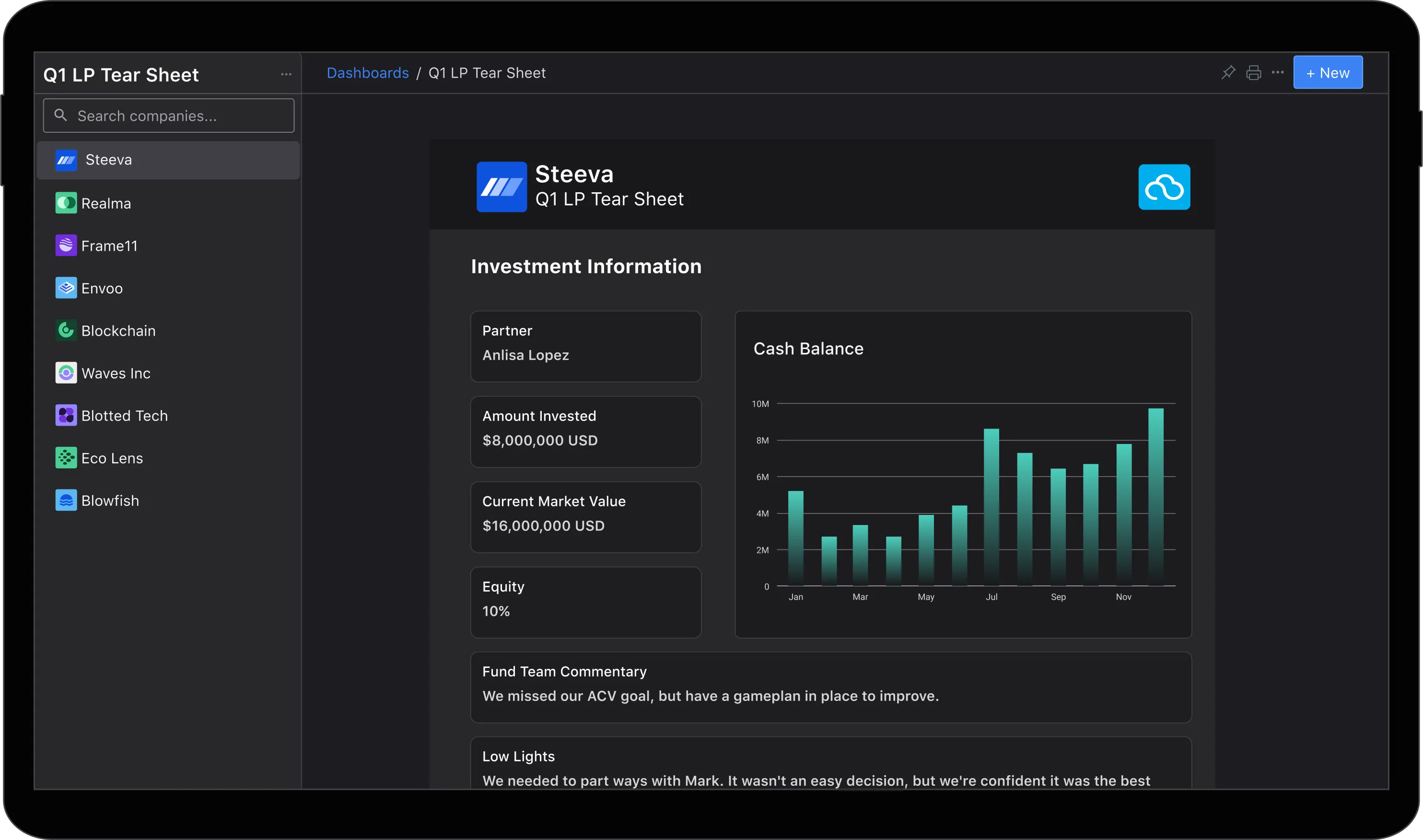
LPs no longer want to dig through their inbox to find your last update. Modern platforms provide secure, self-service investor dashboards that offer real-time performance visibility. Instead of waiting for a quarterly email, an LP can log in at any time to view their specific commitments, fund-level performance, and high-level portfolio company highlights.
Automated Reporting
Compiling quarterly reports manually requires pulling data from various systems and formatting it into a presentation. Great reporting software automates this process. By utilizing pre-built templates and dynamic data fields, fund managers can generate and distribute comprehensive quarterly updates with a few clicks, drastically reducing the time spent on manual assembly.
Portfolio Analytics & Performance Metrics
High-quality portfolio analytics software automatically calculates the exact metrics LPs care about: Internal Rate of Return (IRR), Total Value to Paid-In (TVPI), Distributions to Paid-In (DPI), and Multiple on Invested Capital (MOIC). By standardizing these calculations within the platform, firms eliminate spreadsheet errors and ensure that performance data is always accurate and up-to-date.
Data Integrations
A reporting tool is only as good as the data flowing into it. The best platforms offer seamless integrations with your existing tech stack, syncing directly with accounting software, banking platforms, and internal CRM tools. This eliminates the need for double data entry and ensures that your financial reporting is always tied to real-time account balances.
Document & Data Room Management
Beyond performance updates, LPs require a steady stream of documentation: capital call notices, distribution letters, K-1 tax forms, and annual meeting decks. A modern platform features secure, centralized data rooms. This allows LPs to easily access historical documents in one place while giving GPs strict control over user permissions and viewing rights.
Communication & Investor Updates
Relying on standard email clients to send sensitive financial data is risky and inefficient. Dedicated platforms streamline LP communication by offering native tools to draft, send, and track investor updates.
When building a tech stack, modern venture firms look to unify these fragmented features. Rather than paying for a separate data room, an email marketing tool, and a private equity portfolio monitoring software, firms achieve maximum efficiency with centralized platforms. A comprehensive system like Visible seamlessly bridges these gaps, natively supporting rich investor updates, automated portfolio tracking, secure data rooms, and deep engagement tracking in one unified workflow.
Key Factors for Choosing LP Reporting Software
With the transition to dedicated software becoming the industry standard, the challenge shifts from whether to adopt a platform to how to select the right one. The best LP reporting software for your firm isn't necessarily the one with the longest feature list; it is the one that perfectly aligns with your operational maturity, fund structure, and LP expectations.
Which tool is best for financial reporting? The best tool for financial reporting is one that balances automated data integrations, flawless calculation accuracy for complex metrics (like IRR and TVPI), and a secure, self-serve portal for Limited Partners. It should act as a single source of truth, eliminating the need for manual spreadsheet reconciliation.
Which portfolio tracker is best? The best portfolio tracker is one that seamlessly connects raw, company-level data with fund-level performance metrics. It should allow General Partners to consolidate internal portfolio monitoring with external investor reporting in a single, unified environment, ensuring data consistency across the board.
When evaluating platforms, use this framework to guide your decision:
Ease of Use vs Complexity
A platform is only valuable if your team actually uses it. Overly complex, enterprise-heavy systems often require dedicated training and full-time administrators, leading to low adoption rates. Look for software that is intuitive for your team to navigate on day one, without sacrificing analytical depth.
Data Accuracy & Reliability
Your reporting software must serve as the undisputed source of truth. If the system relies on manual, error-prone data entry, it defeats the purpose of upgrading. Evaluate how the platform handles data ingestion, version control, and the calculation of standardized financial metrics.
LP Experience (UI/UX)
Remember that this software is a direct reflection of your firm's brand. Evaluate the platform from the LP's perspective. Is the investor portal clean, modern, and easy to navigate? Can they find their tax documents and latest fund performance metrics in under three clicks, or is the interface cluttered and confusing?
Customization & Flexibility
Every fund has its own unique reporting cadence, branding guidelines, and specific metrics they track based on their thesis. The platform should adapt to your firm’s specific narrative and aesthetic, rather than forcing you into rigid, unchangeable templates.
Integration Capabilities
A siloed reporting tool creates more work. Your chosen platform must integrate smoothly with your existing technology stack. Ensure it can pull data directly from your accounting software, banking tools, and CRM to maintain real-time accuracy and eliminate duplicate data entry.
Scalability Across Funds
The system you choose today must support the firm you will be tomorrow. While a basic tool might work for managing a single early-stage fund, ensure the architecture can seamlessly scale to handle multiple funds, diverse SPVs, complex fee structures, and co-investments without requiring a complete system overhaul.
The LP Reporting Evaluation Checklist
When sitting down with your operations team to make a decision, use this quick scoring model:
- Does the platform automate our most time-consuming manual tasks?
- Does the LP portal look professional and align with our brand standard?
- Can it automatically calculate IRR, TVPI, DPI, and MOIC?
- Does it integrate directly with our current accounting tools?
- Is the pricing model sustainable as we add more LPs and raise future funds?
Best LP Reporting Software by Category
Searching for the single "best" tool can be misleading, as the ideal solution depends entirely on your firm's stage, AUM, and operational complexity. Rather than comparing brands in a vacuum, it is more effective to evaluate the best LP reporting software based on specific use cases and firm profiles.
Which VC tool offers the best LP reporting? For modern venture capital, the VC tool offering the best LP reporting is an all-in-one system that natively combines portfolio data collection, standardized financial metric calculations, and rich investor communication into a single, seamless workflow.
What is the best software for portfolio tracking? The best software for portfolio tracking is one that goes beyond internal analytics, bridging the gap between raw company performance data and external LP reporting without requiring manual data transfers or spreadsheet exports.
Here is how to categorize the landscape of available tools to find the right fit for your firm:
Best for Emerging Venture Funds
For Fund I or Fund II managers, speed and agility are paramount. The ideal platform in this category is lightweight, easy to implement, and immediately replaces the need for complex spreadsheets. Emerging managers should look for software that offers out-of-the-box templates, simple data ingestion, and a clean, professional LP portal that helps establish institutional credibility early on.
Best for Mid-Sized VC Firms Scaling Reporting
As firms scale and add multiple funds, SPVs, and co-investments, their operational needs mature. The best platforms for mid-sized firms focus heavily on workflow automation and data integration. These tools must flawlessly aggregate data across various entities, calculate accurate fund-level metrics, and allow teams to manage a growing base of LPs without needing to hire a massive back-office team.
Best for Institutional / Multi-Fund Managers
Firms managing billions in AUM with highly complex, global fund structures require enterprise-grade solutions. At this stage, the best private equity portfolio monitoring software will feature deep, custom integrations with legacy accounting systems, highly granular permission settings, and the ability to handle massive datasets while meeting strict regulatory compliance and audit requirements.
Best All-in-One Platform for Reporting + Investor Communication
Many firms realize that buying separate tools for portfolio monitoring, email updates, and secure document storage creates unnecessary tech bloat and data silos. The most efficient approach for modern venture firms is to adopt a unified solution.
An all-in-one platform like Visible sits perfectly in this category. Built specifically for VC workflows, it eliminates the friction of jumping between apps by natively combining automated portfolio data tracking with powerful investor communication tools. By centralizing updates, data rooms, and core metrics in one place, Visible allows firms to manage the entire LP lifecycle, from initial pitch to final distribution, within a single, elegant environment.
LP Reporting Workflow , Before vs After Software
The most effective way to understand the ROI of upgrading your tech stack is to map out the operational transformation. The shift from manual processes to dedicated software fundamentally changes how a firm operates at the end of every quarter.
Before: The Manual Workflow
In a legacy system, the reporting process is highly fragmented, reactive, and prone to bottlenecks.
- Pulling Data from Multiple Sources: Associates spend days extracting financial data from accounting software, chasing portfolio founders for qualitative updates, and exporting metrics from CRM tools.
- Formatting Reports: This raw data is dumped into master spreadsheets where complex formulas are vulnerable to breaking. The finalized data is then manually formatted into slide decks or static PDFs.
- Sending PDFs: The final reports are distributed via mass emails or rudimentary file-sharing links, offering zero visibility into whether an LP actually opened, read, or engaged with the data.
After: The Software-Driven Workflow
By implementing a purpose-built platform, the reporting cycle becomes proactive, secure, and highly automated.
LPs check before they commit. Thomas Ikeda, Principal at Cendana, says it is not uncommon for his firm to do 30 or 40 reference calls when assessing a fund manager.
- Automated Data Syncing: Integrations pull financial and portfolio data directly into the platform, ensuring real-time accuracy and eliminating the need for duplicate data entry.
- Live Dashboards: Standardized metrics are calculated automatically and presented in clean, institutional-grade interfaces that require zero manual formatting.
- LP Self-Service Access: LPs log into a secure, branded portal to find their specific fund commitments, historical documents, and the latest quarterly updates without needing to email the GP.
The Reporting Transformation
| Workflow Stage | Legacy Workflow (Manual) | Modern Workflow (Software) |
|---|---|---|
| Data Collection | Chasing emails & manual data entry | Automated syncing & direct integrations |
| Metric Calculations | Fragile, manual spreadsheet formulas | Standardized, system-generated metrics |
| Distribution | Static PDFs sent via bcc'd emails | Secure, trackable investor portals |
| LP Experience | Reactive requests for lost documents | 24/7 self-service access to data rooms |
| Time to Completion | 3 to 4 weeks post-quarter | 3 to 5 days post-quarter |
The tangible results of this transformation are immediate. Because LPs can instantly access their own K-1s, capital call notices, and historical performance reports, administrative follow-up emails are drastically reduced.
This is where a platform like Visible fundamentally changes firm operations. By replacing manual data wrangling with automated reporting capabilities, centralizing all fund data, and providing top-tier investor visibility, the platform turns reporting from an operational burden into a strategic advantage.
When Do You Actually Need LP Reporting Software?
Many fund managers delay upgrading their tech stack because they believe software is only for mega-funds with billions in AUM. In reality, the breaking point for manual workflows happens much earlier. Upgrading too late often results in fractured data, frustrated investors, and a panicked scramble during the next fundraising cycle.
When should a VC firm start using LP reporting software? A VC firm should start using LP reporting software when the time spent on quarterly reporting exceeds a few days, when the firm launches its second fund or SPV, or when its Limited Partner base grows beyond 20 investors. At these critical thresholds, manual spreadsheet processes become too error-prone, insecure, and time-consuming to scale effectively.
The Software Adoption Decision Checklist
If you are evaluating whether your current workflow is sustainable, consider these specific thresholds. If you check two or more of these boxes, you are actively losing time and operational efficiency by not using dedicated software:
- [ ] Your LP Base Exceeds 20 Investors: Managing a handful of high-net-worth individuals over email is possible. Sending secure, personalized updates to dozens of institutions, family offices, and individual backers is not.
- [ ] Reporting Cycle Exceeds 48 Hours: If compiling, formatting, and distributing quarterly performance metrics takes your team more than two days, your process is creating an operational bottleneck.
- [ ] You Are Managing Multiple Funds or SPVs: Cross-referencing data between Fund I, Fund II, and various co-investment vehicles in disconnected spreadsheets practically guarantees calculation errors.
- [ ] LPs Are Requesting More Transparency: If your investors are frequently emailing you to ask for historical performance data, K-1s, or more granular portfolio insights, your current distribution method is failing to meet their expectations.
Waiting until your operations are completely overwhelmed is a costly mistake. Implementing a centralized platform early allows your firm to build scalable habits, ensuring that when you do raise your next fund, your back-office infrastructure is already institutional-grade.
Core Metrics Every LP Reporting Platform Should Track
Most generic financial tools can track basic cash flows, but venture capital requires highly specific, standardized performance metrics. When evaluating solutions, the depth and accuracy of a platform's metric calculation engine is a major differentiator.
What metrics should LP reporting software include? LP reporting software should inherently track and calculate the core pillars of venture fund performance: Internal Rate of Return (IRR), Total Value to Paid-In (TVPI) capital, Distributions to Paid-In (DPI) capital, and Multiple on Invested Capital (MOIC).
How do VCs calculate IRR, TVPI, and DPI in reporting tools? In modern reporting tools, VCs calculate IRR, TVPI, and DPI automatically by integrating the software with their accounting ledgers. The platform ingests exact cash flow dates (capital calls and distributions) alongside the fund's current Net Asset Value (NAV), calculating standardized, error-free metrics instantaneously without relying on manual XIRR spreadsheet formulas.
Here is a breakdown of the core metrics your platform must track natively:
- IRR (Internal Rate of Return): The annualized, time-weighted rate of return of the fund. Because it factors in the time value of money, IRR is highly sensitive to exactly when capital is called and distributed.
- TVPI (Total Value to Paid-In): Also known as the investment multiple. This measures the overall value of the fund (both realized cash and unrealized paper value) relative to the capital LPs have actually paid in.
- DPI (Distributions to Paid-In): The realization multiple. This divides the actual cash distributed back to LPs by the capital they have paid in. It is the ultimate measure of realized, liquid returns.
- MOIC (Multiple on Invested Capital): Similar to TVPI, but MOIC is typically used to evaluate the gross performance of individual portfolio companies rather than the net performance of the fund as a whole.
What LPs Actually Care About (and Why)
Reporting these metrics isn't just about financial compliance; it is about providing LPs with the specific data they need to make asset allocation decisions.
LPs use your IRR to benchmark your fund against other asset classes, like public equities or real estate. They look at your TVPI to understand the current, albeit unrealized, trajectory of your portfolio.
However, as the old venture adage goes, "You can't eat IRR." Institutional LPs are hyper-focused on DPI. They need to know when cash is coming back to them so they can recycle it into future commitments.
If an LP has to manually calculate your DPI because it was buried in a footnote on page 14 of a PDF, you are creating friction. A platform like Visible removes this friction entirely by pulling these metrics to the forefront of the investor dashboard, automatically updating them as soon as capital moves, and displaying them exactly how an LP wants to see them.
LP Reporting Software vs Portfolio Monitoring Tools
As venture capital operations become more sophisticated, the line between internal data tracking and external investor communication often blurs. A common source of friction for growing firms is understanding where their existing tech stack ends and where a new tool needs to begin.
What’s the difference between portfolio monitoring and LP reporting? The primary difference lies in the end-user and the objective.
- Portfolio monitoring software is designed for internal use. It helps General Partners and associates track the operational health, KPIs, and cap tables of individual portfolio companies to make strategic decisions.
- LP reporting software is designed for external communication. It aggregates that underlying company data, calculates fund-level financial metrics, and securely distributes the consolidated performance story to Limited Partners.
Where the Overlap Exists
While their primary functions differ, the two systems are deeply interconnected. You cannot effectively report on a fund's performance without accurate underlying portfolio data. The overlap exists in data ingestion: both systems require accurate, up-to-date financials and capitalization records.
When firms use disjointed tools, one for monitoring and a different one for reporting, they inevitably end up manually exporting CSVs from one system and importing them into the other, reintroducing the risk of manual error.
Why VCs Often Need Both (or a Unified System)
Venture firms need both capabilities because they serve two distinct mandates: driving portfolio value and maintaining investor trust.
However, modern firms are increasingly moving away from buying two separate point solutions. Instead, they are adopting unified platforms that handle the entire lifecycle of fund data. By using a single system to request KPIs from founders (portfolio monitoring) and automatically funneling that data into high-level investor dashboards (LP reporting), firms eliminate data silos and ensure absolute consistency between internal models and external reports.
Can LP Reporting Software Replace Fund Administrators?
As automation capabilities expand, a common question arises during tech stack evaluations: does adopting dedicated software mean a firm can eliminate its fund administrator entirely?
Can LP reporting software replace fund administrators? No, LP reporting software cannot fully replace a fund administrator. While software automates the aggregation of data, metric calculations, and the distribution of updates to investors, fund administrators are still required for complex tax compliance, regulatory filings, official fund accounting, and independent third-party valuation verification.
Rather than viewing software and fund admins as an either-or decision, modern venture firms treat them as highly complementary pieces of their operational infrastructure.
What Fund Administrators Do
Fund administrators act as an independent third party handling the rigorous financial back-office work of a venture fund. Their responsibilities typically require certified human expertise, including:
- Official Fund Accounting: Managing the general ledger, reconciling bank accounts, and preparing official financial statements.
- Tax & Regulatory Compliance: Preparing and distributing K-1s, managing FATCA/CRS compliance, and ensuring adherence to SEC guidelines.
- Capital Calls & Distributions: Officially calculating and executing the movement of capital between the fund and its Limited Partners.
What Software Can Automate
Where fund admins handle the creation and verification of the underlying financial data, LP reporting software handles the utilization and presentation of that data. Software excels at:
- Data Visualization: Turning raw accounting ledgers into real-time, easily digestible LP dashboards.
- Investor Communication: Facilitating secure, tracked distribution of the documents and updates the admin prepares.
- Portfolio Analytics: Automatically calculating real-time IRR, TVPI, and MOIC based on the latest cash flows without requiring an admin to generate a custom report.
The Need for Human Oversight
Human oversight remains critical for edge cases, complex restructuring, audit defense, and establishing the foundational trust that LPs require. Institutional investors specifically look for the separation of duties; they want to know that an independent third party is verifying the math presented by the General Partner.
Ultimately, deploying strong reporting software doesn't replace your admin; it makes your relationship with them infinitely more efficient. By providing a centralized platform for data storage and LP communication, firms reduce the billable hours their admins spend on low-level data requests, allowing both the firm and the administrator to operate at maximum efficiency.
Frequently Asked Questions
How does LP reporting software impact startup founders during fundraising?
Founders benefit when their venture backers use unified reporting platforms because it standardizes the key performance indicators requested during due diligence. This streamlined data collection allows founding teams to spend less time formatting updates and more time scaling operations.
- Centralizes quarterly performance metrics requested by your lead investors.
- Reduces repetitive administrative data requests across active funding rounds.
- Standardizes financial data formatting for rapid due diligence reviews.
Why do institutional investors require dedicated virtual data room providers?
Institutional investors deploy capital across dozens of funds and demand secure, on-demand access to real-time performance metrics. Virtual data room providers organize these critical tax documents and historical updates in one unified hub to eliminate delayed email threads.
- Grants limited partners instant self-serve access to vital financial documents.
- Maintains strict access controls and granular user viewing permissions.
- Signals operational maturity to external backers evaluating your firm.
What is the difference between portfolio monitoring and LP reporting tools?
Portfolio monitoring software tracks the internal operational health of individual startup investments, whereas LP reporting software securely distributes aggregated fund-level metrics to external backers. Unified platforms merge both functions to eliminate duplicate data entry.
- Monitoring tools help operators track underlying company capitalization tables.
- Reporting tools securely distribute fund-level performance to limited partners.
- Unified systems prevent dangerous data fragmentation across both workflows.
Can an automated reporting platform replace a fund administrator?
No software can fully replace a certified fund administrator for strict regulatory compliance, official fund accounting, or independent valuation verification. Software simply automates the visual presentation and secure distribution of the official data your administrator prepares.
- Administrators manage the general ledger and complex tax compliance requirements.
- Software visualizes official accounting data into easily scannable performance dashboards.
- Using both provides the independent third-party verification that investors demand.
What core financial metrics must reporting software calculate automatically?
A robust platform natively calculates standardized venture benchmarks by integrating exact cash flow dates with current net asset values. This automation eliminates the severe risks associated with fragile spreadsheet formulas when sharing historical performance data.
- Internal Rate of Return to benchmark against other active asset classes.
- Distributions to Paid-In capital to track realized liquidity and returns.
- Total Value to Paid-In capital to measure unrealized portfolio trajectory.