

Key Takeaways
-
We list the largest venture capital firms in 2026 by composite ranking of AUM, fund size, and exit track record.
-
A Tier 1 VC firm is a venture capital firm with durable scale (typically $10B+ AUM), proven exit track record, and gravitational pull on downstream investors; the designation is reputational, not regulatory, which is why published rankings disagree.
-
Discover the list of the largest European VC firms, and the total European venture capital AUM reached approximately $95 billion across the continent, with London alone accounting for $45 billion.
-
Mega-funds write minimum check sizes that exclude most seed and early Series A rounds: Andreessen Horowitz averages $17.6 million at seed and $24.1 million at Series A, meaning founders raising under $10M often capture better ownership economics, partner attention, and downstream signaling from Tier 2 generalists or sector specialists.
-
Founders must align their capital needs with the fund's mechanical constraints, ensuring the venture capital firm can realistically lead the current round and follow-on in the future.
The largest venture capital firms in 2026 are led by Andreessen Horowitz and Sequoia Capital, each managing roughly $90 billion in assets, followed by Insight Partners, General Catalyst, and Thrive Capital. Global venture investment hit $300 billion across 6,000 startups in Q1 2026 alone, a record high, and just 12 firms captured over 50% of all venture capital raised in the first half of 2025. AUM signals scale, but the latest fund size, check range, and deployment velocity matter more to founders deciding whom to actually pitch.
This guide ranks the top 20 venture capital firms globally using a methodology that weights AUM, flagship fund size, deployment pace, and exit track record, rather than relying on any single metric. It also covers the six additional European firms that anchor the $95 billion European VC ecosystem but get systematically undercounted in U.S.-origin rankings. Every firm profile includes stage, typical check size, sector focus, notable portfolio, and a direct assessment of when a founder should pitch them.
Beyond the rankings, this guide answers the questions founders raising Pre-Seed through Series B capital actually need answered before a fundraise. Sections cover what Tier 1 and Tier 2 actually mean, and which accelerators reliably bridge founders to Tier 1 Series A rounds.
The largest VC firm is not always the right VC firm, and AUM alone is a poor proxy for founder-stage fit. What follows is the framework for deciding whom to pitch, when, and why.
AUM Comparison Table: Top 20 Venture Capital Firms in 2026
| Rank | Firm | HQ | AUM | Latest Flagship Fund | Stage Focus |
|---|---|---|---|---|---|
| 1 | Andreessen Horowitz | Menlo Park, CA | $90B+ | $15B multi-fund raise | Seed to Growth |
| 2 | Sequoia Capital | Menlo Park, CA | $56B to $90B range | $7B expansion fund | Seed to Growth |
| 3 | Insight Partners | New York, NY | $90B+ estimated | Fund XIII | Series A to Growth |
| 4 | General Catalyst | Cambridge, MA | $30B+ estimated | $10B multi-vehicle raise in progress | Seed to Growth |
| 5 | Thrive Capital | New York, NY | $36B+ | Thrive X, $10B | Series A to Growth |
| 6 | New Enterprise Associates (NEA) | Chevy Chase, MD | $28B+ | NEA 18 | Seed to Growth |
| 7 | Tiger Global Management | New York, NY | Growth equity / multi-strategy | Tiger Private Investment Partners XVI, raising $2.2B | Series B to Growth |
| 8 | Lightspeed Venture Partners | Menlo Park, CA | Multi-billion (not officially disclosed) | $9B raise | Seed to Growth |
| 9 | Accel | Palo Alto, CA | $20B+ | Multi-region vehicles | Seed to Series B |
| 10 | Peak XV Partners | Bengaluru, India | $9B across 13 funds | $1.3B across 3 funds | Seed to Growth |
| 11 | Battery Ventures | Boston, MA | $13B+ raised historically | Battery Ventures XV, $3.25B | Seed to Growth and Buyout |
| 12 | Kleiner Perkins | Menlo Park, CA | $3.5B across active 2026 funds | KP22, $1B early-stage + $2.5B growth | Seed to Growth |
| 13 | Founders Fund | San Francisco, CA | Multi-billion (not officially disclosed) | Fund IX | Seed to Growth |
| 14 | Bessemer Venture Partners | San Francisco, CA | $20B+ estimated | Bessemer Fund XII | Seed to Growth |
| 15 | Greylock Partners | Menlo Park, CA | Multi-billion (not officially disclosed) | Greylock XVII | Seed to Series A |
| 16 | Khosla Ventures | Menlo Park, CA | $15B | KV VIII | Seed to Growth |
| 17 | Index Ventures | London and San Francisco | Multi-billion across global funds | $2.3B across early and growth | Seed to Growth |
| 18 | Redpoint Ventures | Menlo Park, CA | $4.5B | $650M tenth early-stage fund | Seed to Growth |
| 19 | Atomico | London, UK | $4.7B | Atomico VII, $1.24B dual fund | Series A to Growth |
| 20 | Balderton Capital | London, UK | $3B+ across active funds | $1.3B across early and growth | Seed to Series B |
What Does AUM Mean for a Venture Capital Firm?
AUM stands for assets under management and refers to the total capital a firm has raised and currently manages across all of its active funds. For venture capital firms, AUM includes committed capital from limited partners across every vehicle the firm operates: flagship venture funds, growth funds, opportunity funds, sector-specific funds, and any evergreen structures. It does not typically include capital that the firm has already returned to LPs from prior funds.
Ranked purely by AUM, the five largest VC firms in 2026 are Andreessen Horowitz ($90B+), Insight Partners ($90B+), Sequoia Capital ($56B to $90B depending on source), Thrive Capital (approximately $37B after the 2026 Thrive X raise), and General Catalyst ($30B+).
These figures draw on firm disclosures, Form ADV filings, and reputable secondary sources, with ranges provided where estimates conflict. Asian and European firms that do not file Form ADV with the SEC are systematically undercounted in most U.S.-origin AUM rankings.
AUM is a useful but incomplete signal. A firm with $50B AUM and a $12B current flagship fund operates very differently from a firm with $50B AUM spread across thirty smaller funds. Two metrics do more to predict how a firm will actually behave toward a founder: the size of its latest flagship fund, which determines how big a check it needs to write to move the needle, and dry powder, which is committed but undeployed capital available to invest today.
Founders should treat AUM as the shape of a firm's ambition rather than its immediate capacity. A firm with $90B AUM will not write a $500K seed check unless that check positions them to lead a $50M Series B eighteen months later. Understanding that mechanical constraint is the difference between pitching a firm that can actually back you and pitching one that will pass in the first meeting.
What Is a Tier 1 VC Firm, and How Do You Actually Rank Them?
A Tier 1 VC firm is a venture capital firm with durable scale, proven exit track record, and gravitational pull on downstream investors. Tier 1 firms typically manage $10 billion+ in committed capital, raise new flagship funds every two to three years, and lead first institutional rounds across seed, early, and growth stages. The designation is reputational, not regulatory, which is why rankings disagree.
Which Four Metrics Actually Define a Tier 1 Firm?
No authoritative body certifies Tier 1 status, so founders and LPs have to assess it themselves. The most defensible framework combines four dimensions, because any single metric produces a distorted picture. A firm with $50 billion AUM and no recent exits is not operationally Tier 1, and a firm with one legendary exit and no current fund is not either.
The four metrics that actually matter are:
- Assets under management, with the latest flagship fund size weighted more heavily than total historical AUM
- Deployment velocity, measured in new first-check investments per year over the trailing 24 months
- Exit track record, specifically distributions to paid-in capital (DPI) across the last three funds, and unicorn count among active portfolio companies
- Brand gravity, measured by how frequently other Tier 1 firms co-invest or follow on after the firm leads a round
Applied together, these four metrics produce a short list that is remarkably stable year over year.
What Is a Tier 2 VC Firm?
A Tier 2 VC firm is a venture capital firm that consistently leads rounds, attracts top-tier co-investors, and produces strong exits, but operates on a smaller scale than Tier 1 firms or specializes in a narrower range of stages or sectors. Tier 2 firms typically manage $500 million to $10 billion, with active flagship funds ranging from $200 million to $1 billion. The line between Tier 1 and Tier 2 is blurry, and firms move between tiers based on recent fund performance and deployment pace.
For founders, Tier 2 is rarely the wrong choice and frequently the right one. A Tier 2 lead at Series A often produces more partner attention, more tailored support, and better ownership economics than a Tier 1 lead, where your company is one of sixty in the fund. The real risk is misalignment between stage and check size, because a Tier 2 firm whose typical Series A check is $5M will struggle to anchor a $20M round.
Tier 2 firms also tend to have sharper sector theses than the generalist mega-funds. Firms like Redpoint, Battery, Khosla, and Greylock are classified as Tier 2 by AUM but function as Tier 1 within their core sectors. Founders should evaluate firms against stage and sector fit first, then treat tier designation as a shorthand rather than a ranking.
Who Are the Largest Venture Capital Firms in the World in 2026?
The largest venture capital firms in 2026, ranked by a composite of AUM, latest fund size, deployment velocity, and exit track record, are Andreessen Horowitz, Sequoia Capital, Insight Partners, General Catalyst, and Thrive Capital. Together, these five firms manage over $300 billion in committed capital. The top 20 spans Silicon Valley, New York, London, and Bengaluru, with AI, defense, and vertical software accounting for the majority of deployments from 2025 to 2026.
Who Are the Tier 1 VC Firms?
Tier 1 firms combine scale, deployment velocity, and a track record of category-defining exits. All five below have raised new flagship vehicles in 2025 or 2026 and are leading rounds at the seed, early, and growth stages simultaneously.
Andreessen Horowitz (a16z)

- Location: Menlo Park, California
- AUM: $90B+
- Latest Fund: $15B multi-fund raise, January 2026 (includes American Dynamism $1.176B, Apps $1.7B, Bio + Health $700M, Infrastructure $1.7B, Growth $6.75B, other strategies $3B)
- Stage: Seed through Growth
- Check Size: Averages $17.6M at seed, $24.1M at Series A, $121M at Series B
- Sector Focus: AI infrastructure, American Dynamism (defense, aerospace, manufacturing), crypto, bio and health, consumer
- Notable Portfolio: OpenAI, Databricks, Anthropic, Anduril, Thinking Machines Lab
- Founder Takeaway: a16z's January 2026 raise accounted for over 18% of all venture capital dollars allocated in the United States in 2025, meaning they have unmatched dry powder and unmatched selectivity.
Sequoia Capital

- Location: Menlo Park, California
- AUM: $90B
- Latest Fund: $7 billion expansion strategy fund
- Stage: Seed through Growth
- Check Size: $1M to $100M+, depending on stage
- Sector Focus: AI infrastructure and applications, enterprise SaaS, fintech, consumer, crypto
- Notable Portfolio: OpenAI, Anthropic, Physical Intelligence, Factory, Stripe, Harvey
- Founder Takeaway: Sequoia operates an evergreen fund structure and recently completed a leadership transition to Alfred Lin and Pat Grady. The firm writes fewer, higher-conviction checks than a16z at early stage, so a Sequoia lead signals curatorial selection more than capital availability.
Insight Partners

- Location: New York, New York
- AUM: $90B+ estimated
- Latest Fund: Fund XIII
- Stage: Primarily Series B through Growth; selective Series A
- Check Size: Averages $31.9M at Series A, $55.2M at Series B, $72.7M at Series C
- Sector Focus: Enterprise software, vertical SaaS, fintech, cybersecurity, developer tools
- Notable Portfolio: Shopify, DocuSign, Wiz, Wonderful (AI agents), Ayar Labs
- Founder Takeaway: Insight's Onsite platform, with 130+ operators, is the firm's genuine differentiator for post-product-market-fit scaling. The firm is the default choice for SaaS founders at $5M+ ARR seeking capital and a playbook for go-to-market scale, but it rarely writes first-institutional checks.
General Catalyst

- Location: Cambridge, Massachusetts (with hubs in San Francisco, New York, London, Bengaluru)
- AUM: $30B+
- Latest Fund: $10B+ multi-vehicle raise in progress across early-stage and growth equity funds
- Stage: Seed through Growth
- Check Size: Averages $7.6M at seed, $27.7M at Series A, $58.1M at Series B
- Sector Focus: AI, defense technology, climate tech, healthcare, fintech, vertical industrial technology
- Notable Portfolio: Anthropic, Ramp, Samsara, Nirvana, Serval, ICEYE
- Founder Takeaway: General Catalyst committed $5 billion over five years to the Indian startup ecosystem in late 2025 and is one of the most stage-flexible firms at this scale. The firm's CEO, Hemant Taneja, has argued publicly that the traditional SaaS playbook is dead, which sets the bar for what kind of thesis wins a meeting.
Thrive Capital

- Location: New York, New York
- AUM: $37 billion
- Latest Fund: Thrive X
- Stage: Series A through Growth
- Check Size: $25M to $500M+
- Sector Focus: AI foundation models, consumer, fintech, enterprise software
- Notable Portfolio: OpenAI, SpaceX, Stripe, Ramp, Databricks
- Founder Takeaway: Josh Kushner runs one of the most concentrated portfolios at this scale, meaning Thrive picks fewer names and writes much larger checks. Thrive is a fit for founders already at the top of their category who need a growth partner comfortable with $100M+ checks and secondary liquidity.
Who Are the Tier 2 VC Firms?
Tier 2 firms are generalist multi-stage investors with $10B+ in committed capital and proven exit track records. Founders raising seed through Series B will find meaningful stage coverage across this group, often with more time and attention per portfolio company than Tier 1 can offer.
New Enterprise Associates (NEA)

- Location: Chevy Chase, Maryland (with offices in Menlo Park, San Francisco, and New York)
- AUM: $28 billion+
- Latest Fund: NEA 18
- Stage: Seed through Growth
- Check Size: $500K to $50M+
- Sector Focus: AI, deep tech, biopharma, medical devices, enterprise software
- Notable Portfolio: Plaid, Patreon, Upstart, Databricks, Tempus AI
- Founder Takeaway: NEA's 50-year track record and healthcare depth make it one of the few Tier 1-adjacent firms that can lead both a $2M seed and a $75M Series C in the same company. Biotech and medical device founders should consider NEA a first call, given the firm's dedicated healthcare practice.
Tiger Global Management

- Location: New York, New York
- AUM: Multi-strategy (public and private equity); private venture AUM not officially disclosed
- Latest Fund: Tiger Private Investment Partners XVI, targeting $2.2B, raising as of December 2025
- Stage: Series B through Growth
- Check Size: $25M to $500M
- Sector Focus: Consumer internet, fintech, enterprise software, AI applications
- Notable Portfolio: Stripe, Databricks, Ramp, Waymo, Rogo
- Founder Takeaway: Tiger's pace has slowed materially since its 2021 peak, but the firm remains among the fastest at diligence for growth-stage rounds. Founders raising $50M+ should expect term sheets within two weeks if Tiger engages seriously, with limited governance in exchange for speed.
Lightspeed Venture Partners
- Location: Menlo Park, California
- AUM: Multi-billion; figure not officially disclosed
- Latest Fund: $9 billion
- Stage: Seed through Growth
- Check Size: $500K to $150M
- Sector Focus: AI foundation models, enterprise, consumer, health, fintech
- Notable Portfolio: Anthropic, xAI, Glean, Databricks, Ramp
- Founder Takeaway: Lightspeed has committed over $5.5 billion to AI since 2012 and backed more than 165 AI-native companies, making it one of the most concentrated AI investors in the world. Founders outside AI will get fewer warm handoffs here than at a true generalist.
Accel

- Location: Palo Alto, California (with offices in San Francisco, London, Bengaluru)
- AUM: $20 billion+
- Latest Fund: Multi-region vehicles closed across 2024 and 2025
- Stage: Seed through Growth
- Check Size: $1M to $75M
- Sector Focus: AI infrastructure and agentic workflows, enterprise SaaS, consumer, fintech, marketplaces
- Notable Portfolio: Facebook, Spotify, Slack, Dropbox, Freshworks
- Founder Takeaway: Accel's barbelled strategy means the firm is equally active at $3M Series A and $75M Series C, which creates genuine follow-on signaling if it leads your first round.
Peak XV Partners

- Location: Bengaluru, India (with offices across India and Southeast Asia)
- AUM: $9 billion across 13 funds
- Latest Fund: $1.3 billion across three new funds (India Seed Fund, India Venture Fund, APAC Fund)
- Stage: Seed through Growth
- Check Size: $1M seed (via Surge) to $100M+
- Sector Focus: AI-native applications, fintech, consumer internet, SaaS, infrastructure and developer tools
- Notable Portfolio: 400+ companies, approximately 40 with $100M+ revenues; includes Freshworks, Zomato, Byju's, Meesho
- Founder Takeaway: Peak XV separated from U.S. Sequoia in 2024 and now operates independently, so a warm intro from Peak XV no longer unlocks access to Sequoia U.S., and vice versa. The Surge program provides up to $3M in seed capital and is the most efficient on-ramp for founders in India and Southeast Asia raising their first institutional check.
Battery Ventures
- Location: Boston, Massachusetts (with offices in San Francisco, Menlo Park, New York, London, Tel Aviv)
- AUM: $13 billion+ raised since inception
- Latest Fund: Battery Ventures XV, $3.25 billion, closed February 2026
- Stage: Seed through Growth and buyout
- Check Size: $1M seed to $100M+ at growth and buyout
- Sector Focus: Application software, infrastructure software (data/AI, dev tools, cybersecurity), industrial technology, life science tools
- Notable Portfolio: Coinbase, Affirm, Databricks, Wayfair, Guidewire Software
- Founder Takeaway: Battery's stage-agnostic single-fund model means one firm can support a company from $2M seed through a $500M buyout, rare at this scale. Industrial tech and life sciences founders will find more senior partner attention here than at comparably-sized but more software-concentrated firms.
Kleiner Perkins

- Location: Menlo Park, California
- AUM: $3.5 billion across new 2026 funds; historical AUM significantly larger
- Latest Fund: KP22, $1 billion early-stage fund, plus $2.5 billion in growth funds, announced 2026
- Stage: Seed through Growth
- Check Size: $500K to $75M
- Sector Focus: AI, software, healthcare, transportation and autonomy, climate
- Notable Portfolio: Anthropic, Waymo, Glean, OpenEvidence, Rippling, Harvey, Together AI
- Founder Takeaway: Kleiner's 2026 refresh positions it as a high-conviction AI-era firm under Mamoon Hamid and Ilya Fushman, after a decade of rebuilding. Founders should weigh the brand heritage alongside the fact that this is a more concentrated, smaller-check firm today than its historical reputation suggests.
Founders Fund

- Location: San Francisco, California
- AUM: Multi-billion; not officially disclosed
- Latest Fund: Fund IX, 2023
- Stage: Seed through Growth
- Check Size: $1M to $100M+
- Sector Focus: Defense and aerospace, AI, crypto, biotech, advanced manufacturing
- Notable Portfolio: SpaceX, Anduril, Palantir, Stripe, Scale AI
- Founder Takeaway: Founders Fund is the definitive first call for defense, aerospace, and American reindustrialization companies, full stop. The firm's contrarian thesis discipline means it will pass on categories it considers overvalued, even when every other Tier 1 is piling in.
Bessemer Venture Partners
- Location: San Francisco, California
- AUM: $20 billion+ estimated
- Latest Fund: Bessemer Fund XII
- Stage: Seed through Growth
- Check Size: $500K to $75M
- Sector Focus: Cloud and enterprise software, cybersecurity, vertical SaaS, healthcare, fintech infrastructure
- Notable Portfolio: Shopify, Pinterest, LinkedIn (original backer), ServiceTitan, Toast
- Founder Takeaway: Bessemer's published Cloud Index and Roadmaps have made it one of the most transparent firms about its investment framework, which works to a founder's advantage because you can reverse-engineer the pitch. The firm's healthcare practice is one of the oldest at this scale and a genuine differentiator for digital health founders.
Greylock Partners

- Location: Menlo Park, California
- AUM: Multi-billion; not officially disclosed
- Latest Fund: Greylock XVII
- Stage: Pre-seed, Seed, Series A
- Check Size: $500K to $25M
- Sector Focus: AI at the application and infrastructure layer, enterprise software, cybersecurity
- Notable Portfolio: Workday, Palo Alto Networks, Figma, Discord, Coda
- Founder Takeaway: Greylock has deliberately repositioned around AI-first pre-seed and seed over the past three years, with a company-building program for pre-idea founders. Partner intros still matter more here than cold inbound, so a warm path through the Greylock network is nearly mandatory.
Who Rounds Out the Top 20 Largest Venture Capital Firms?
The final five firms include specialist and regional powerhouses that earn Top 20 inclusion on AUM, returns, or strategic importance to founders who might not otherwise find them through U.S.-centric rankings.
Khosla Ventures
- Location: Menlo Park, California
- AUM: $15 billion as of 2021 disclosure; current figure likely higher but not publicly confirmed.
- Latest Fund: KV VIII
- Stage: Seed through Growth
- Check Size: $1M to $50M
- Sector Focus: AI, deep tech, climate and energy, space, healthcare and biotech
- Notable Portfolio: OpenAI (first institutional investor), DoorDash, Impossible Foods, Commonwealth Fusion, Comp (Brazilian HR)
- Founder Takeaway: Vinod Khosla is one of the most technically literate generalist investors at this scale and has taken public positions contrary to most Tier 1 firms on energy and deep tech. Expect a technical bar that is unusually high for a generalist firm.
Index Ventures

- Location: London, United Kingdom and San Francisco, California
- AUM: Multi-billion across global funds
- Latest Fund: $2.3 billion across early-stage and growth funds
- Stage: Seed through Growth
- Check Size: $1M to $100M
- Sector Focus: Agentic AI, enterprise infrastructure, fintech, consumer, marketplaces
- Notable Portfolio: Figma, Scale AI, Revolut, Dream Games, Wise
- Founder Takeaway: Index had a banner 2025 with Figma and Scale AI exits, which typically precedes a more aggressive deployment year. The firm's transatlantic model is one of the few that genuinely serves founders building in both Europe and the U.S. from Series A onward.
Redpoint Ventures

- Location: Menlo Park, California (with offices in San Francisco, Los Angeles)
- AUM: $4.5 billion
- Latest Fund: $650 million tenth early-stage fund
- Stage: Seed, Series A, Growth
- Check Size: $1M to $25M early-stage; larger on growth
- Sector Focus: AI infrastructure and applications, enterprise SaaS, developer tools, cybersecurity, fintech
- Notable Portfolio: Snowflake, Twilio, Stripe (early), Poolside, Cockroach Labs
- Founder Takeaway: Redpoint's $650M fund size matched its prior vehicle, which in a market where many venture firms are decreasing their capital hauls, signals LP confidence in disciplined fund sizing. Founders who do not want to take a $4 billion fund's seed check because of downstream signaling issues will find Redpoint's check size calibrated for healthy ownership without over-funding.
Atomico

- Location: London, United Kingdom
- AUM: $4.7 billion
- Latest Fund: Atomico VII, $1.24 billion dual fund ($754M growth fund and $485M early-stage fund)
- Stage: Series A through Growth
- Check Size: $5M to $50M
- Sector Focus: Industrial automation, internet infrastructure and security, frontier tech, fintech, climate
- Notable Portfolio: Klarna, DeepL, Supercell, Pipedrive, Mews
- Founder Takeaway: Atomico is the default Tier 1 for European founders at Series A and beyond, with operational support concentrated on cross-border scaling. Founded by Skype co-founder Niklas Zennström, the firm's ethos leans toward European technical founders with global ambition rather than U.S.-style growth-at-all-costs plays.
Balderton Capital
- Location: London, United Kingdom
- AUM: $3 billion+ across active funds
- Latest Fund: $1.3 billion across new early and growth funds
- Stage: Seed through Series B, with selective growth
- Check Size: $2M to $40M
- Sector Focus: Fintech, SaaS, AI, consumer, deep tech
- Notable Portfolio: Revolut, Citymapper, GoCardless, Depop, Aircall
- Founder Takeaway: Balderton is one of the few European firms with a multi-stage platform that can lead seed and follow all the way through Series C without handing off. European founders seeking a single capital partner for Series B should consider Balderton alongside Index and Atomico.
Who Are the Largest Venture Capital Firms in Europe in 2026?
The largest venture capital firms in Europe in 2026 are Index Ventures, Atomico, HV Capital, Northzone, Balderton Capital, and EQT Ventures. European venture capital AUM reached approximately $95 billion across the continent, with London anchoring $45 billion of that total. Germany, France, and the Nordic countries round out the continent's four major venture hubs.
The European VC landscape differs structurally from the U.S. in ways that matter to founders. Rounds are typically smaller at each stage, the time from the first meeting to the term sheet is longer, and government-backed capital (the European Investment Bank, national sovereign wealth funds) plays a much larger role in anchoring funds. UK startups raised approximately $17 billion in 2025, the highest since 2022 and representing about 29% of total European VC funding. However, UK VC fundraising itself dropped 56% to $3.7 billion, falling behind France for the first time.
Why Are European Firms Underrepresented in Global AUM Rankings?
Most U.S.-origin rankings systematically undercount European venture capital for a specific regulatory reason. Asian and European VC firms are systematically underrepresented in SEC-based rankings because they typically do not file Form ADV with the US regulator. Rankings that pull from SEC Investment Adviser Public Disclosure data are, therefore, almost entirely U.S.-weighted by construction.
A second factor is fund size convention. European firms tend to denominate in euros, raise smaller flagship vehicles more frequently, and operate continuation funds rather than evergreen structures, which makes direct AUM comparisons against U.S. mega-funds misleading. A €1 billion European flagship fund often deploys more selectively per portfolio company than a $3 billion U.S. fund of the same vintage.
Which European Firms Appear in the Global Top 20?
Three European firms earn Top 20 inclusion in the global composite ranking covered earlier in this guide. All three are profiled in full above.
Index Ventures operates transatlantic headquarters in London and San Francisco and is arguably the most successful pan-European firm, having exited Figma and Scale AI in 2025.
Atomico, founded by Skype co-founder Niklas Zennström, is the largest Europe-only platform with $4.7 billion in AUM and the publisher of the annual State of European Tech report.
Balderton Capital is London's longest-running pure-play European VC and one of the few European firms with a multi-stage platform that can lead from seed through Series C.
Which Additional European Firms Are Essential for Founders to Know?
The four firms below operate at a meaningful scale within Europe but fall outside the global Top 20. For founders building in Germany, the Nordics, or across continental Europe, these firms are often the more appropriate first call than a transatlantic firm like Index.
HV Capital
- Location: Munich, Germany (with offices in Berlin)
- AUM: €2.8 billion across 225+ portfolio companies
- Latest Fund: HV Capital Fund IX, €710 million, 2023, plus HV COCO Growth continuation fund (€430M)
- Stage: Seed through Series D
- Check Size: €0.5M to €10M at early stage; up to €60M at growth; €100M per-company cap including follow-ons
- Sector Focus: B2B SaaS, fintech, climate tech, consumer, logistics, AI, healthcare
- Notable Portfolio: Zalando, HelloFresh, SumUp, FlixBus, Delivery Hero
- Founder Takeaway: HV is the default multi-stage lead for DACH-region founders and one of the few European firms structurally positioned to hold positions for 10+ years. The continuation fund mechanism is unusual in European VC and removes the pressure for forced exits that founders often face from U.S. growth investors.
Northzone

- Location: London, United Kingdom (with hubs across the Nordic region and New York)
- AUM: $2 billion across active funds
- Latest Fund: €1 billion
- Stage: Seed through Growth
- Check Size: €1M to €40M
- Sector Focus: Consumer, fintech, healthcare, AI, software, gaming
- Notable Portfolio: Spotify, Klarna, Spring Health, Black Forest Labs
- Founder Takeaway: Northzone is the rare European firm that leads at seed and has the fund size to follow into growth without syndicate friction. The firm is known for deliberate, research-heavy diligence, so founders optimizing for speed should expect a longer process in exchange for deeper partner engagement.
EQT Ventures

- Location: Stockholm, Sweden (with offices in London, Berlin, Paris, Amsterdam, San Francisco)
- AUM: €1.1 billion invested behind the EQT Venture strategy; €2.3 billion total raised across three funds since 2016
- Latest Fund: EQT Ventures III, €1.1 billion
- Stage: Seed through Growth
- Check Size: €2M to €50M
- Sector Focus: Climate tech, food tech, creator economy, energy, fintech, software, data and IT infrastructure, deep tech
- Notable Portfolio: Wolt, Einride, Handshake, Netlify, Nothing, Parloa
- Founder Takeaway: EQT Ventures is backed by the EQT Group private markets platform, which gives portfolio companies access to operational support typically reserved for later-stage PE-backed firms. The firm's Motherbrain AI platform drives portfolio sourcing, which means cold inbound with a clear data signature actually gets read.
Creandum

- Location: Stockholm, Sweden (with hubs in Berlin, London, San Francisco)
- AUM: $500 million+ across active funds
- Latest Fund: Creandum VII
- Stage: Pre-seed, Seed, Series A
- Check Size: €500K to €15M
- Sector Focus: Consumer, fintech, climate, health, SaaS, gaming
- Notable Portfolio: Spotify, Klarna, Bolt, Kry, Small Giant Games
- Founder Takeaway: Creandum has an unusually high hit rate with roughly one in six of their 130+ seed and Series A companies becoming unicorns. This return profile rivals top-quartile U.S. firms. The San Francisco presence makes Creandum a practical bridge investor for European founders planning to raise U.S. growth capital.
When Are the Largest VC Firms Actually the Right Fit for Your Stage?
The largest VC firms are the right fit when you can absorb a $20M+ check, can credibly lead a $50M+ round within 18 months, and when your market supports a $5 billion-plus outcome. For founders raising a $2M to $5M seed, a specialist or smaller generalist with a $3M average check usually produces better ownership outcomes, partner attention, and downstream signaling than a Tier 1 lead.
Most founders who read this guide will eventually pitch to at least one Tier 1 firm. The question is not whether to pitch them but when a Tier 1 lead makes your company stronger, and when it quietly makes it weaker.
When Is a Tier 1 Lead Worth the Dilution?
A Tier 1 lead costs more in equity than a comparable check from a smaller firm, and it buys three things that may or may not matter for your company. The first is downstream follow-on capacity, because a firm with $90 billion AUM can self-fund your Series B, C, and D without forcing a broken process. The second is cap table gravity, because other Tier 1 firms pattern-match to existing Tier 1 leads and will take your Series B meeting faster when Sequoia or a16z already leads your A.
The third is talent and customer access, because Tier 1 firms run genuine operator networks, recruiting pipelines, and enterprise customer relationships at a scale smaller firms cannot match. These advantages matter most when you are building in a winner-take-most category, targeting a $5 billion-plus outcome, and expect to need $100M+ of cumulative capital before exit. If any one of those three conditions does not hold, the Tier 1 premium probably is not earning its keep.
Common mistakes founders make in this decision include over-indexing on brand (picking the famous firm for signaling rather than operational fit) and under-pricing partner engagement (a Tier 1 partner spread across thirty boards may offer less than a Tier 2 partner spread across eight). Before accepting a Tier 1 term sheet, ask how many boards the lead partner currently sits on and how many new investments their fund plans to make this year.
What Is Driving Capital Deployment From the Largest VC Firms in 2026?
The largest VC firms in 2026 are deploying capital into six dominant categories: AI infrastructure, vertical AI applications, defense and dual-use technology, healthcare AI, fintech infrastructure, and climate tech. Q1 2026 alone saw $300 billion invested across 6,000 startups globally, with U.S. companies capturing $250 billion or 83% of that total. The concentration is unprecedented: just 12 firms captured over 50% of capital raised in H1 2025, and the top 30 firms secured 74% of all available capital.
This is the defining feature of 2026 venture capital. The mega-funds are not just larger than they were three years ago; they are allocating a much bigger share of their capital into a much narrower set of sectors. For founders, that concentration means category selection matters more than ever, because a company outside the current thesis of the largest firms will struggle to find a lead regardless of traction.
Which Accelerators and Programs Bridge Founders to Tier 1 VC?
The accelerators and programs that most reliably bridge founders to Tier 1 VC are Y Combinator, Techstars, Antler, Seedcamp, South Park Commons, and Plug and Play. These programs differ sharply in structure, equity terms, and downstream investor relationships.
Still, all six produce enough Tier 1-funded alumni each year that acceptance measurably increases a founder's odds of raising a subsequent Series A from the largest firms. The global accelerator market reached $5.11 billion in 2025 and is projected to reach $6.07 billion in 2026, with an 18.6% CAGR.
Not every program is structured to feed mega-fund capital. The six below were selected because their demo days, alumni networks, and partner relationships consistently surface portfolio companies into Tier 1 Series A rounds. Programs optimized for grant funding, government contracts, or regional ecosystems serve founders well but fall outside the specific Tier 1 bridge function this section covers.
Y Combinator

- Location: San Francisco, California
- Program Length: 3 months
- Equity: $500K total for 7% equity ($125K on post-money SAFE) plus $375K on uncapped MFN SAFE
- Acceptance Rate: Under 2%, statistically harder to get into than most Ivy League schools
- Batch Focus: Roughly 60% of 2026 batches are AI companies, up from 40% in 2024
- Notable Alumni: OpenAI, Stripe, Coinbase, Airbnb, DoorDash, Scale AI, Reddit, Instacart, GitLab
- Founder Takeaway: YC remains the single highest-signal bridge to Tier 1 VC, with 5,668+ companies funded and $600B+ combined portfolio valuation across 82 unicorns. The tradeoff is that YC's standard deal has become more expensive as fund valuations rose, so founders who already have warm Tier 1 relationships may capture more value raising directly.
Techstars

- Location: New York, New York (city- and partner-led cohorts globally)
- Program Length: 3 months
- Equity: $220K total ($20K for 5% common stock plus $200K on uncapped MFN SAFE)
- Acceptance Rate: Approximately 10%
- Batch Focus: Generalist, with city-specific and corporate-partner specializations in fintech, mobility, sustainability, and healthcare
- Notable Alumni: SendGrid, SalesLoft, Outreach, ClassPass, DigitalOcean
- Founder Takeaway: Techstars updated its deal in Fall 2025 to match YC's structure, which closed the historical gap between the two programs on pure capital. The differentiation now is network density: Techstars alumni average $1M+ raised in their first post-program round, with strong corporate partner relationships that YC does not replicate.
Antler
- Location: Global residencies (Singapore, London, Berlin, Sydney, New York, others)
- Program Length: 10 to 12 weeks
- Equity: $250K for approximately 9% in the U.S.; terms vary by geography
- Acceptance Rate: Less than 3% of 100,000+ annual applicants
- Batch Focus: Pre-idea and pre-seed founders, including co-founder matching within cohorts
- Notable Alumni: Two unicorns to date, with $1 billion+ in global capital raised by alumni
- Founder Takeaway: Antler is the right choice for technical founders without a co-founder or product, because the residency model is structurally different from YC and Techstars. Antler closed $510 million in new global funds in January 2026, with half earmarked for U.S. founders, which signals expanded downstream capital for alumni scaling into Series A.
Seedcamp

- Location: London, United Kingdom
- Program Length: Rolling (not cohort-based)
- Equity: Up to £300K initial investment; follow-on capacity through dedicated fund
- Acceptance Rate: Not publicly disclosed; highly selective
- Batch Focus: European pre-seed and seed, generalist across fintech, enterprise SaaS, AI, healthcare
- Notable Alumni: Wise, Revolut (via alumni network), UiPath
- Founder Takeaway: Seedcamp is the highest-signal early-stage program for European founders and has direct relationships with every major European Tier 1 (Index, Atomico, Balderton, Accel London). For founders building in Europe who eventually plan to raise from U.S. mega-funds, Seedcamp's cross-Atlantic network is more useful than a U.S. accelerator with limited European infrastructure.
South Park Commons

- Location: San Francisco, California (with New York community)
- Program Length: Open-ended; Fellowship is 1 year with optional extension
- Equity: $1M total ($400K for 7% plus $600K guaranteed in next round)
- Acceptance Rate: Not publicly disclosed; extremely selective
- Batch Focus: Technical founders at the idea or very early prototype stage
- Notable Alumni: Cresta, Nuro, Airtable (via community), multiple AI-first companies
- Founder Takeaway: SPC functions more like a founder community than a traditional accelerator, and the capital guarantee on the follow-on round is unusual enough to warrant close attention. The structure favors founders who want flexibility on timing and company-building path over the compressed cohort timeline of YC or Techstars.
Plug and Play

- Location: Sunnyvale, California (with programs in 40+ cities globally)
- Program Length: 3 months, multiple tracks per year
- Equity: None for most tracks; corporate partnership model
- Acceptance Rate: Varies by track
- Batch Focus: 550+ corporate partners across verticals; 35 unicorns produced
- Notable Alumni: Dropbox, PayPal, LendingClub, N26
- Founder Takeaway: Plug and Play is the strongest option for founders whose primary need is enterprise customer access rather than capital or mentorship. The equity-free structure preserves cap table flexibility, which matters especially for founders planning to raise from mega-funds that will scrutinize existing dilution.
How Should Founders Think About Accelerator Fit Against Tier 1 Targeting?
The accelerator decision comes down to three questions: whether the network access justifies the equity cost, whether the program's alumni consistently raise from the Tier 1 firms you want to eventually pitch, and whether the cohort model matches your company's current stage. Founders with existing warm Tier 1 introductions, technical co-founders already in place, and a defensible sector position often capture more value raising directly than going through YC or Techstars.
Founders without those three assets usually get more from an accelerator than the equity cost implies, because the network and signaling compounds faster than a cold outbound process would. The common mistake is treating acceptance into a top program as validation of the idea rather than a structured way to accelerate validation. Use the cohort to pressure-test the thesis, then use the demo day to convert Tier 1 meetings, and expect to raise a priced round within 90 days of the program ending.
Connect With the Largest VC Investors Using Visible
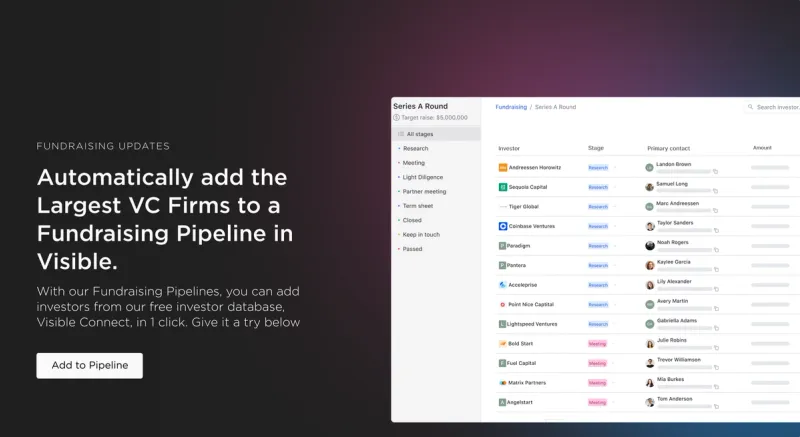
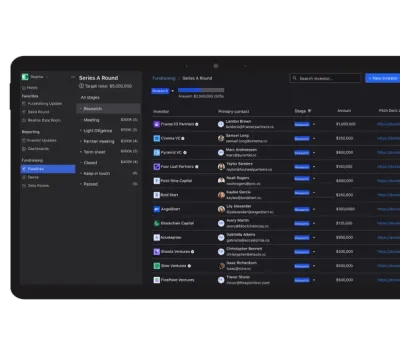
At Visible, we often compare a fundraise to a B2B sales and marketing funnel. At the top of your funnel, you are finding new investors. In the middle, you are nurturing and pitching potential investors. At the bottom of the funnel, you are working through diligence and ideally closing new investors.
With the introduction of data rooms, you can now manage every aspect of your fundraising funnel with Visible.
- Find investors at the top of your funnel with our free investor database, Visible Connect and find a filtered list of investors.
- Track your conversations and move them through your funnel with our Fundraising CRM
- Share your pitch deck and monthly updates with potential investors
- Organize and share your most vital fundraising documents with data rooms
Manage your fundraise from start to finish with Visible. Give it a free try here.
Frequently Asked Questions
What Are the Top 5 Venture Capital Firms in 2026?
The top 5 venture capital firms in 2026, ranked by a composite of AUM, fund size, and exit track record, are Andreessen Horowitz, Sequoia Capital, Insight Partners, General Catalyst, and Thrive Capital. Andreessen Horowitz leads with $90 billion+ in AUM after its $15 billion January 2026 raise, tied with Sequoia Capital at approximately the same scale. Insight Partners, General Catalyst, and Thrive Capital round out the top five, with Thrive's position elevated by the 2026 close of its $10 billion Thrive X fund.
What Is the Largest Venture Capital Firm in the World?
Andreessen Horowitz and Sequoia Capital are tied as the largest venture capital firms in the world in 2026, each managing approximately $90 billion in assets under management. Andreessen Horowitz's January 2026 $15 billion fundraise accounted for over 18% of all venture capital dollars allocated in the United States in 2025, putting the firm neck and neck with Sequoia at the top of the global ranking. Insight Partners also manages $90 billion+, bundling venture, growth equity, and credit strategies.
Who Are the Top 10 Venture Capital Firms?
The top 10 venture capital firms in 2026 are Andreessen Horowitz, Sequoia Capital, Insight Partners, General Catalyst, Thrive Capital, New Enterprise Associates (NEA), Tiger Global Management, Lightspeed Venture Partners, Accel, and Peak XV Partners. These ten firms collectively manage over $400 billion in committed capital and lead rounds across seed, early, and growth stages. Peak XV Partners, formerly Sequoia Capital India and Southeast Asia, operates independently from U.S. Sequoia since the 2024 split and manages $9 billion in AUM across 13 funds.
What Are the Largest Venture Capital Firms in Europe?
The largest venture capital firms in Europe in 2026 are Index Ventures, Atomico, HV Capital, Northzone, Balderton Capital, and EQT Ventures. Atomico manages $4.7 billion in AUM, while HV Capital oversees €2.8 billion across 225+ portfolio companies from its Munich headquarters. European venture capital AUM reached approximately $95 billion across the continent, with London anchoring $45 billion of that total and Germany, France, and the Nordics making up most of the remainder.
What Is a Tier 1 VC Firm?
A Tier 1 VC firm is a venture capital firm with durable scale, proven exit track record, and gravitational pull on downstream investors. Tier 1 firms typically manage $10 billion+ in committed capital, raise new flagship funds every two to three years, and lead first institutional rounds across seed, early, and growth stages. The designation is reputational rather than regulatory, which is why rankings differ across sources; the most defensible framework combines AUM, the size of the latest flagship fund, deployment velocity, and exit track record (including DPI and unicorn count).
Who Are the Top Venture Capital Firms for Technology Startups?
The top venture capital firms for technology startups in 2026 are Andreessen Horowitz, Sequoia Capital, Lightspeed Venture Partners, General Catalyst, Accel, Kleiner Perkins, and Founders Fund. All seven firms lead rounds across AI, enterprise software, and defense technology at seed through growth stages. Lightspeed has backed more than 165 AI-native companies and committed over $5.5 billion to the category since 2012, making it the most concentrated AI investor among the mega-funds, while Founders Fund remains the first call for defense and aerospace founders.