









Key Takeaways
- Proactive risk mitigation: Memos force you to identify internal threats and outline exact solutions before an investment committee can question your viability.
- Due diligence alignment: The claims you make in your document must perfectly mirror the financial models and contracts securely hosted by your virtual data room providers.
- Pricing realities: Founders frequently overpay for enterprise diligence tools, but startup-focused virtual data room providers should cost between $20 and $200 per month.
- Traction over vision: Institutional investors ignore subjective excitement and instead demand mathematical proof like customer acquisition cost and net retention rate.
- Systematized data workflows: Centralizing your narrative and metrics prevents version control issues and ensures your team shares one reliable source of truth throughout the fundraise.
An investment memo is your opportunity to control the narrative. Whether you are preparing for a pitch, answering investor diligence questions, or aligning your internal team, a well-structured memo builds conviction and saves everyone time.
You don't need to start from a blank page. Below is a free, VC-ready investment memo template you can copy, download, and use immediately to streamline your fundraising prep.
Free Investment Memo Template
Use this foundational structure to draft your memo. You can copy the fill-in-the-blank text below directly into your preferred document editor to get started immediately.
1. Executive Summary
- Company: [Company Name]
- The Ask: Raising a $[Amount] [Round Name] round at a $[Valuation] valuation.
- The Pitch: [Company Name] is building [Product/Solution] for [Target Customer] to solve [Core Pain Point]. We recommend this investment because [Core Reason/Traction].
2. Company Overview
- Founded: [Year]
- Team: Led by [Founder Names/Backgrounds].
- Stage: [Current stage of product development, e.g., Post-revenue, Beta, etc.]
3. Problem & Market Opportunity
- The Problem: [Target Audience] struggles with [Specific Pain Point], which costs them [Time/Money/Resources].
- Market Size: TAM is $[Amount], SAM is $[Amount], and SOM is $[Amount].
4. Product & Solution
- How it Works: [1–2 sentences explaining the mechanism of the product].
- Key Differentiator: Unlike the status quo, we [Unique value proposition].
5. Business Model
- Revenue Streams: [e.g., SaaS subscription, transaction fee].
- Pricing: [Price point] per [Unit/User/Month].
6. Traction & Key Metrics
- Revenue/Users: $[Amount] MRR / [Number] Active Users.
- Growth Rate: Growing at [Percentage]% MoM.
- Key Logos: [Customer 1], [Customer 2].
7. Competitive Landscape
- Direct Competitors: [Competitor A], [Competitor B].
- Our Edge: [Why your moat protects your market share].
8. Go-To-Market Strategy
- Primary Channels: [e.g., Inbound SEO, Outbound Enterprise Sales].
- CAC / LTV: $[Amount] CAC / $[Amount] LTV.
9. Financials & Projections
- Runway: This round provides [Number] months of runway.
- Goal: Will get the company to $[Amount] ARR by [Date].
10. Risks & Mitigations
- Risk: [Identify the biggest threat to the business].
- Mitigation: [How you are proactively solving it].
11. Investment Recommendation
- Why Now: [The specific catalyst making this the right time to invest].
What Is an Investment Memo?
An investment memo is a structured document used to evaluate a startup's viability and justify a funding decision. It translates the excitement of a pitch deck into an objective, data-backed narrative covering the market, business model, traction, and risks.
Before diving into how to write an investment memo (or learning how to write an investment note for smaller, faster deals), it helps to know who uses them and why:
- Founders: To clarify their narrative, stress-test their business model, and proactively answer deep diligence questions before investors even ask.
- Venture Capitalists (VCs): To summarize a deal for their Investment Committee (IC) to secure final approval for deploying capital.
- Angel Investors: To organize their thoughts and share deal flow opportunities with syndicates.
At its core, the memo shifts the conversation from pitching a vision to proving a business case.
Investment Memo Template (Step-by-Step Structure)
Whether you need a simple investment memo template or a comprehensive VC-grade document, the foundational elements remain the same. Here is the step-by-step breakdown of exactly what to include in each section of your memo.
1. Executive Summary
This is the most critical part of the document. State the company name, the core problem it solves, the size of the round, and the ultimate recommendation.
- Prompt: Why should someone invest in 30 seconds?
- Example Snippet: "We recommend a $2M Seed investment in [Company]. They are tackling a $5B market in [Industry] with a product that reduces [Pain Point] by 40%. With $50k MRR and a highly technical founding team, this is an opportunity to lead a rapidly growing category."
2. Company Overview
Briefly explain the founding story, the core team’s background, and what the product does today. Investors care most about "founder-market fit" why is this specific team uniquely qualified to build this company?
3. Problem & Market Opportunity
Define the specific, urgent problem your target audience faces. Then, quantify the market opportunity using the TAM/SAM/SOM framework (Total Addressable Market, Serviceable Available Market, Serviceable Obtainable Market). Focus on why this problem is big enough to generate venture-scale returns.
4. Product & Solution
Explain how your product uniquely solves the problem outlined above. Avoid deep technical jargon; focus instead on the user experience, core features, and key differentiators that make your solution superior to the status quo.
5. Business Model
Detail exactly how the company makes money. Outline your revenue streams, pricing strategy, and average contract value (ACV). If applicable, mention key unit economics like Customer Acquisition Cost (CAC) and Lifetime Value (LTV).
6. Traction & Key Metrics
This section provides the hard proof that your solution works. Highlight revenue growth, active usage, retention rates, and notable customer logos.
7. Competitive Landscape
List your direct and indirect competitors. Do not pretend you have no competition. Instead, use a simple matrix or bulleted list to show your strategic positioning and why your moat will defend your market share.
8. Go-To-Market Strategy
How are you acquiring customers? Outline your primary acquisition channels (e.g., inbound content, outbound enterprise sales, partnerships) and your overarching strategy for scaling growth efficiently.
9. Financials & Projections
Provide a snapshot of historical financials (if applicable) and forward-looking revenue forecasts for the next 3–5 years. Be prepared to back up the key assumptions driving these projections.
10. Risks & Mitigations
The best memos are intellectually honest. Identify the 2–3 biggest risks to the business (e.g., regulatory changes, dominant competitors, platform reliance) and explicitly state how the team plans to mitigate them.
11. Investment Recommendation
Conclude with a definitive stance. Reiterate the final decision (or the ask, if you are the founder) and emphasize "Why now." What is the compelling catalyst that makes this the exact right time to invest?
VC Investment Memo Example
To write a strong document, it helps to see what "good" looks like. Whether you are generating a VC investment memo template for your team or looking for a VC investment memo PDF to model your own after, seeing a completed example brings the framework to life.
Below is a condensed, realistic example of an investment memo for a fictional B2B SaaS startup.
Company: NexusFlow (Seed Round)
Author: Deal Lead
Date: October 12, 2026
1. Executive Summary > We recommend a $2.5M Seed investment in NexusFlow at a $12M post-money valuation. NexusFlow is building an automated compliance workspace for fintechs. They have reached $60k MRR in 8 months, growing 15% MoM, with a highly technical team previously from Stripe.
Why this works: It gets straight to the point. In three sentences, the reader knows the ask, the product, the traction, and the team's pedigree.
2. Problem & Market > Fintechs spend an average of 40 hours a week manually reconciling compliance logs. The TAM for financial compliance software is $8B, driven by tightening global regulations.
Why this works: The pain point is quantified (40 hours), and the market size is explicitly stated.
3. Solution & Traction > NexusFlow integrates directly with banking APIs to automate log reconciliation. Since launch, they have onboarded 12 mid-market fintechs, achieving 130% Net Retention Rate (NRR) and a CAC payback period of just 4 months.
Why this works: It focuses on hard data. NRR and CAC payback are the exact metrics a VC wants to see to validate product-market fit.
4. Risks & Mitigations > Risk: High reliance on changing API structures of legacy banks.
Mitigation: NexusFlow has built a proprietary abstraction layer that normalizes data regardless of downstream bank changes, insulating them from API breaks.
Why this works: It shows intellectual honesty and proves the founders are proactively managing threats.
One-Page and Simple Investment Memo Templates
Not every situation requires a 10-page document. Depending on your audience and the stage of your raise, a shorter format is often more effective.
One-Page Investment Memo Template
A one-page investment memo template strips the narrative down to its absolute core. It is highly visual and relies heavily on bullet points.
- When to use it: Early-stage rounds (Pre-Seed/Seed), quick internal IC reviews, or as a "teaser" document sent ahead of a pitch deck.
- Core sections: Executive Summary, Problem/Solution, Key Metrics, Ask/Terms.
Simple Investment Memo Template
A simple investment memo template acts as an internal structuring tool. It provides a minimal framework for founders to get their thoughts out of their heads and onto paper.
- When to use it: When founders are preparing for a fundraise and need to align on the core narrative before building the financial model or pitch deck.
- Core sections: The Team, The Market, The Product, The Plan.
How to Write a Great Investment Memo
Knowing how to write an investment memo, or how to write a good investment memo that actually moves the needle, comes down to process and clarity.
Step-by-Step Process
- Gather your data: Before writing a single word, assemble your historical financials, customer metrics, and market research.
- Structure the narrative: Use the templates above to outline your document. The story should flow logically from the problem to the solution, and finally to the financial upside.
- Validate assumptions: Ensure every forward-looking statement (like market capture or revenue projections) is backed by a defensible assumption.
- Refine for clarity: Edit ruthlessly. Cut buzzwords, shorten paragraphs, and use bullet points to make the document highly skimmable.
What Investors Look For in an Investment Memo
When an investor or IC reads your memo, they are scanning for four specific signals:
- Clarity of problem: Do you understand the customer's pain better than anyone else?
- Strength of team: Do you have the domain expertise to execute?
- Evidence of traction: Are customers willing to pay for this, and do they stick around?
- Risk awareness: Are you realistic about the threats to your business?
Common Mistakes to Avoid
- Too much fluff: Avoid adjectives like "revolutionary" or "disruptive." Let the data speak for itself.
- Lack of data: A memo without hard numbers is just an opinion. Support your claims with metrics.
- Weak differentiation: Saying "we are better" isn't enough. Explain how your product creates an economic or structural moat.
- Overly optimistic projections: Forecasting a jump from $1M to $100M in revenue in 12 months damages your credibility. Keep projections aggressive but mathematically possible.
When to Use an Investment Memo (and Why It Matters)
Founders often wonder if they should spend time writing a memo when they already have a pitch deck. The answer is yes. A memo serves a fundamentally different purpose in the fundraising lifecycle.
Here is when a well-crafted memo is most critical:
- Before investor meetings: Writing a memo forces internal alignment. It highlights holes in your logic before an investor can point them out.
- During due diligence: When a firm wants to dig deeper, handing them a comprehensive, data-backed memo saves weeks of back-and-forth Q&A.
- For IC decision-making: VCs write their own memos for their Investment Committees. By providing a founder-written memo, you give your deal champion the exact narrative and data they need to advocate for you behind closed doors.
Investment Memo vs Pitch Deck
While they cover similar topics, pitch decks and investment memos are distinct tools used at different stages of the funnel.
- The Pitch Deck (The "Hook"): A highly visual, 10–15 slide presentation used to generate excitement and secure an initial meeting. It focuses on the high-level vision, the size of the opportunity, and the story. [Link: See Pitch Deck Templates]
- The Investment Memo (The "Proof"): A text-heavy, deeply analytical document used during due diligence. It strips away the visual polish and focuses entirely on the mechanics of the business, financial models, and risk mitigation.
They complement each other perfectly. The deck wins the meeting; the memo wins the check.
Turn This Template Into a Repeatable Investment Workflow
Starting with a template is the fastest way to get your thoughts on paper, but static documents have limits when you are in the middle of an active fundraise.
[Insert MCP Screenshot Here]
The Limitation of Static Templates
- Data becomes outdated: As MRR grows or new customers sign on, you have to manually update numbers across multiple versions of the same document.
- Collaboration is messy: Emailing Word docs or PDFs back and forth with co-founders or lead investors leads to version control issues.
- Hard to reuse: Moving from Seed to Series A requires rewriting everything from scratch if your data isn't structured.
What a Better System Looks Like
A highly efficient fundraising process relies on a centralized system where data, narrative, and investor updates live in one place. A structured system allows for real-time updates, secure collaboration, and the ability to turn a one-time memo into an evergreen company overview.
How Platforms Like Visible Help
Instead of managing your fundraise across different tools, Visible is all-in-one:
- Structured Templates: Move beyond blank pages and build memos using proven, repeatable frameworks.
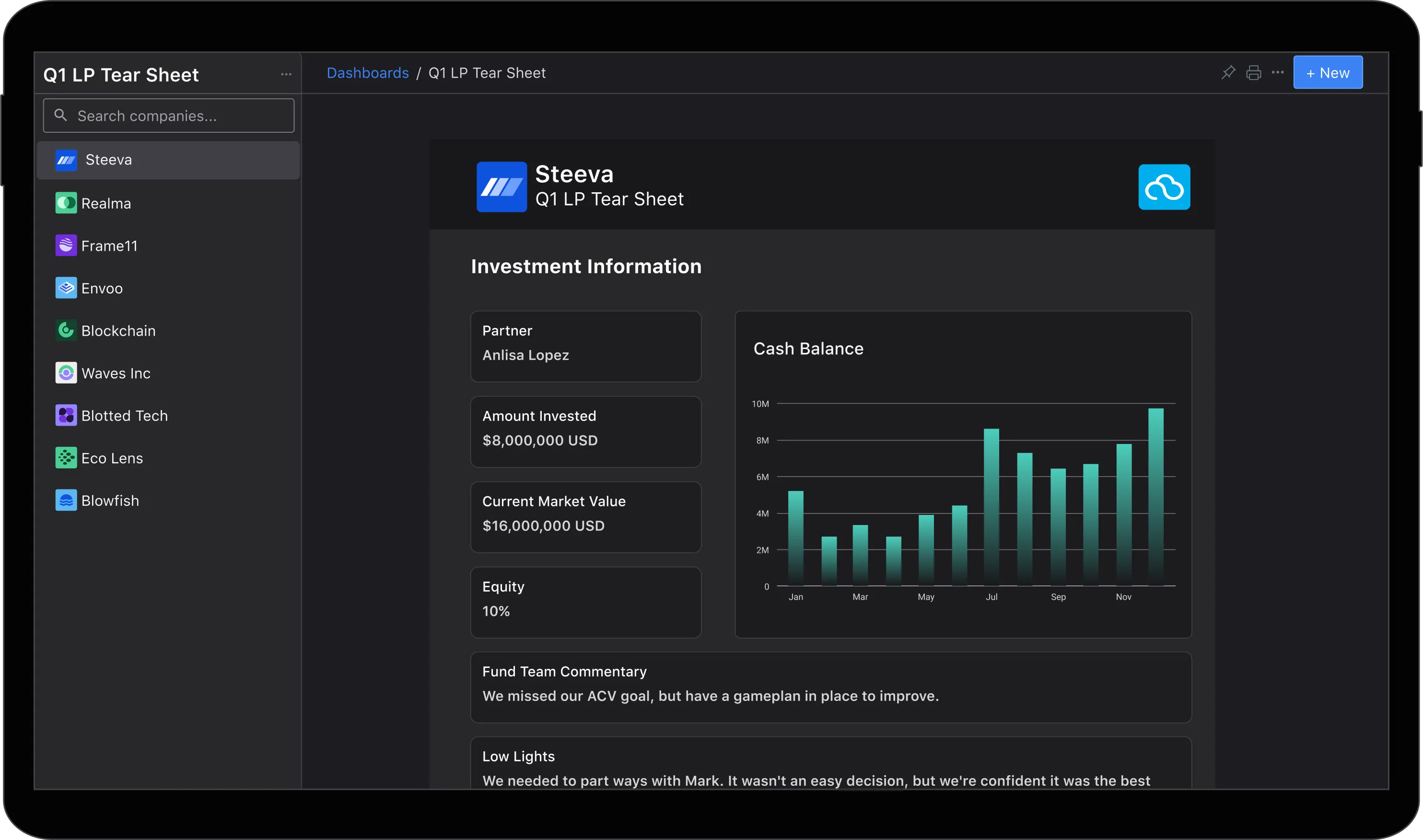
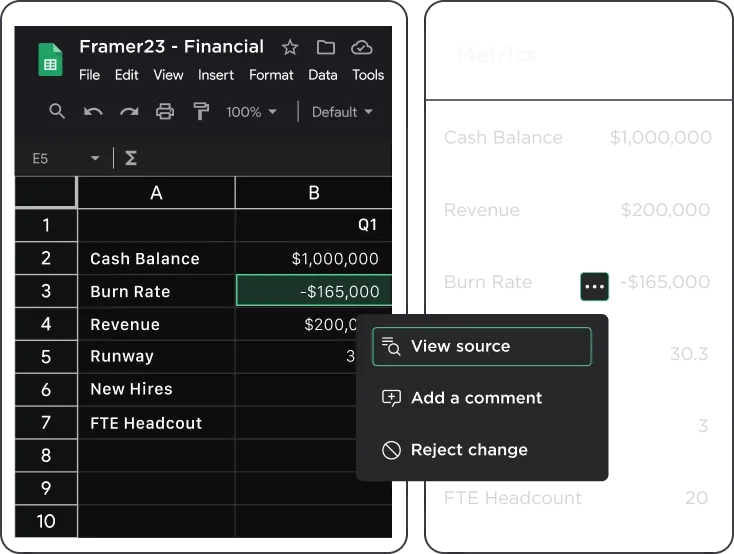
- Centralized Metrics: Pull live data directly into your reporting, ensuring investors always see the most accurate numbers without manual entry.
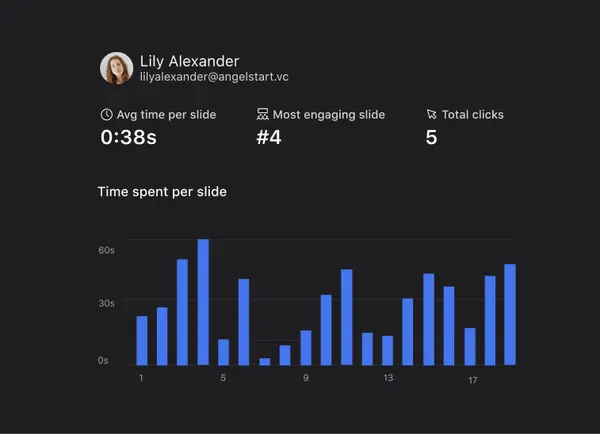
- Shared Workspaces: Securely share memos, data rooms, and updates from a single platform, giving you visibility into who is engaging with your materials.
Use the YC Series A Investment Memo Template
If you are raising a Series A or want to model your document after one of the most successful accelerators in the world, we recommend starting with a proven framework.
Why This Template Works
The Y Combinator framework is designed for high-quality decision-making. It cuts through the noise and focuses strictly on the metrics, market dynamics, and team capabilities that top-tier VCs require to write a Series A check.
How to Use It
- For fundraising preparation: Stress-test your business model before you take your first Series A meeting.
- For internal clarity: Align your executive team on the exact narrative you are taking to market.
- For investor communication: Share a structured, highly professional brief with your lead investors.
Access the Template
For the best results, this template is best used within a structured system where it can be reused, updated, and securely shared over time.
Frequently Asked Questions
What is the difference between an investment memo and a pitch deck?
A pitch deck is a visual presentation designed to capture interest and secure an initial meeting, whereas an investment memo is a highly analytical, text-based document used by institutional investors to validate claims during due diligence.
- Pitch decks prioritize high-level vision, market opportunity, and narrative hooking to win the first conversation.
- Investment memos provide mathematical proof, outlining unit economics, retention rates, and customer acquisition costs.
- Decks win the initial meeting, but structured, data-backed memos win final investment committee approval.
When should a startup founder share an investment memo with investors?
You should distribute your investment memo immediately after a successful initial pitch, right as the investor transitions into the formal due diligence phase to accelerate their internal review and secure committee alignment.
- Distribute the memo alongside access to your virtual data room providers to create a frictionless review workflow.
- Provide the document to your deal champion so they can effectively defend your metrics to their internal committee.
- Avoid sending the memo cold; rely on the pitch deck first to establish the relationship and core value proposition.
How long should a standard VC investment memo be?
A highly effective investment memo runs between three to five pages, focusing entirely on dense, data-backed insights and unit economics rather than repeating the aspirational vision found in your initial deck.
- Pre-seed and seed rounds often require only a single-page brief covering early traction and market sizing.
- Series A and B memos demand deeper multi-page analysis on competitive moats and historical financial models.
- Format your document for scannability by utilizing bulleted lists, bolded key metrics, and strict paragraph limits.
Why must founders include business risks in an investment memo?
Explicitly identifying business risks demonstrates intellectual honesty and proves to institutional investors that you have the operational maturity to anticipate and systematically mitigate existential threats before they impact capital efficiency.
- Institutional investors will inevitably discover vulnerabilities during diligence; disclosing them first allows you to control the narrative.
- Pair every listed risk with a proactive, data-backed mitigation strategy your team is already actively executing.
- Focus on structural risks like regulatory shifts or platform dependencies rather than generic execution fears.
How often should you update an investment memo during a fundraise?
You must treat your memo as a living document, updating your core metrics, customer logos, and financial projections weekly to ensure active investors always review the most accurate, real-time data.
- Stale revenue numbers or outdated retention metrics can instantly stall momentum during a critical diligence review.
- Utilize centralized investor relations platforms to push synchronized updates without managing messy email attachments or version control issues.
- Sync your memo’s claims directly with the underlying financial models and contracts hosted in your data room.