
Key Takeaways
- EdTech funding has stabilized at a projected 214 billion dollars for 2026 as investors move away from experimental pilots toward capital-efficient platforms with proven net revenue retention.
- The industry is currently facing the Efficacy Reckoning where founders must provide specific evidence of pedagogical impact and logic models to avoid significant valuation discounts during due diligence.
- Agentic AI is replacing standard generative tools by executing autonomous multi-step workflows like personalized interventions and administrative reporting that can reduce institutional labor costs by over 30%.
- Compliance is a mandatory growth engine in 2026 due to the April 24 deadline for ADA Title II and COPPA 2.0 standards that require all digital learning tools to meet strict accessibility and privacy criteria.
- Interoperability has transitioned from a technical preference to a procurement requirement as school districts prioritize LTI 1.3 standards to ensure seamless integration and secure data flows across their ecosystems.
What is the state of EdTech funding and innovation in 2026?
In 2026, the Education Technology (EdTech) sector has shifted from remote access toward Outcome-Based Intelligence. While 2023 was defined by a funding correction, the current market is characterized by the Efficacy Reckoning. Investors now prioritize platforms that leverage Agentic AI to solve the student-teacher ratio gap and provide verifiable proof of learning impact.
Market Snapshot: EdTech in 2026
Is EdTech still a growing market? Yes. The global EdTech market reached a valuation of 189.15 billion dollars in 2025 and is projected to hit 214.58 billion dollars in 2026. Success for modern founders depends on demonstrating Pedagogical Efficacy and Verifiable Skill Acquisition rather than platform reach or simple user engagement metrics.
VCs Investing in the EdTech Space
1. NewSchools Venture Fund

About: “NewSchools Venture Fund is a is a national nonprofit venture philanthropy working to reimagine public education. Since our founding, in 1998, we have invested nearly $200 million in 200 education ventures. Our investments were instrumental in the creation of nearly 470 new schools with the potential to serve more than 200,000 students, and the development of ed tech products that serve more than 60 million students and their teachers.”
Thesis: “We are the first venture philanthropy focused on K-12 education. As a nonprofit and intermediary funder, we raise charitable donations and then grant those funds to early-stage entrepreneurs who are reimagining public education. While we have a rigorous investment process, we seek educational and social returns, not financial ones.”
Stage: Pre-Seed, Seed, Series A, Growth
EdTech Notable Investments: ClassDojo, Handshake, and Uncommon Schools.
2. EduCapital

About: The largest European Edtech & Future of Work VC. Educapital invest’s in innovative European companies with the highest potential to scale and become European and global leaders.
Thesis: We invest in Entrepreneurs shaping the future of education & future of work.
Stage: Seed, Series A, Series b, Growth
EdTech Lastest Investments: Tomorrow University of Applied Sciences, Edflex, Lunii
3. Bonsal Capital

About: We support tech-enabled, mission-driven startups and funds and leverage our experience as educators, venture capitalists, and ecosystem leaders to empower you to find the resources you need, so you can better serve your end user and customer.
Thesis: Bonsal Capital is a mission-driven partnership, and supporting education has been a core driver since our founding in 1999. With decades of experience in education as investors, practitioners, and volunteers, our principals have authentically grown a partnership that seeks founders and leaders who want to make a positive impact with a product and/or service, and who keep prospective scale and sustainability at the forefront. We support the growth of companies focused on tech-enabled services in education, and we have invested in and partnered with more than 20 such companies over the past two decades, providing human and financial capital, as well as other resources, that have made a positive impact on tens of millions of end users. We believe that, by fostering education, we can make the world a better place and feel good about our place in it.
Stage: Seed, Series A, Growth
EdTech Notable Investments: Upswing, Nepris, and Everyday Labs
4. Learn Capital

About: LearnCapital is a venture capital firm focused exclusively on funding entrepreneurs with a vision for better and smarter learning.
Thesis: “We back and build rapidly scaling tech-enabled companies that tackle the world’s biggest human-centered problems and help us all reach our full potential.”
Stage: Seed, Series A, Growth
EdTech Notable Investments: Udemy, Coursera, and Chegg.
5. Emerge Education

About: LearnCapital is a venture capital firm focused exclusively on funding entrepreneurs with a vision for better and smarter learning.
Stage: Pre-Seed and Seed
EdTech Notable Investments: Tomorrow University of Applied Sciences, Edurino, and Colossyan
6. Owl Ventures

About: “Founded in 2014, Owl Ventures is the largest venture capital firm in the world focused on the education technology market with over $2 billion in assets under management. The Silicon Valley-based firm was purposely built to partner with and help scale the world’s leading education companies across the education spectrum encompassing PreK-12, higher education, future of work (career mobility/professional learning), and “EdTech+” (intersection of EdTech and other major industries such as FinTech and healthcare).”
Thesis: “We believe there is a digital revolution rapidly unfolding in education and workforce development. This revolution is creating a historic opportunity to invest in companies that are disrupting and improving the over $6 trillion global education market. The entire education and training sector is shifting rapidly as access to the internet and connected devices has flourished. Hundreds of millions of students and teachers around the world can now leverage innovative learning platforms.”
Stage: We invest in companies at all stages from seed, early, growth, and later stages, globally.
EdTech Notable Investments: MasterClass, degreed, Khan Academy, Schoology, and Knewton.
7. Reach Capital

About: Reach supports the most promising entrepreneurs developing technology solutions for challenges in early childhood, K-12, and higher education.
Thesis: “Education is a critical engine for economic mobility. Alongside health, wellbeing, career development and healthy relationships, we are interested in all ideas that empower people to learn, grow and succeed — in school, at home, for work … wherever they go.”
Stages: “early, and support you at every stage of your journey”
EdTech Notable Investments: Guild Education, Classcraft, and Merit America.
8. General Catalyst

About: General Catalyst backs exceptional entrepreneurs who are building innovative technology companies and market leading businesses, including Airbnb, BigCommerce, ClassPass, Datalogix, Datto, Demandware, Gusto (fka ZenPayroll), The Honest Company, HubSpot, KAYAK, Oscar, Snap, Stripe, and Warby Parker. The General Catalyst team leverages its broad experience to help founders build extraordinary companies. General Catalyst has offices in Cambridge, MA, Palo Alto, CA and New York City.
Thesis: General Catalyst is a venture capital firm that makes early-stage and growth equity investments.
Stages: Seed, Series A, Series B, Growth
EdTech Notable Investments: Chegg, Coursera, and Udacity.
9. Kapor Capital

About: Kapor Capital invests in early stage gap-closing tech enabled startups.
Thesis: Kapor Capital invests in tech-driven early-stage companies committed to closing gaps of access, opportunity or outcome for low-income communities and/or communities of color in the United States. Stages: Pre- Seed, Seed, Series A, Series B
Where are the high-growth opportunities in EdTech?
The 2026 market is driven by a move from content consumption to Active Learning. The most significant growth is concentrated in two primary sectors: Agentic AI infrastructure and Job-Aligned Workforce Upskilling. In fact, Corporate Training and Skill Development is currently seeing a blistering 44.8% compound annual growth rate through 2030, outpacing traditional K-12 and Higher Education.

The Agentic Pivot: Generative vs. Agentic AI
Founders must distinguish their product from 2023-era wrappers.
- Generative AI (2023-2024): Assists users by creating content (lesson plans, quiz questions, or emails) based on prompts.
- Agentic AI (2025-2026): Acts as a digital teammate by executing multi-step workflows autonomously, identifying a student's skill gap, triggering a personalized intervention, and updating the institutional gradebook without human intervention.
Critical Growth Engines
- Workforce Upskilling & The Flight to Job-Ready: The biggest momentum in EdTech is now found outside traditional classrooms. Employers are actively seeking Simulation-Based Training and Micro-credentials that offer immediate, verifiable skills. Platforms that provide career-connected learning are seeing increased demand as organizations search for ways to upskill staff on emerging technologies like data science and cybersecurity without relying on long-form university programs.
- Compliance-as-a-Feature: A massive, overlooked opportunity exists in the Compliance space. As of April 24, 2026, new mandatory digital accessibility and data privacy standards (COPPA 2.0) are in effect for most K-12 districts and public universities. Startups that offer built-in compliance as part of their infrastructure are winning procurement contracts over point solutions that require manual auditing.
Which technologies are essential for EdTech scalability?
Two Technical Pillars for 2026 Fundraising
- LTI 1.3 & LTI Advantage: School districts now prioritize the LTI 1.3 standard for its OAuth 2.0 security. Implementing LTI Advantage services allows your tool to sync results continuously with an institutional gradebook, reducing administrative friction and making your product sticky.
- Socratic AI Tutors: The market for simple chatbots is saturated. High-growth opportunity lies in tutors that scaffold learning using Multimodal Sensing to detect student confusion. Research indicates these models can reduce time-to-understanding by 31.6%.
How should EdTech founders navigate the New Efficacy Reckoning?
In 2026, the primary hurdle for fundraising is no longer technical capability but accountability. Institutional buyers and VCs now operate under a mandate where every dollar must be justified by measurable outcomes. For founders, this means transitioning from a feature-led roadmap to an evidence-led strategy that can survive the intense scrutiny of a post-stimulus (ESSER) budget environment.
The 2026 Due Diligence Standard
What is the most critical factor in 2026 VC due diligence? The most critical factor is Product-Market-Efficacy Fit. Investors now utilize external learning scientists to audit whether a startup’s Agentic AI actually moves the needle on student mastery or workforce readiness. In early 2026, startups that cannot provide a Logic Model or third-party validation of their educational impact are seeing their valuations discounted by as much as 30% to 50%.
Three Strategic Imperatives for Founders
- Solve for the Procurement Logic: With the expiration of federal ESSER funds, school districts are right-sizing their budgets. To win contracts, you must position your product as a Cost-Saver, not just a Nice-to-Have. Specifically, focus on how your platform automates administrative complexity or replaces multiple fragmented legacy tools. Tool Consolidation is the most successful sales angle for institutional procurement.
- Embed Efficacy into the Daily Operating Loop: Efficacy can no longer be a once-a-year white paper. Modern winners build Tech-Assisted Measurement directly into their platforms. Your dashboard should show administrators real-time signals of student progression, mastery, and engagement. This Continuous Evidence loop is what secures high Net Revenue Retention (NRR), which is the primary metric VCs use to evaluate Series A and B readiness.
- Execute a Flight to Quality Data Strategy: Proprietary Data is your only defensible moat. Founders must secure high-quality, ethically sourced datasets to train their AI models. Investors are increasingly wary of startups that are merely wrappers around third-party LLMs. Proving that you own the feedback loop between your AI's intervention and the student’s improved test score is the key to achieving a premium multiple.
Articulating Unique Value Proposition for EdTech Founders
As the EdTech marketplace starts to rapidly grow and is swarming with innovation, it is crucial for founders to effectively articulate the unique value proposition (UVP) of their startups. Your UVP is essentially the backbone of your business.
Understanding and expressing your UVP is vital, particularly in the EdTech sector. This is because educational institutions, teachers, students, and parents – the primary stakeholders in EdTech – are looking for targeted solutions to specific challenges they face in the educational landscape. Whether it’s improving learning outcomes, enhancing teacher productivity, or increasing education accessibility, the ability to distinctly show how your solution addresses these challenges can make or break your fundraising efforts.
Improving Learning Outcomes
If your EdTech solution can improve learning outcomes, demonstrate this with data from pilot studies or user testimonials, showing how your product increases knowledge retention, improves grades, or develops specific skills. Highlight unique features of your product that facilitate these improved outcomes, such as AI-powered adaptive learning paths or gamified learning experiences.
Enhancing Teacher Productivity
EdTech is not only about students but also about empowering teachers. If your product can enhance teacher productivity, illustrate how it reduces their administrative burden, automates repetitive tasks, or assists in more efficient classroom management. Show how your product can help teachers spend more time doing what they do best—teaching and mentoring students.
Increasing Education Accessibility
In a world increasingly focused on equality and inclusion, EdTech solutions that increase educational accessibility have a powerful appeal. If this is your company’s strength, show how your product helps reach underprivileged communities, accommodates students with special needs, or allows flexible learning for those who can’t attend traditional classes. Concrete examples and stories will help your audience understand the real-world impact of your solution.
Future Outlook: Trends and Predictions in EdTech
The future of EdTech is marked by a landscape of continuous innovation and adaptation. For EdTech founders, staying abreast of these trends and predictions is crucial to developing solutions that meet the evolving needs of learners and educators. By embracing these changes and anticipating future needs, EdTech companies can not only contribute to the advancement of education but also thrive in a dynamic and growing market.
Key Trends Shaping the Future
- Growth in Virtual and Augmented Reality: VR and AR are anticipated to gain more traction in the educational sector. These technologies will provide immersive and interactive learning experiences, making complex concepts more accessible and engaging.
- Rise of Microlearning and Bite-Sized Content: The trend towards microlearning is expected to grow. Short, focused learning sessions that fit into busy schedules are increasingly appealing, especially for continuous adult education and corporate training.
- Focus on Lifelong Learning and Upskilling: As job roles evolve rapidly, there will be a heightened focus on lifelong learning and upskilling. EdTech platforms that cater to professional development and career transitions will likely see increased demand.
- Expansion of Gamification in Education: Gamification will continue to be a key element in engaging learners. By making learning more fun and interactive, EdTech solutions can improve retention and motivation across various age groups and educational contexts.
- Greater Emphasis on Inclusive and Accessible Education: There will be a growing focus on making education more inclusive and accessible. This includes developing solutions for learners with disabilities and those in underserved communities.
Predictions for Growth and Evolution
- Market Expansion: The global EdTech market is projected to continue expanding, driven by technological advancements and the increasing acceptance of digital learning solutions.
- Diversification of EdTech Solutions: Expect to see a broader range of EdTech products catering to different educational needs, including early childhood education, K-12, higher education, and adult learning.
- Integration with Traditional Education Systems: EdTech will increasingly complement and integrate with traditional education systems, bridging gaps and enhancing the overall learning experience.
- Adoption in Emerging Markets: Emerging markets will likely see a surge in EdTech adoption as internet penetration increases and digital devices become more affordable.
- Investment Shifts: While venture capital funding may fluctuate, investment in EdTech is expected to remain strong, with a shift towards more strategic and impact-focused funding.
Resources
- EdTech VC connect profiles in our Fundraising CRM
- From Exploding Topics:
- $30B in government funding available to educators in the US
- Events: SXSW EDU, and Bett Show attract educators, and GSV Ventures hosts their annual ASU + GSV summit
Looking for Investors? Try Visible Today!
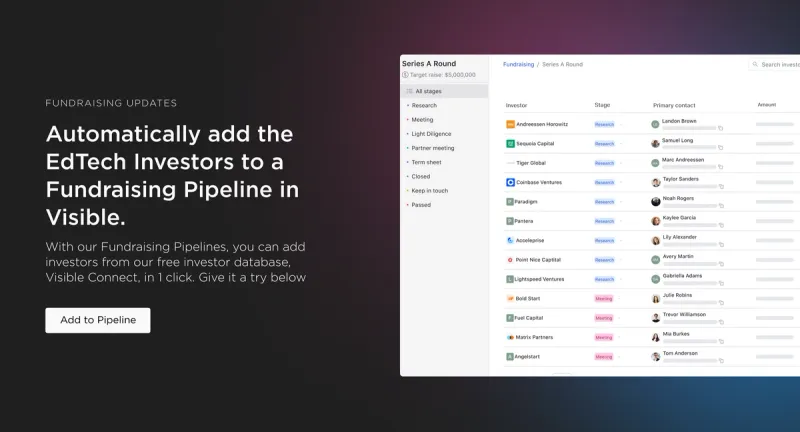
Use Visible to manage every part of your fundraising funnel with investor updates, fundraising pipelines, pitch deck sharing, and data rooms.
Raise capital, update investors, and engage your team from a single platform. Try Visible free for 14 days.
Related Resource: EdTech VC connect profiles in our Fundraising CRM
Frequently Asked Questions
What are the primary EdTech trends for startup founders in 2026?
The dominant EdTech trends in 2026 revolve around The Efficacy Reckoning and Agentic AI. Founders are moving away from passive content delivery toward autonomous "Agentic" systems that manage student feedback and personalization. Additionally, there is a massive shift toward Workforce Upskilling as employers prioritize micro-credentials and simulation-based training over traditional degrees.
How has EdTech venture capital funding changed for early-stage startups in 2026?
EdTech venture capital has stabilized at approximately 12.6 billion dollars globally in 2026. While the era of "mega-rounds" has cooled, Seed and Series A funding remain robust for companies with high Net Revenue Retention (NRR). Investors now prioritize "capital efficiency," favoring startups that demonstrate a clear path to profitability and measurable pedagogical impact.
What is the Efficacy Reckoning in the 2026 EdTech market?
The Efficacy Reckoning is a market-wide shift where institutional buyers and VCs demand verifiable proof that a tool improves learning outcomes. In 2026, simple engagement metrics are insufficient; founders must provide Logic Models or third-party research proving their product increases student mastery or teacher productivity by at least 10% to secure contracts.
What are the mandatory COPPA 2.0 compliance requirements for EdTech in 2026?
As of April 24, 2026, new federal standards under COPPA 2.0 and ADA Title II require all EdTech platforms serving public K-12 districts to have built-in digital accessibility (WCAG 2.1 Level AA) and strict data retention limits. Founders who automate these compliance workflows within their software are seeing significantly faster procurement cycles and lower legal friction.
Why is interoperability and LTI 1.3 essential for EdTech scaling in 2026?
In 2026, LTI 1.3 interoperability is a mandatory requirement for institutional sales. Modern school districts and universities will not purchase "walled garden" platforms. By implementing LTI Advantage standards, founders ensure their tool syncs seamlessly with an institution's Gradebook and LMS, reducing administrative friction and significantly increasing the product's "stickiness" and long-term retention.