
Key Takeaways
-
Treat your data room for investors as a product that proves your operational maturity and accelerates the due diligence process.
-
Discover the optimal folder structure and document checklist required to validate your pitch deck and avoid common red flags like missing IP assignments.
-
Learn why virtual data rooms offer superior security and engagement analytics compared to standard cloud storage solutions.
-
Identify the best data room for startups by prioritizing workflow integration and speed over complex legacy enterprise software.
-
Understand exactly when to share access with investors to maintain leverage and control the narrative until you have serious interest.
The Founder’s Guide to Data Rooms: Mastering Due Diligence
A data room is a secure digital repository where a startup stores confidential documents for potential investors to review during the due diligence process. While the technical definition is simple, the strategic reality is far more complex. In the current fundraising environment, the data room serves as your company's single source of truth. It serves as the final hurdle between a signed term sheet and a bank wire.
Founders often view data rooms as an administrative burden or a compliance checklist. You might rush to populate folders at the last minute or dump disorganized files into a cloud drive, hoping investors will sort through the chaos. This approach is a strategic failure. Your data room functions as a proxy for your operational maturity. A disorganized data room signals a disorganized company. On the other hand, a structured, comprehensive, and readily accessible data room signals that you are disciplined, transparent, and ready to scale.
The importance of a pristine data room has escalated significantly in recent years. The era of loose diligence and capital abundance is effectively over. Investors scrutinize unit economics, legal hygiene, and intellectual property ownership with intense rigor. They look for reasons to say no. A lack of a robust data room gives them an easy excuse to pass on or delay the deal. Friction kills deals. Every time an investor has to ask for a missing document or clarify a discrepancy in your financials, momentum stalls.
You need to treat your data room as a product. It requires a user interface (your folder structure), a user experience (ease of navigation), and a clear value proposition (the narrative your documents tell). When you build this correctly, you accelerate due diligence, reduce the risk of re-trading on valuation, and instill confidence in your future board members. This guide addresses the critical questions founders ask about building, managing, and optimizing data rooms to close rounds faster.
Looking for a deep dive of what to include in your data room? Head here.
Frequently Asked Questions
What is a data room for investors and why is it critical?
A data room for investors is a centralized, secure online location where founders house all documents required for an investor to verify the claims made in a pitch deck. The primary purpose is to facilitate due diligence by enabling investors to audit your company's legal, financial, and operational health without compromising sensitive information.
Investors use the data room to validate your narrative. If your pitch deck claims 200% year-over-year growth, the data room must include the bank statements and profit-and-loss statements that support it. If you claim to have proprietary technology, the data room must hold the patent filings and IP assignment agreements. Beyond verification, it serves as a test of executive competence. Investors assume that the state of your back office reflects the state of your product code and sales operations. A well-organized room reduces the perceived risk of the investment.
How do I create a data room that accelerates the deal process?
You create a data room by systematically collecting, auditing, and organizing your company's core documentation into a tiered folder structure before you even begin fundraising.
Follow this process to build a room that speeds up diligence:
- Audit your existing documentation to identify missing items, such as unsigned Board minutes or expired contracts.
- Select a secure provider that offers document analytics and access controls.
- Establish a clear directory structure that mirrors standard due diligence checklists.
- Convert all proprietary files to read-only PDF formats to prevent editing.
- Upload your files and ensure consistent naming conventions, such as YYYY-MM-DD Document Name.
- Test the viewer experience from an external account to ensure permissions function correctly.
Speed comes from preparation. The most effective founders build their data room continuously as they operate the business, rather than scrambling to assemble it after receiving a term sheet.
What is the best data room for startups at the Seed and Series A stages?
The best data room for startups is one that balances security with speed and user experience. For Seed, Series A, and even Series B rounds, you should prioritize a solution that integrates with your existing fundraising workflow rather than clunky, legacy enterprise software.
Founders often make the mistake of choosing complex "M&A-style" data rooms too early. These tools often introduce friction with cumbersome login requirements and poor mobile experiences. Instead, look for a platform that offers:
- Frictionless Access: Simple link-based sharing with password protection, so investors can view files without jumping through hoops.
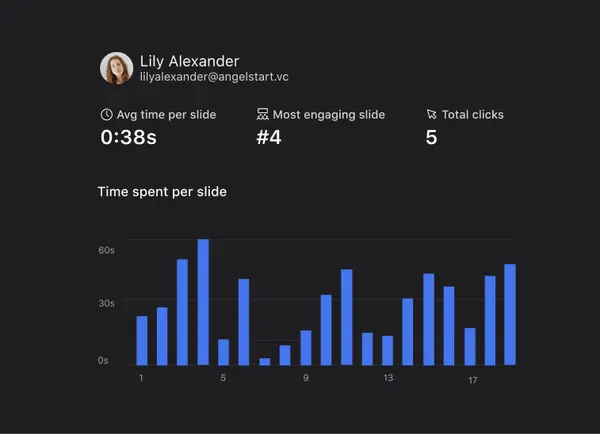
- Engagement Analytics: Detailed tracking that shows you exactly who is viewing your documents and for how long.
- Workflow Integration: The ability to manage your pitch deck, investor updates, and data room in a single hub (like Visible) to keep your data synchronized and your process efficient.
What should be included in data rooms for due diligence?
Data rooms for due diligence must include all material documents that define your company's legal standing, financial history, and intellectual property rights.
Your index should include these core categories:
- Corporate Governance: Articles of Incorporation, Bylaws, Board Meeting Minutes, and the capitalization table.
- Financials: Historical Profit and Loss statements, Balance Sheets, Cash Flow statements, and your forward-looking financial model.
- Intellectual Property: Patents, trademarks, open-source code usage policies, and proprietary algorithms documentation.
- Team and HR: Standard employment agreements, IP assignment agreements for all staff and contractors, and the current organizational chart.
- Legal and Contracts: Material customer contracts, partnership agreements, lease agreements, and any active or past litigation records.
- Compliance: Data privacy policies, security audits (SOC2), and regulatory permits.
How do virtual data rooms differ from standard cloud storage like Google Drive?
Virtual data rooms differ from standard cloud storage by offering advanced security protocols, granular permission settings, and detailed activity tracking designed specifically for high-stakes transactions.
Standard cloud storage focuses on collaboration and file editing. A virtual data room focuses on security and access control. In a standard drive, sharing a folder often gives the recipient the ability to download, print, or edit files. In an actual data room environment, you can restrict downloading, watermark pages with the viewer's email address to prevent leaks, and expire access after a set date. Furthermore, virtual data rooms provide audit logs that show exactly which investor viewed which document and when. This behavioral data helps you gauge investor interest and anticipate their concerns before they even ask a question.
How should a data room startup folder structure be organized?
A data room startup folder structure should be organized logically by function, using a numbered hierarchy to keep folders in a specific order.
Organize your root directory as follows:
- Corporate Formation and Legal
- Financials and Tax
- Intellectual Property and Technology
- Human Resources and Employees
- Material Agreements and Contracts
- Sales and Marketing
- Board and Investor Reporting
- Regulatory and Compliance
Within these parent folders, use sub-folders to separate years or specific categories. For example, under Financials, you might have sub-folders for 2023, 2024, and 2025 YTD. This rigid structure prevents investors from getting lost and reduces the cognitive load required to review your company. A clean structure implies a clean operation.
What are common red flags investors look for in a data room?
Investors look for inconsistencies between the data room and the pitch deck, missing IP assignments, and messy financial records.
Specific red flags include:
- Unsigned Contracts: Key employee agreements or customer contracts that lack signatures are legally void and represent a major risk.
- Cap Table Discrepancies: If the math on your fully diluted share count does not align with your legal filings, the deal halts immediately.
- Missing IP Assignments: Everyone who has ever touched your code or product must have signed an agreement assigning their work to the company. If this is missing for a co-founder or early contractor, the company may not own its own product.
- Inconsistent Financials: If your deck says you have 1 million ARR, but your bank deposits show 800k, you lose credibility instantly.
- Litigation Risks: Hiding a lawsuit or a threatening legal letter is worse than disclosing it. Transparency allows you to control the narrative; discovery during diligence destroys trust.
When is the right time to share the data room with investors?
You should share the data room only after you have established a serious interest from an investor, typically after the second or third meeting.
Sharing the data room too early can be detrimental. It allows investors to find reasons to say no before they have fallen in love with the vision. Your goal is to sell the dream first, then back it up with data in the data room. Start by sharing your pitch deck via a trackable link. Once a partner indicates they are bringing the deal to their partnership meeting or explicitly asks for access to begin diligence, you grant them access. You may also choose to use a staged data room approach, where you provide a light version initially and open up the full, comprehensive room only after a term sheet is signed or heavily negotiated.