
Board meetings require a specific kind of preparation: quantitative and qualitative, backward-looking and forward-facing, company-specific and market-aware. Getting there means pulling revenue data, reading through the deck the founder shared, understanding churn trends, sizing up the runway, and doing enough market research to understand the market landscape and how the company stacks up against peers.
Most of that work is manual. It involves opening dashboards, cross-referencing data, rereading update threads, and doing research you probably won't have time for the morning of. The result is that even well-prepared investors sometimes walk in missing context they should have.
Visible's MCP server changes that. By connecting your AI tool directly to your live Visible data, you can run the entire pre-meeting research process in minutes, not hours. Learn how to leverage our MCP Server to prep for your next board meeting below:
Before You Start: Getting the Deck Into Visible
The workflow in this guide starts with one important step: importing the board deck into Visible using the AI Inbox. When a founder shares a deck ahead of the meeting, run it through the AI Inbox - Visible will parse the document, extract key metrics, highlights, and lowlights, and save that information directly to the company's profile.
Once that's done, the MCP server can query it alongside all of your structured metric data. The qualitative context from the deck and the quantitative data from your portfolio live in the same place, and your AI tool can work across both at once.
Prepping for Your Next Board Meeting With Our MCP Server
If you need help setting up the Visible MCP Server, head here or reach out to your account manager.
Step 1: Revenue performance against targets
The prompt
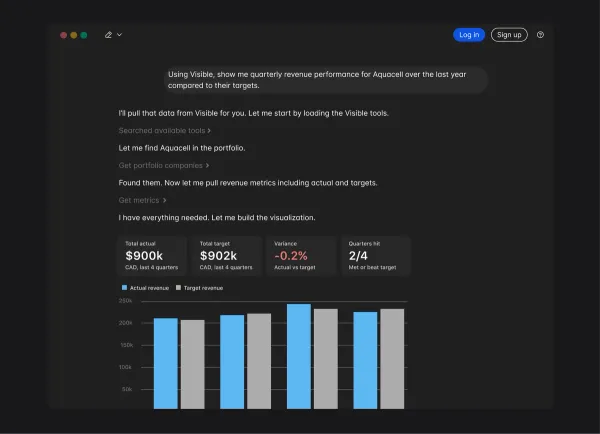
"Using Visible, show me quarterly revenue performance for AquaCell over the last year compared to their targets."
What it returns
The response gives you a full quarter-by-quarter revenue breakdown, along with target figures, sourced directly from the founder's submission.
Why it matters
A material miss, an unexpected win, a shift in pipeline. Whatever stands out, surfacing it clearly before the meeting means you arrive with a specific question ready: what drove it, and is it structural or one-time? That's a much more productive starting point.
Step 2: Highlights and challenges from the board deck
The prompt
"Based on the most recent board update from AquaCell, what were their key highlights and challenges?"
What it returns
Because the board deck was already imported via the AI Inbox, this query pulls directly from the founder's own narrative - not a summary you wrote, not a stale note from a prior update. The response surfaces the qualitative picture alongside the numbers.
Why it matters
The qualitative layer is often where the real signal sits. A founder's framing of a result, a flagged risk, or a shift they're watching; these are the threads worth pulling on before the meeting. They become agenda items you can prepare for specifically, rather than topics you discover in the room
Step 3: Churn trends and what they mean for retention
The prompt
"What do churn trends look like over the last several quarters for AquaCell, and what does it mean for their gross dollar retention?"
What it returns
This query pulls churn data across multiple quarters and contextualizes it against ARR.
Why it matters
Trends say more than snapshots. Churn viewed across quarters and weighed against ARR gives you the shape of the problem, not just the size of it, and surfaces the questions worth asking: what's the retention playbook, and when should results show up? These are easy to let slide in a board meeting without specific data in front of you. Now you can ask them directly.
Step 4: Runway and fundraise timing
The prompt
"Based on the current cash balance, burn rate, and their plan to raise a Series A, how much runway does AquaCell have, and when do they need to start the process?"
What it returns
The response draws from the most recent metrics submitted by the founder.
Why it matters
The runway number is one thing. The timing implication is the more important output. When the math points to a decision that needs to happen soon, that's not a future agenda item, it needs to be brought up in the board meeting. Walking in with the numbers already worked through means you can drive the conversation, not react to it.
Step 5: Benchmarking against comparable companies
The prompt
"Based on current revenue, team size, ARR, and fundraising stage, how does AquaCell compare to other early-stage water technology and renewable infrastructure companies at a similar point in their journey?"
What it returns
This is where the MCP server does something genuinely different. It combines two sources in a single query: the company’s live data from Visible - ARR, quarterly revenue, team size, fundraising stage - and publicly available information about comparable companies in the same sector and stage.
The result is a real benchmarking output: how does the company’s ARR growth rate compare to peers at a similar stage? Is the team size consistent with other similar companies? How does their fundraising timeline align with others who have gone through a similar process?
Why it matters
This is the kind of context founders expect their investors to bring to the table. It demonstrates that your team has done the work beyond what's in the deck, and it gives the board conversation a frame of reference that goes beyond internal metrics alone. Historically, it's also been the most time-intensive research to do manually, but the MCP server changes that.
Get the Full Picture in Minutes
Here's what this workflow produces before a single slide is opened in the meeting room:
- A clear view of revenue performance vs. targets, with the variance quantified
- Qualitative context pulled directly from the founder's deck - highlights, challenges, and explanations
- Churn analysis with retention implications and a specific question to raise
- A runway calculation with timing for the next fundraise already worked out
- A market benchmarking snapshot that positions the company against comparable peers
That's the full pre-meeting picture - quantitative and qualitative, internal and market-facing - without exporting a spreadsheet, cross-referencing dashboards, or spending a morning on research.
The board deck came in through the AI Inbox. The metrics live in Visible. The MCP server connects it all, so your AI tool can answer direct questions across both at once.
Start Walking Into Board Meetings Fully Prepared
Your portfolio data is already in Visible. The MCP server connects it to the AI tools you use every day, so the research that used to take hours takes minutes instead.