
Key Takeaways
-
Global venture capital deployment is projected to reach 400 billion in 2026 with a specific focus on high conviction technology leaders.
-
AI-native startups currently command a 42 percent valuation premium over traditional software companies, as investors prioritize proprietary data moats.
-
Success with the Best Tech VC Firms now requires a transition from generalist copilot tools to agentic workflows that replace legacy seat-based revenue models.
-
Tech sovereignty and regional infrastructure projects in Europe and the Middle East are creating localized funding advantages for founders in deep tech and defense.
The 2026 tech fundraising landscape is defined by a flight to quality, where AI-native execution and proprietary data moats command a 42% valuation premium. To secure funding, tech founders must pivot from raw model experimentation to demonstrating agentic workflows. This guide identifies the top 15 tech VC firms and the strategic execution layers needed to win in an era of capital concentration.
For technology founders, 2026 represents a selection cycle where global VC deployment is projected to hit $400 billion, yet deal counts remain low as investors consolidate capital into high-conviction tech leaders. The barrier to entry has shifted from discovery to deployment, with a specific focus on full-stack AI-native firms and startups solving physical bottlenecks in robotics and industrial automation. Founders must now articulate how their tech stack bypasses manual workflows rather than merely assisting them.
Valuations in the tech sector are increasingly bifurcated; AI and machine learning startups captured 64.3% of total venture deal value in recent months, leaving a materially tougher environment for non-AI ventures. To command the 10x to 20x revenue multiples seen in current top-tier rounds, founders must leverage intangible assets like proprietary datasets and strong intellectual property portfolios. Understanding these tech-specific valuation drivers is critical for any founder entering a 2026 fundraising sprint.
Which Tech VC Firms are Leading in 2026?
The following 15 firms represent the most active and influential venture capital entities in the global tech ecosystem. They have been selected based on their 2026 assets under management (AUM), lead investor frequency, and their focus on high-conviction tech sectors such as AI-native SaaS, robotics, and deep tech.

Focus: Core tech across all stages with a 2026 emphasis on "Company Design" and AI infrastructure.

Focus: A "software is eating the world" specialist now deploying massive funds into AI, bio + health, and crypto.

Focus: Early and growth-stage capital for category-defining companies in SaaS and consumer infrastructure.

Focus: Global multi-stage firm bridge-building between Europe and the US for enterprise and fintech founders.
Focus: Deep-tech and enterprise cloud experts known for their annual "State of the Cloud" and vertical AI playbooks.

Focus: A high-conviction, partner-equal firm specializing in early-stage social, mobile, and enterprise platforms.

Focus: Multi-stage powerhouse targeting enterprise, consumer, and health sectors globally.

Focus: Supporting "enduring" companies from seed to growth, with a new 2026 fund specifically for applied AI.

Focus: Bold, high-risk bets on "black swan" technologies including clean energy, robotics, and frontier AI.

Focus: Stage-agnostic investments in difficult technical problems across aerospace, biotech, and AI.

New Enterprise Associates (NEA)
Focus: One of the world's largest multi-stage firms with a portfolio spanning technology and healthcare.

Focus: Partnering with founders at the earliest stages to build era-defining technology companies.

Focus: Growth-equity specialist for high-velocity software and B2B SaaS companies.

Focus: Aggressive global investor focusing on high-growth SaaS, fintech, and consumer tech.

Focus: Alphabet’s venture arm providing stage-agnostic capital for life sciences, consumer, and frontier tech.
Which Founder Resources and Accelerators are Essential in 2026?
For technology founders, choosing the right accelerator or resource hub is no longer about general mentorship; it is about accessing specific compute power, proprietary data, and enterprise entry points. The following resources are specifically curated for founders building in the AI-native, B2B SaaS, and deep-tech sectors.
What are the Top Tech Accelerators for 2026?
The big three global accelerators have pivoted their 2026 cohorts to favor technical founders solving high-utility bottlenecks.
- Y Combinator
- Deal: $500,000 ($125k for 7% plus a $375k uncapped MFN SAFE).
- Focus: Highly favored toward AI-native startups and startups with agentic workflows.
- South Park Commons (SPC) Founder Fellowship
- Deal: $400k for 7% SAFE plus $600k guaranteed in the next round.
- Focus: Best for pre-idea or early-stage founders in frontier tech and research-driven sectors.
- a16z Speedrun (SR006)
- Deal: Up to $1 million investment.
- Focus: Specifically for founders at the intersection of Tech and Games, including AI-driven content engines.
Which Specialized Tech Incubators Should Founders Consider?
Generalist programs are being replaced by sector-specific hubs that provide the technical infrastructure necessary for modern tech stacks.
- AI2 Incubator (Seattle)
- Focus: Provides up to $600k in funding plus direct access to world-class AI researchers and massive compute credits.
- Alchemist Accelerator
- Focus: The gold standard for B2B and enterprise-focused startups. It features a six-month program specialized in complex sales cycles.
- NVIDIA Inception
- Focus: This is a non-dilutive program (no equity taken) that provides critical GPU discounts, technical training, and exposure to VC partners.
What are the "Can’t-Miss" Tech Events in 2026?
- SaaStr AI Annual (May 12-14, 2026 | San Francisco)
- Purpose: The definitive gathering for SaaS founders. It offers tactical advice on scaling from $1M to $100M ARR.
- NVIDIA GTC 2026 (March 2026)
- Purpose: While technically a developer conference, it has become the primary watering hole for VCs seeking the next wave of infrastructure and agentic AI startups.
- Web Summit 2026 (November 9-12, 2026 | Lisbon)
- Purpose: Best for global visibility and meeting European/Middle Eastern LPs who are increasingly active in the sovereign tech space.
- SXSW Pitch (March 13-14, 2026 | Austin)
- Purpose: A high-profile stage for startups in Intelligent Systems and Robotics, to pitch in front of a specialized jury.
What is the Tech Fundraising Landscape in 2026?
The 2026 tech ecosystem is characterized by recovery without uniformity, with global venture capital investment projected to reach $598 billion despite a 15% decrease in total deal count. For technology founders, this translates to a quality-driven market where capital is abundant but reserved for startups that demonstrate a clear leap from AI experimentation to industrial-scale deployment.
Why Is Tech Sovereignty Influencing VC Decisions?
Tech sovereignty has evolved from a policy slogan into a primary investment filter. Over $100 billion has been committed to building Sovereign AI infrastructure to ensure national data and compute autonomy. This shift rewards founders who can align their tech stack with regional strategic interests:
- Regional Infrastructure Plays: Middle Eastern sovereign wealth funds are prioritizing startups that build localized LLMs and cloud resilience to reduce dependence on foreign digital stacks.
- Dual-Use Technology: Startups in Europe and the US that develop technologies serving both civilian and defense markets, such as advanced sensing and maritime logistics, are attracting disproportionate capital.
How Are Valuation Metrics Shifting for 2026 Tech Startups?
Investors now apply sharper metrics, demanding that startups show a clear path to profitability before committing to Series A or B rounds.
- The AI Multiplier: AI-native startups currently trade at a median market cap-to-revenue multiple exceeding 10x, while traditional SaaS companies often sit below 5x.
- Unit Economic Gatekeepers: To secure a high-tier round, founders must maintain a burn multiple below 2.0x and an LTV to CAC ratio over 3:1.
- Structural Variable COGS: Investors are scrutinizing how inference and GPU compute costs scale; more usage can lead to margin collapse if pricing architecture isn't optimized for outcome-based models.
What Regional Advantages Exist for Tech Founders Today?
Geography now dictates the type of capital and strategic support available. While the US remains the leader in concentrated AI-native funding, Europe and the Middle East offer distinct advantages:
- Europe: A powerhouse for deep tech and quantum computing, supported by massive government-backed initiatives like the $30 billion Deutschlandfonds and Horizon Europe grants.
- Middle East: A record amount of capital was committed to VC vehicles in 2024 and 2025, leaving managers well-capitalized to fund international companies that build up regional tech hubs.
Which Sector-Specific Opportunities Are Dominating 2026?
For the tech-focused founder, 2026 is the year of Systemic Replacement. The venture capital community has shifted its appetite from "AI as a feature" to "AI as the operator." To win a high-stakes round today, you must position your startup within one of the following high-conviction structural shifts.
The Rise of Vertical AI and Agentic Moats
Horizontal AI (general tools like ChatGPT) has become a commodity. The premium valuations in 2026 are found in Vertical AI, models trained on proprietary, industry-specific data that general models cannot access.
- From Assistance to Automation: Investors are moving away from copilots that help humans work faster. They are now funding agents that perform multi-step logic and replace entire service-layer workflows in legal, accounting, and healthcare.
- Proprietary Data Moats: In 2026, your code is rarely your moat. Your moat is the feedback loop of unique, industry-specific data you use to fine-tune your models. This data is the new oil that drives 10x to 20x revenue multiples.
The Shift Toward Physical AI and Deep Tech
As software becomes hyper-competitive, VCs are moving down the stack into the physical world. This is where the most defensible hard tech moats are being built.
- Robotics and Logistics: The convergence of AI and robotics has moved past the pilot stage. Warehouses and factories are now deploying autonomous operators that handle real-time inventory and delivery with 50% higher productivity than traditional methods.
- The Power Constraint: Startups solving the energy and compute bottlenecks, such as microgrid management for data centers or custom silicon for edge AI, are seeing megarounds even in a cautious market.
How Should Founders Pitch "Dual-Use" Technology?
In 2026, the distinction between commercial and government technology is blurring. VCs are aggressively seeking Dual-Use companies that can sell into both private enterprise and public infrastructure.
- Cybersecurity as Trust: With AI-driven cyber threats on the rise, cybersecurity is no longer an IT expense but a strategic priority. Startups providing cloud security and digital identity validation are seeing massive strategic acquisitions.
- Infrastructure Resilience: Technologies that secure supply chains, harden energy grids, or provide sovereign data residency are gaining a sovereignty premium in Europe and the Middle East.
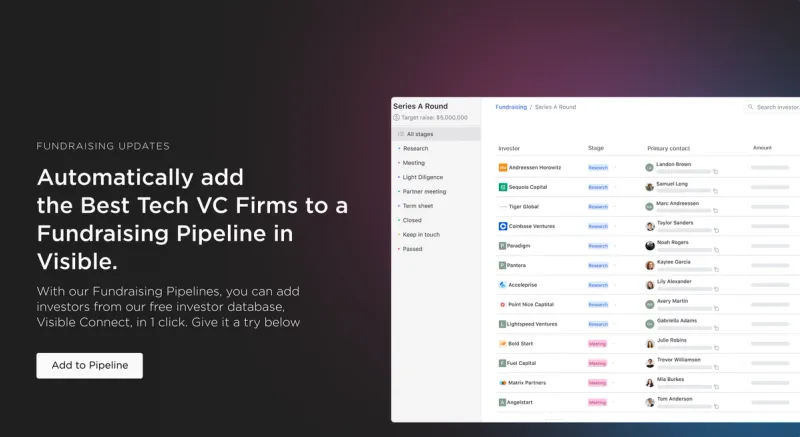
Partner With the Best Tech VC Firms Investing In Tech Startups with Visible
Venture capital has emerged as a powerful catalyst for progress in the healthcare industry. By bridging the funding gap, providing expertise, and fostering innovation, VCs enable healthcare startups to thrive and create transformative solutions.
Funding not only drives financial success but also cultivates a future where patient care is enhanced, medical outcomes are improved, and the boundaries of what is possible in healthcare are continually pushed.
Check out Visible’s investor database, Connect, to find VCs investing specifically within the healthcare space.
Companies should leverage VCs expertise and resources to accelerate their growth, navigate regulatory challenges, and scale their impact.
Also, get access to Visible for free for 14 days.
Frequently Asked Questions
What are the best tech VC firms for early-stage founders in 2026?
The best tech VC firms for early-stage rounds include Sequoia Capital, Andreessen Horowitz, and Benchmark, as they consistently lead high conviction seed and Series A deals. These firms prioritize founders building AI native infrastructure and agentic workflows. Targeting these top-tier investors requires demonstrating proprietary data advantages and a clear path to capital efficiency.
Can I raise capital from the best tech VC firms without revenue?
Yes, you can raise capital without revenue if you demonstrate significant technical validation or a high-demand MVP. The best tech VC firms in 2026 often back pre-revenue teams with deep domain expertise in frontier tech or robotics. Investors look for early traction signals like paid pilots, strong customer interview feedback, or a growing waiting list.
How do the best tech VC firms evaluate AI startups today?
The best tech VC firms evaluate AI startups based on execution and deployment rather than raw model capability. In 2026, investors favor vertical AI companies that solve specific industry bottlenecks using unique datasets. They prioritize agentic models that perform autonomous tasks, as these command a 42% valuation premium over simple human-augmented tools.
What metrics do the best tech VC firms require for Series A?
To secure a Series A from the best tech VC firms, founders must show a burn multiple below 2.0 and predictable unit economics. Investors expect a documented sales playbook and a repeatable go-to-market motion that proves revenue growth is scalable. High-quality recurring revenue and evidence of customer indispensability are now critical for winning these selective funding rounds.
Why are the best tech VC firms focusing on tech sovereignty?
The best tech VC firms are prioritizing tech sovereignty because digital infrastructure is now viewed as a strategic national asset. This trend is driving massive investments into localized AI, semiconductors, and cybersecurity across Europe and the Middle East. Founders who align their products with these regional security and autonomy goals can access specialized, government-backed venture capital pools.