
Key Takeaways
- 30% of VC firms report AI has meaningfully impacted portfolio support, tied with marketing and communications and investment decisions
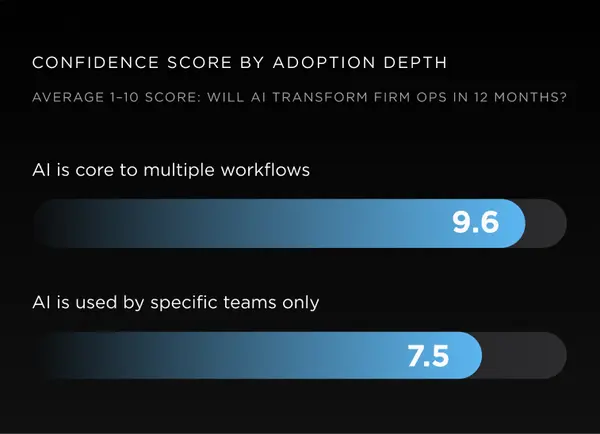
- 9.6 out of 10: average confidence score among firms where AI is core to multiple workflows, vs. 7.5 for firms using AI in specific teams only
- 49% say AI has reduced time on repetitive tasks, the most commonly reported operational outcome
- 2-3 hours: estimated weekly reduction in ad hoc internal pings reported by a Visible MCP user, from faster portfolio data access
The efficiency argument for AI in venture is well supported by the data. According to the Visible AI Sentiment Report, 49% of VC firms say AI has reduced time spent on repetitive tasks. That is a real and measurable gain, and it is worth pursuing.
But the survey data also surfaces something the efficiency framing tends to obscure. The use cases where AI is showing the strongest reported impact at VC firms are not the ones that reduce headcount or automate workflows. They are the ones that help firms show up better for founders and LPs.
Portfolio Support a Standout
When asked where AI has had the most impact on firm operations, portfolio support came in at 30%, tied with marketing and communications and investment decisions, and ahead of deal sourcing (27%), LP reporting (16%), and benchmarking (8%).
Portfolio support is not a category most firms would associate with automation or efficiency gains. It is relational work: helping founders navigate hiring decisions, customer introductions, follow-on fundraising, and the hundred other moments where a firm's value-add either shows up or it does not.
But that is exactly why AI is breaking through here. For lean firms operating without large platform teams, the operational lift of staying consistently present with every portfolio company has always been a constraint. AI is removing that constraint, not by replacing the relationship, but by reducing the friction that kept firms from showing up as often as they wanted to.
Consistent founder check-ins. Timely introductions. Proactive outreach before a problem becomes a crisis. These are the touchpoints that define a firm's reputation with founders over time, and they were previously out of reach for teams stretched thin across a large portfolio.
The Confidence Gap Between Deep and Shallow Adopters
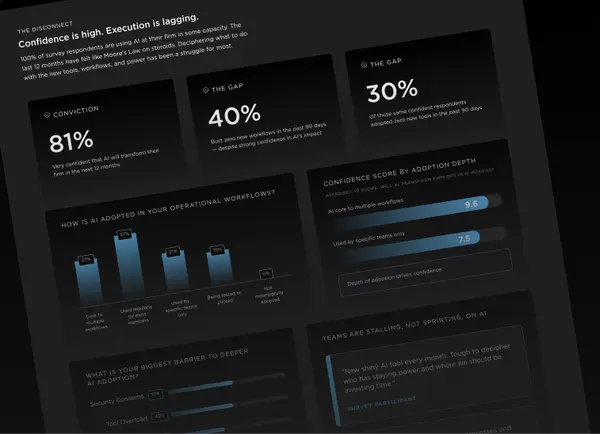
The Visible AI Sentiment Report reveals a meaningful correlation between the depth of AI adoption and confidence in AI's future impact. Firms where AI is core to multiple workflows report an average confidence score of 9.6 out of 10 that AI will transform their operations in the next 12 months. Firms where AI is used only by specific teams score 7.5.
That 2.1-point gap is not explained by access to better tools. Both groups have access to the same models and the same products. The difference is in how deeply AI has been integrated into the workflows that matter most, including the relationship-facing ones.
Firms at the 9.6 level are not just using AI to be faster. They are using it to be more present. More prepared for board meetings because portfolio data is accessible in seconds. More proactive with LPs because they know exactly who needs a touchpoint and what to say. More consistent in communicating with founders because the operational lift has been dramatically reduced.
As the team at Haatch put it, "Visible has shifted Haatch from reactive to anticipatory portfolio management. Decisions are data-backed rather than anecdotal, and the team can allocate its limited time to where it will have the most impact."
That is not an efficiency story. That is a presence story.
The Lowest-Impact Categories Reveal the Biggest Opportunity
The areas with the least reported AI impact are LP reporting (16%), identifying trends across portfolio data (16%), and benchmarking (8%). These are not low-priority tasks. They are some of the most time-intensive and highest-stakes work a firm does.
The gap likely reflects a data problem more than a tool problem. AI can only surface insights from data that is structured, accessible, and current. Firms that have invested in clean portfolio data infrastructure are the ones unlocking AI's highest-value use cases. Firms that have not are still waiting for the payoff.
That is the real dividing line in the current moment. Not which AI tools a firm has licensed. Not how many team members have ChatGPT accounts. But whether the underlying data is in good enough shape for AI to do something meaningful with it.
What This Means for Firms Still in Early Stages
The firms scoring 9.6 confidence did not get there by finding a better model. They got there by delving deeper into the workflows that matter most, starting with those that directly touch founders and LPs.
For firms still in early stages of AI adoption, the question is not "what tools should we try next." It is "where does showing up more consistently matter most for our portfolio and our LPs, and what is standing in the way of doing that today."
AI is a good answer to that second question. But only if the underlying data is ready. Read the full AI Sentiment Report to see how best-in-class VC ops teams are putting AI to work below: