
Key Takeaways
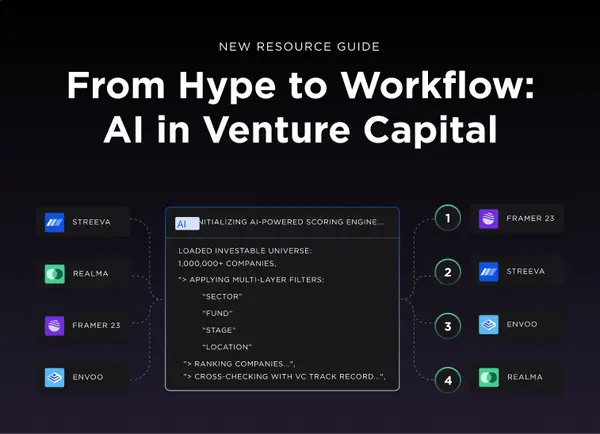
- Sourcing beyond intros: A fund scores companies against investment criteria with AI and surfaces startups matching the thesis before the founders have launched a website.
- Wider decision inputs: A fund feeds pitch transcripts, market data, product feedback, hiring activity and social sentiment into a model and reasons against the combined set rather than stitching the inputs together by hand.
- Prediction accuracy: Jared Heyman reports that nearly 70 percent of the startups Rebel Fund's Rebel Theorem 4.0 model predicted would succeed did succeed, roughly 2.5 times the Y Combinator average.
- Support without headcount: A platform team turns raw portfolio data into repeatable services with AI, so support scales as the portfolio grows without adding people.
- Network activation: A fund differentiates on activating a network rather than having one, matching open portfolio roles against firm contacts through a system rather than a spreadsheet.
AI is making its presence felt in venture workflows everywhere. But most firms are still applying it in piecemeal ways. ChatGPT for pitch decks here, Claude for LP updates there.
The real strategic advantage comes when AI is embedded across your team, tools, and data.
That embedding takes years, not quarters. Lacey Behrens, Partner at 01 Advisors, traces her firm's back end to a spreadsheet: "technology changes every single day and new things launch and my original Airtable table that I built and just continued to maintain painfully so has now powered the whole back end of our natural language ChatGPT model."
That’s where AI moves from automation to amplification.
In our latest guide, we break down how leading funds are:
- Centralizing data to build a shared source of truth
- Using AI to enhance sourcing, decision-making, LP relations, and support
- Moving from siloed outputs to system-wide insights
See how best-in-class firms are putting AI to work to centralize data, make informed decisions, and generate reports.
Frequently Asked Questions
How are most venture firms using AI right now?
Most venture firms apply AI piecemeal, one tool at a time, with no strategy connecting the uses to each other. One team reaches for a general purpose chatbot to work through pitch decks while another uses a different one for LP communications.
Why does adopting AI tool by tool fail to give a fund a competitive edge?
Tool-by-tool adoption produces isolated outputs that stay inside the team that generated them, so nothing compounds at the level of the firm. The advantage arrives when AI is embedded across the team, the tools and the data together.
What is the difference between AI as automation and AI as amplification at a venture firm?
Automation applies AI to a single task inside one team, while amplification embeds it across the team, the tools and the data so the firm works from one system. A chatbot drafting in one corner of the firm and a second one drafting elsewhere sits on the automation side of that line.
How does centralizing data change what AI can do for a fund?
Centralizing data gives a fund one shared source of truth for AI to work against, which is what turns isolated outputs into insight that covers the whole system. Without it, each team's AI work draws on its own slice of the data and the results stay siloed.