
Overview
This year marks the tenth annual edition of our benchmarks report, and with it, a new name. What began as the SaaS Benchmarks Report is now the Startup Benchmarks Report. Company cohort data and year-over-year comparability remain intact, but the new name reflects the broader set of companies being built today. We're deeply grateful to every founder, CEO, and startup leader who contributed, to presenting partner Customers Bank, and to the venture and platform partners who helped make it possible. Our goal is unchanged: to make this report an indispensable resource for the entire startup ecosystem.
AI has been the headline story for three straight years. In 2024 we called it Generation AI, when companies were just starting to build in a new landscape. In 2025 we called it Operation AI, the shift from invention to impact. This year, AI has moved from something teams operate to something companies are built on. We call it Foundation AI.
For the first time, this year's report splits companies by when they were founded. We refer to companies founded in 2022 or later as AI-era and those founded in 2021 or earlier as Pre-AI, shorthand for either side of the moment ChatGPT opened the world's eyes to AI. Pre-AI is not a pejorative. It's simply a reference to timing, and those companies carry real advantages: established customers, proven distribution, and years of accumulated data.
Let's get into the data!
 500+ Survey Respondents
The majority of respondents came from the US (75%) and Europe (10%)
 63% of Respondents Identified as a CEO or Founder
Other respondents included Head of Finance (14%), Head of Operations (6%), and Other (17%)
 54% of Respondents Are AI-Era Companies
The rest (46%) are Pre-AI companies founded in 2021 or earlier. AI is core to the product for 41% of respondents and a supporting feature for 47%
 66% of Respondents with More Than $1M in ARR
Other respondents reported ARR of $1-5M (31%), $5-20M (24%), $20-50M (8%), and greater than $50M (3%)
Thank you to our 2026 partners who made this report possible.
Foundation AI: Built on AI, Built to Scale
AI changed what it means to start a company. A generation of founders has now built from scratch since AI went mainstream, while everyone else is retrofitting, rewiring teams and workflows around the same idea. The gap between the two shows up in how teams are staffed, how products are priced, and how companies fund themselves. Yet founders in both groups say the same thing keeps them up at night: executing the fundamentals, not AI itself.
Foundation AI is a call to stop bolting AI onto legacy processes and teams, and to start designing the company around it: how you build, who you hire, and where you let software do the work. AI is no longer a layer on top of the business. It's the layer underneath.
The Five Pillars of Foundation AI
Newer Vintage, Faster Growth
Company vintage is the sharpest growth divider in the survey. AI-era companies grow 2x faster than Pre-AI peers below $1M ARR and up to 8x faster at $5-20M ARR, with no meaningful gross margin penalty. Pre-AI founders should benchmark against their own vintage before judging their growth rate.
Retrofit Deliberately
Pre-AI companies are rewiring in real time and are more likely to have slowed hiring or cut roles because of AI. The next wave of cuts is moving from customer support into back-office finance. Retrofitting works best as a deliberate redesign, not a series of point tools layered on old workflows.
Prove the Payoff
Seven in ten founders now say AI has significantly improved or revolutionized their team's productivity, up from 44% a year ago. AI-era teams are more likely to call the gains significant. The work now is turning that conviction into numbers a board can see.
Price for Usage and Outcomes
AI-era companies are less likely to rely on seat-based subscriptions alone and more likely to price on usage, outcomes, or a hybrid of the two. Companies whose revenue rises with customer usage grow at more than twice the pace of their peers, with median NRR of 112%.
Lean, Efficient Teams
ARR per employee hit a five-year high in every ARR band. Companies with below-median headcount for their band are more likely to be growing faster (70% vs. 50%) and more than twice as likely to be cash-flow positive or neutral. Staying lean did not cost companies growth.
Newer Vintage, Faster Growth
AI-era companies are growing materially faster than their Pre-AI peers, with no meaningful gross margin penalty.
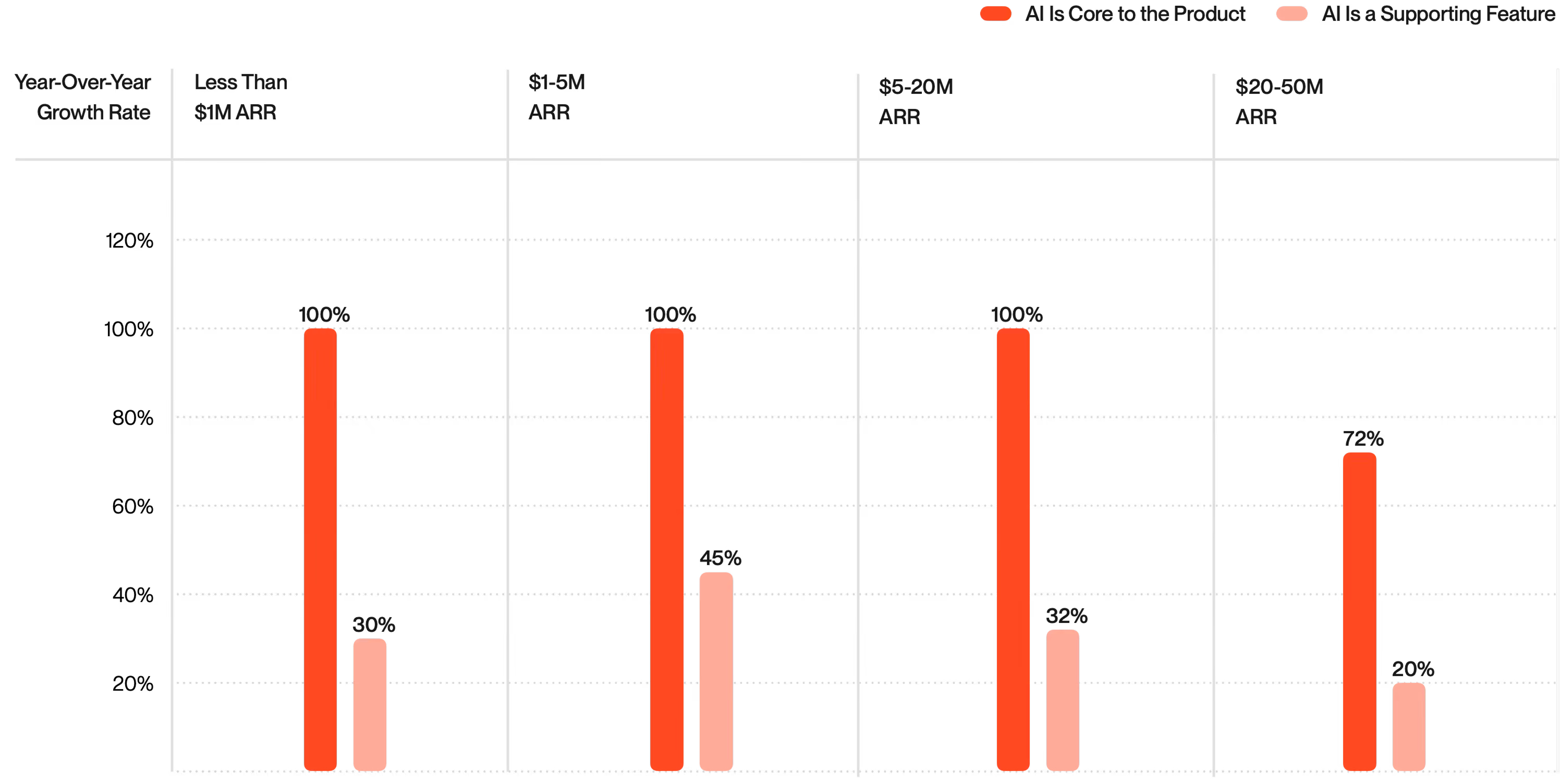
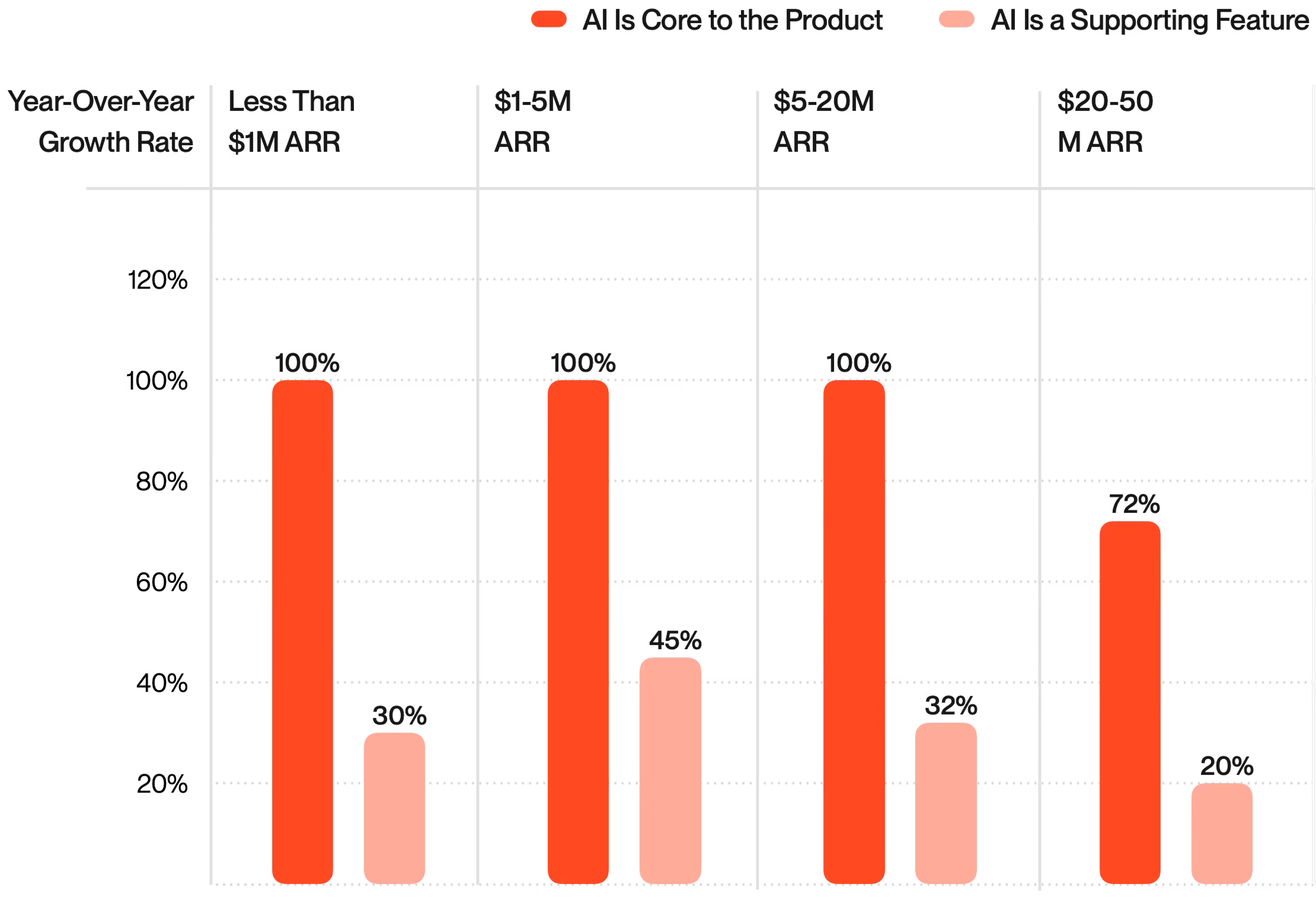
Company vintage is the sharpest growth divider in this year's survey. Startups founded in 2022 or later grow at least twice as fast as Pre-AI companies at every stage, and up to eight times as fast at $5-20M ARR. How deeply AI sits in the product matters too: companies where AI is core keep growing at 100% through $20M ARR, while those with AI as a supporting feature stay in the 20-45% range.
For companies founded before 2022, the takeaway isn't panic. It's perspective. Benchmark against your own vintage before judging your growth rate.
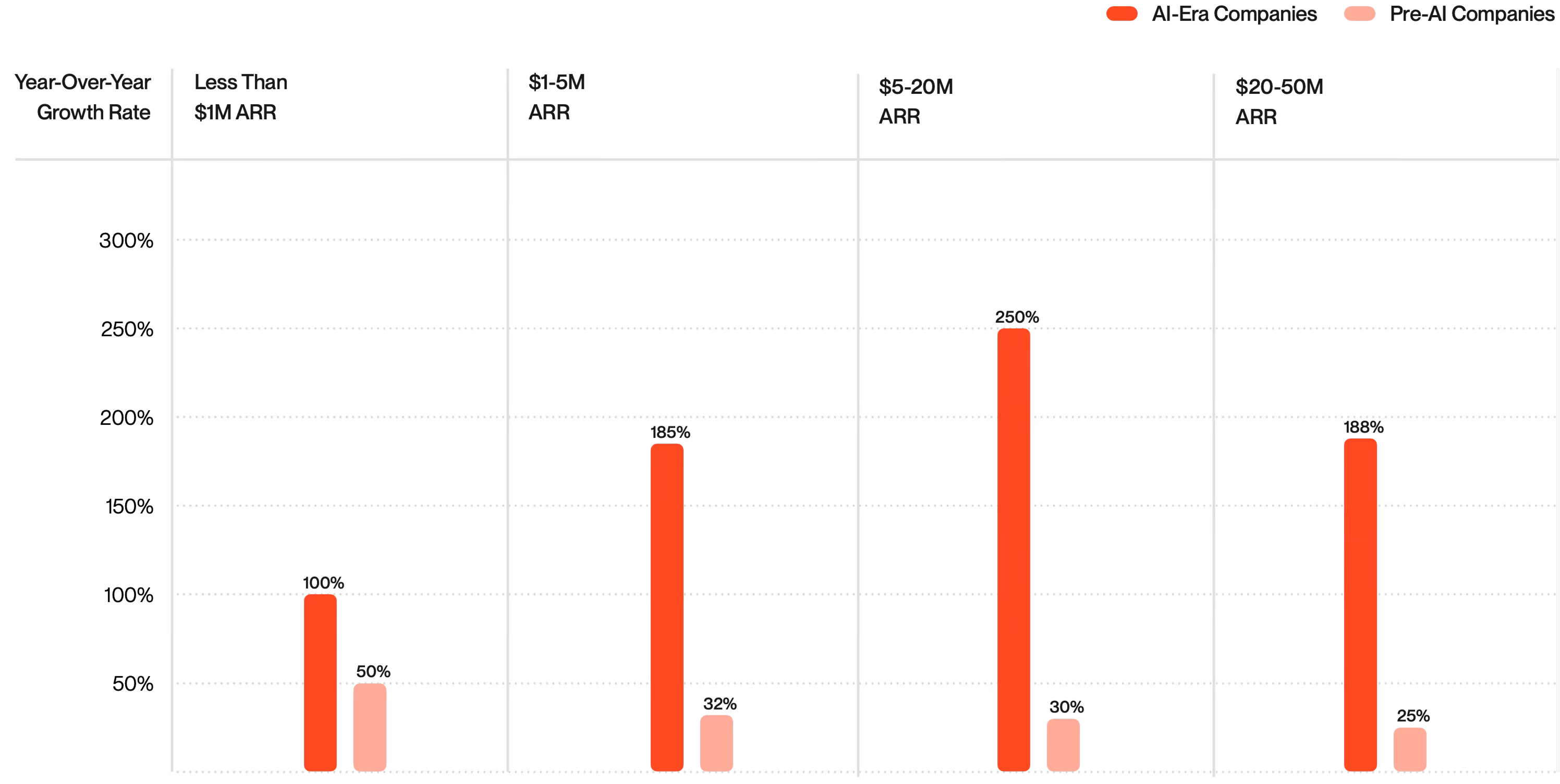
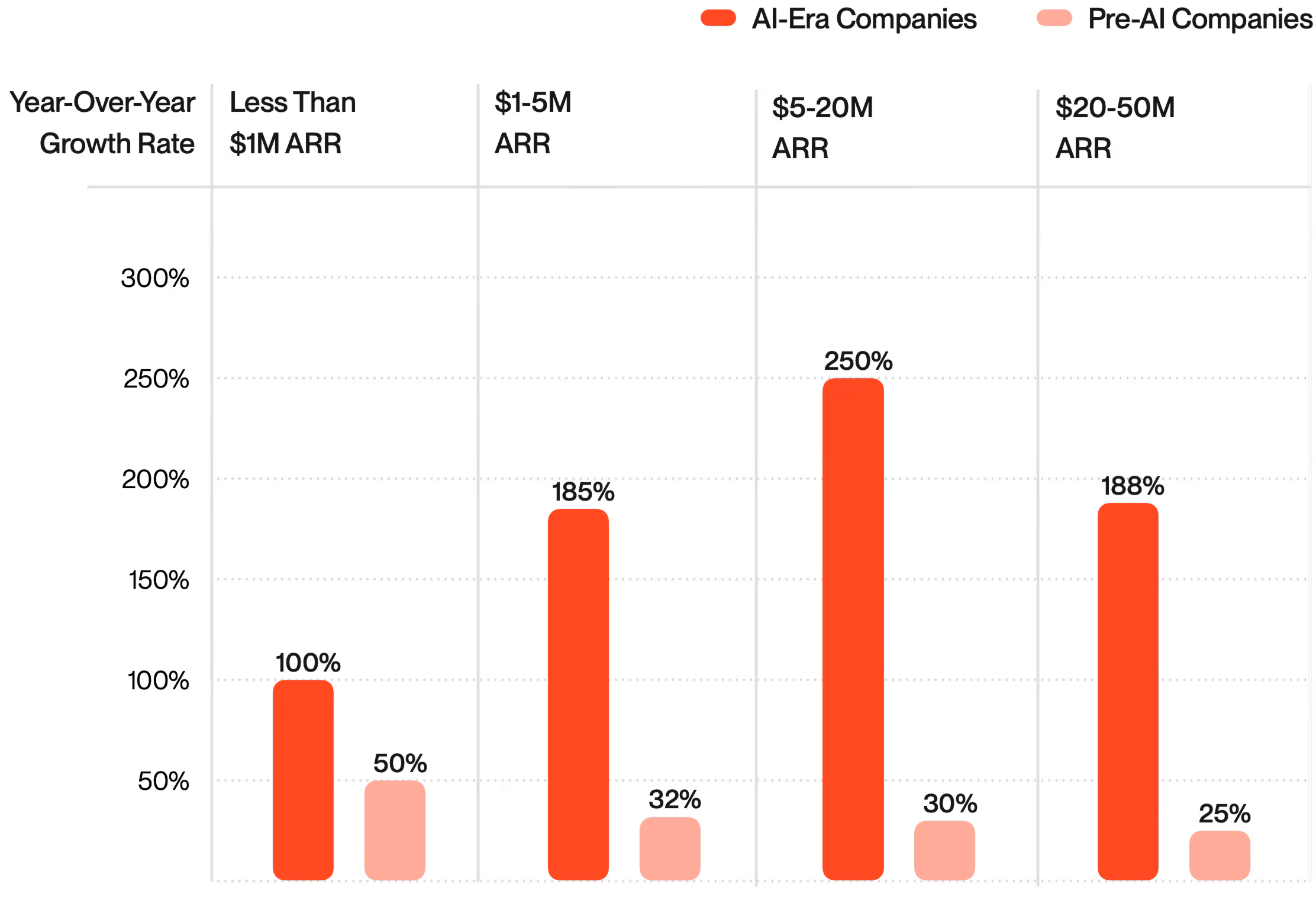
- Median Growth Rate Based on Company Vintage of AI-Era vs. Pre-AIStartups Born After ChatGPT Growing Up to 8x Faster
 Source: 2026 Startup Benchmarks Report by High Alpha + VisibleInsights
Below $1M ARR, AI-era companies grow 2x the rate of Pre-AI companies. That gap widens to nearly 6x at $1-5M (185% vs. 32%), over 8x at $5-20M (250% vs. 30%), and over 7x at $20-50M (188% vs. 25%). Pre-AI medians sit between 25% and 32% in every band from $1M up. The upper quartile tells the same story, with AI-era companies reaching 342% growth at $5-20M ARR.
- Median Growth Rate Based on How Deeply AI Is Incorporated Into the Product OfferingCompanies Where AI Is Core to the Product Grow 3x Faster
 Source: 2026 Startup Benchmarks Report by High Alpha + VisibleInsights
Companies where AI is core to the product don't slow down as they scale, at least not until $20M. The median AI-core company grows 100% year over year in each of the first three ARR bands, so a company at $5-20M grows as fast as one under $1M. The premium holds in the upper quartile too: 263% vs. 155% at $1-5M ARR, widening to 243% vs. 59% at $5-20M.
- VintageVintage
- AI CoreAI Core
Retrofit Deliberately
Pre-AI companies are rewiring in real time and are more likely to have slowed hiring or cut roles because of AI.
Over half of startups say AI has led to team reductions, and the cuts are moving. Engineering is still the most common target, but the next wave is shifting from customer support into back-office finance. Meanwhile, AI worry runs highest at companies adding AI to an existing product, not at those built around it.
For Pre-AI companies, the challenge is rebuilding around AI without breaking the customer base, distribution, and data you spent years earning. That takes a deliberate redesign, not a series of point tools layered on old workflows.
AI Headcount Cuts Shift from Support to Finance
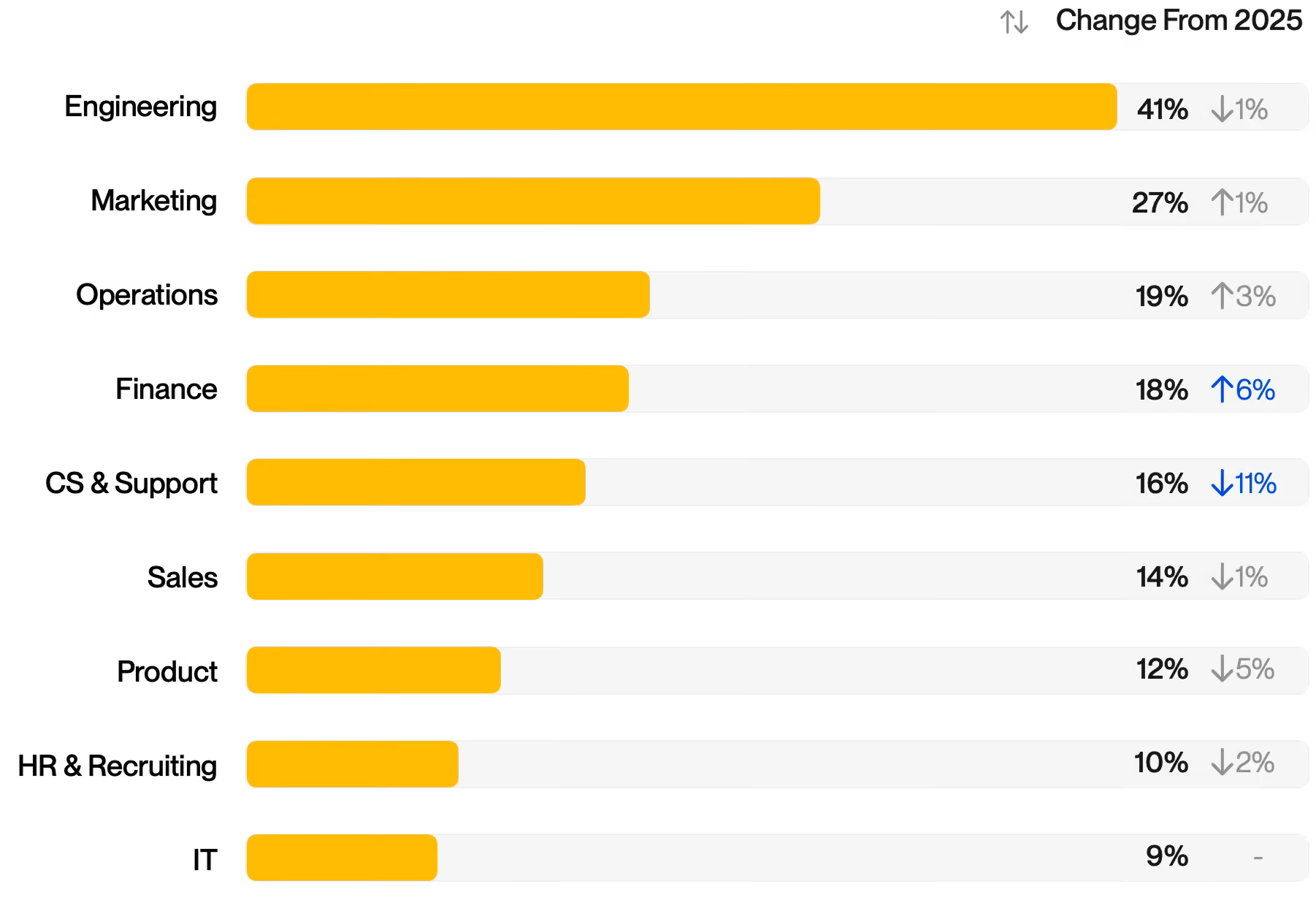
Engineering remains the most common AI-driven reduction at 41% of companies. The bigger story is what moved underneath it. Customer Success & Support fell from 27% to 16% of respondents and dropped out of the top three, while Finance rose from 12% to 18%, the sharpest gain of any function.
Companies that already realized savings in support appear to have turned to finance operations next. Invoicing, reporting, and reconciliation roles are where AI tooling is now making the clearest headcount case.
Percent of Companies Reducing Headcount Due to AI by Functional AreaCustomer Success and Support Fall by Nearly Half While Finance Increases Materially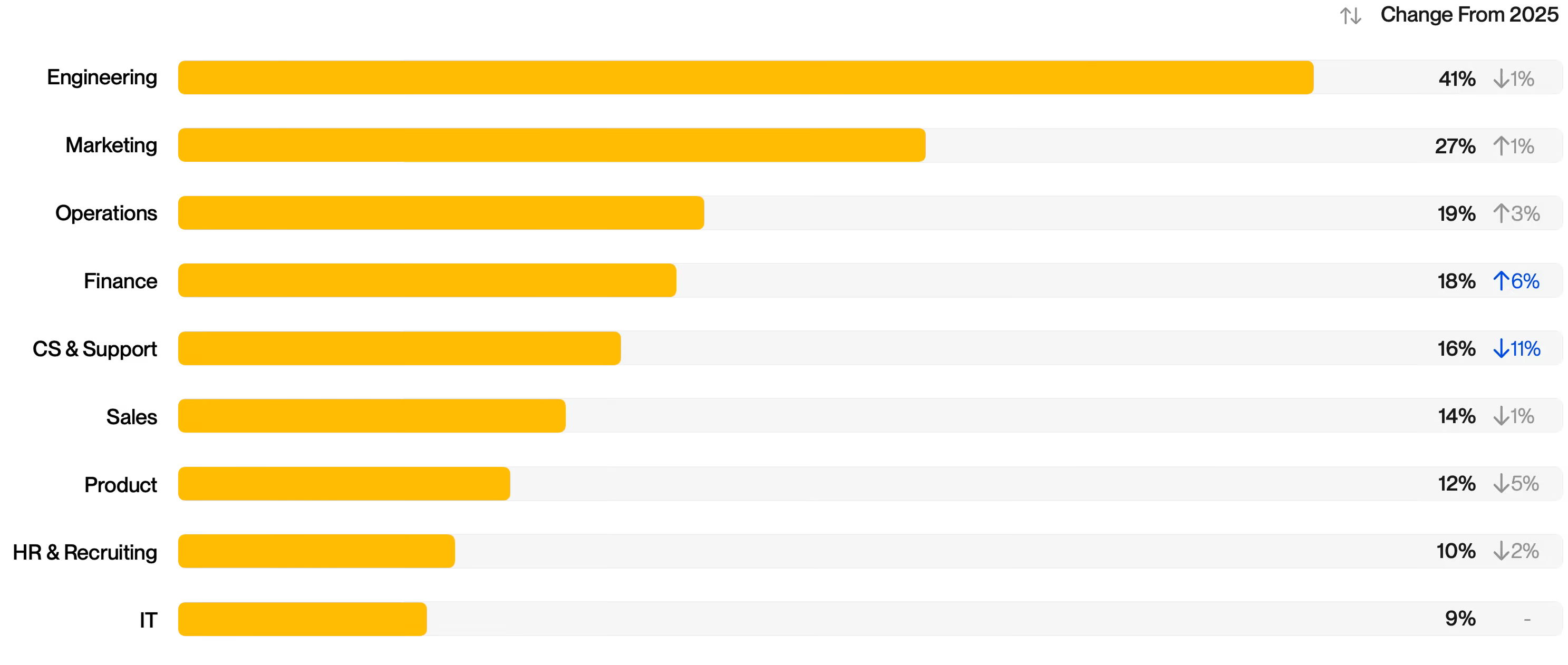
 Source: 2026 Startup Benchmarks Report by High Alpha + Visible
AI Has Changed Almost Everything, But GTM Remains Top Concern
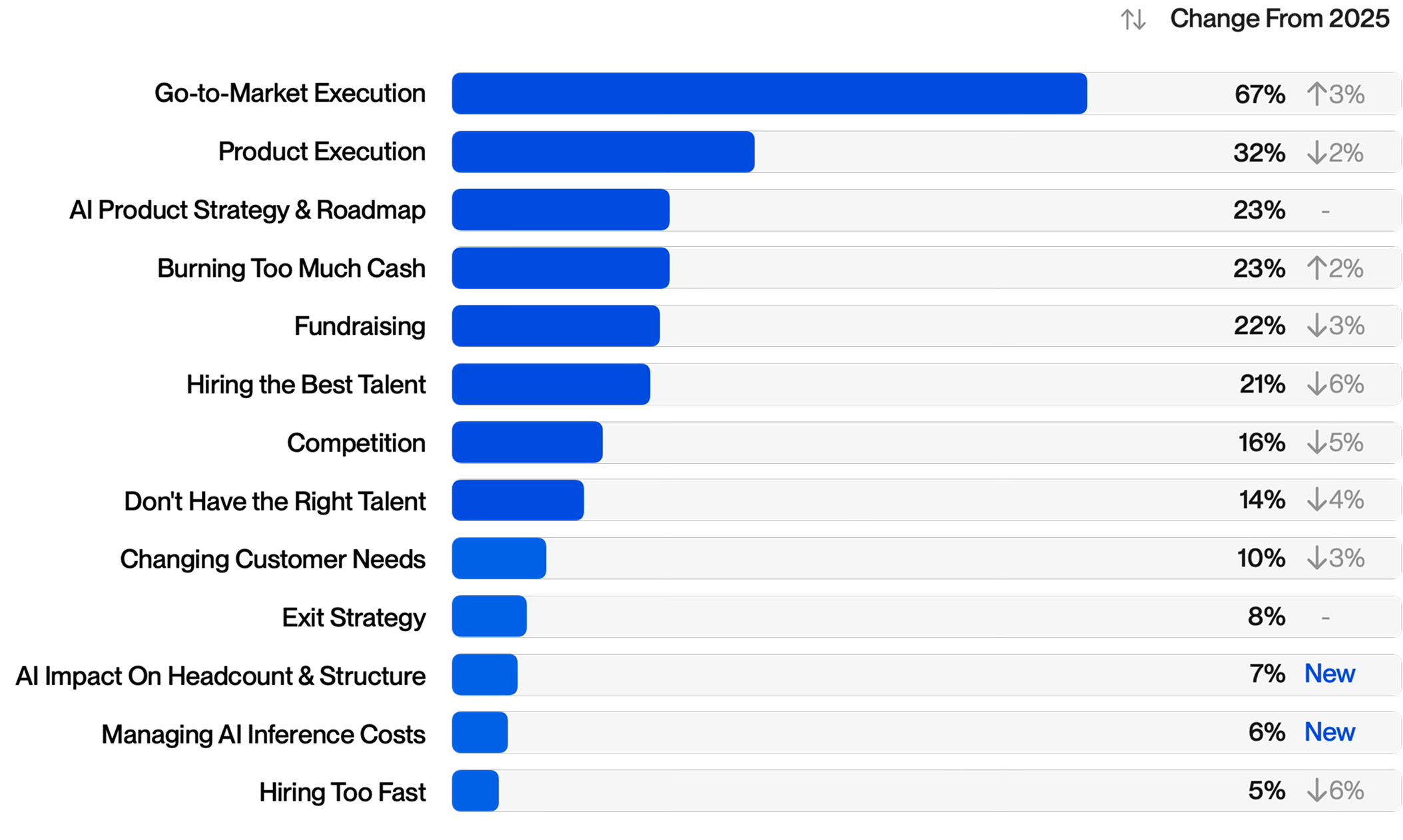
Go-to-market execution is the top founder concern at 67%, about twice as often as product execution (32%). It ranks first at about 70% for AI-era and Pre-AI companies alike, so it isn't an AI-readiness issue. Growth is still harder for founders than building.
AI Product Strategy & Roadmap debuts as the third-biggest concern at 27%. AI worry is highest among retrofitters: 38% of AI-supporting companies name an AI concern, versus 23% of AI-core companies. Founders who built around AI worry less about it than those retrofitting it.
Top Concerns for FoundersNearly One Third of Founders Name at Least One AI-Specific Concern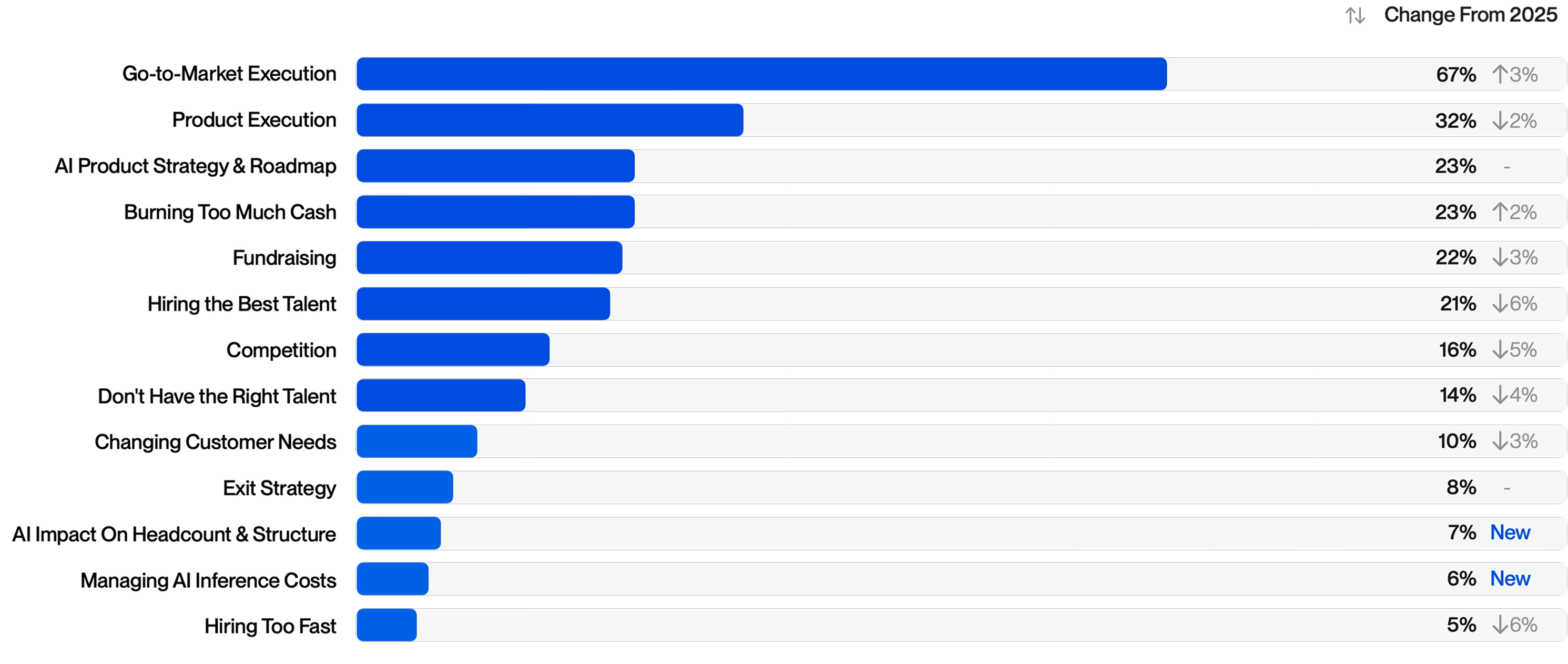
 Source: 2026 Startup Benchmarks Report by High Alpha
Prove the Payoff
Most founders say AI has meaningfully improved their team's efficiency, and AI-era teams are more likely to call the gains significant.
A year ago, AI productivity was a promising experiment. Today it's the norm: seven in ten founders say AI has significantly improved or revolutionized how their teams work. The gains show up on the P&L too. AI-core companies spend twice as much of revenue on inference, yet hold the same gross margins as their peers.
The job now is turning that conviction into numbers a board can see: where capacity went, what it cost, and what it returned.
AI Productivity Gains Are Near-Universal, and Substantial
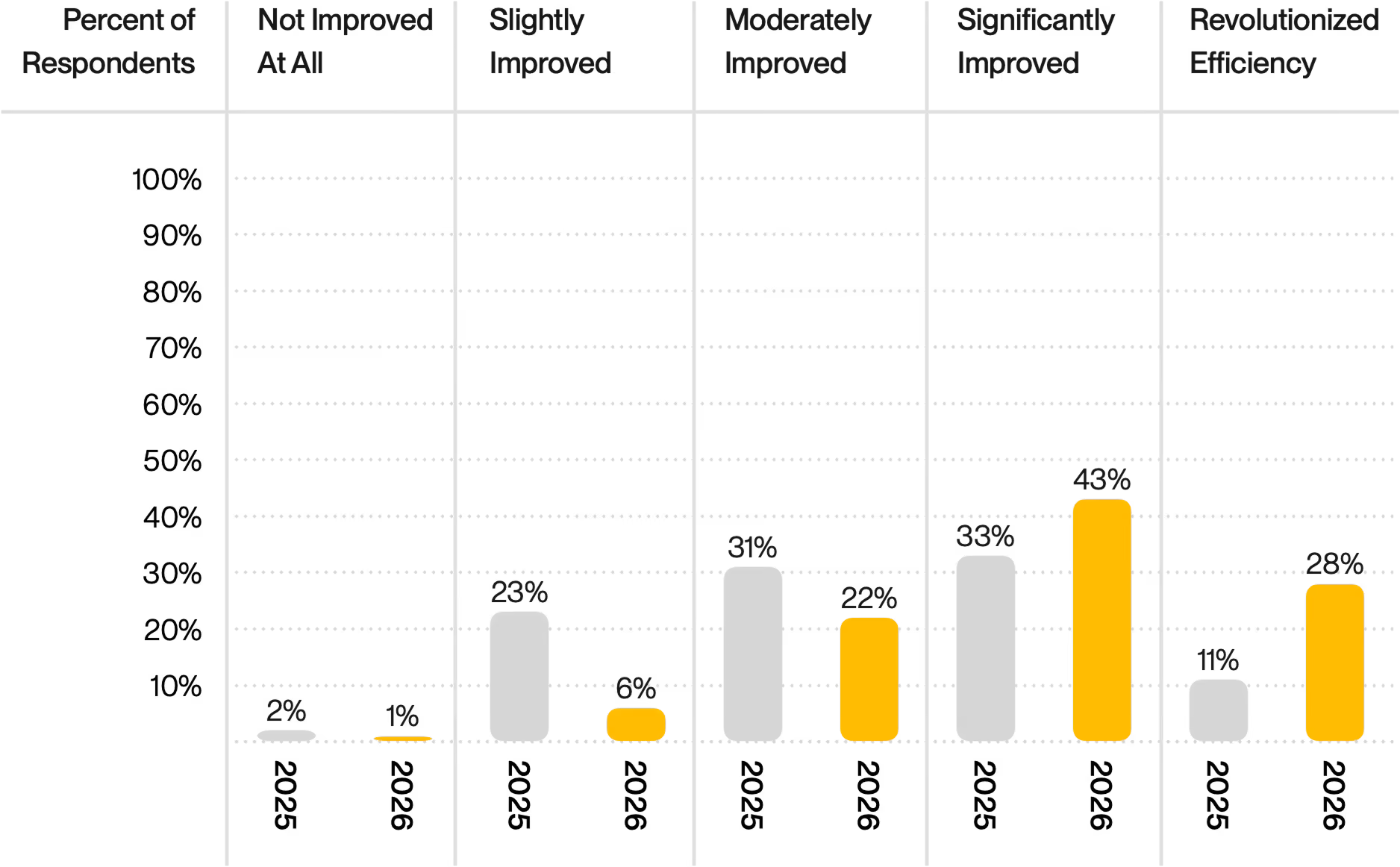
In the last year, the share of founders reporting significant or transformative AI productivity gains jumped from 44% to 71%, while those reporting only slight gains fell from 23% to 6%. The gains are biggest at the earliest stage: 82% of companies under $1M ARR report significant or transformative gains, versus 55% of companies at $1M and above. Smaller teams can adopt AI across every function at once, while larger companies must retrofit existing processes.
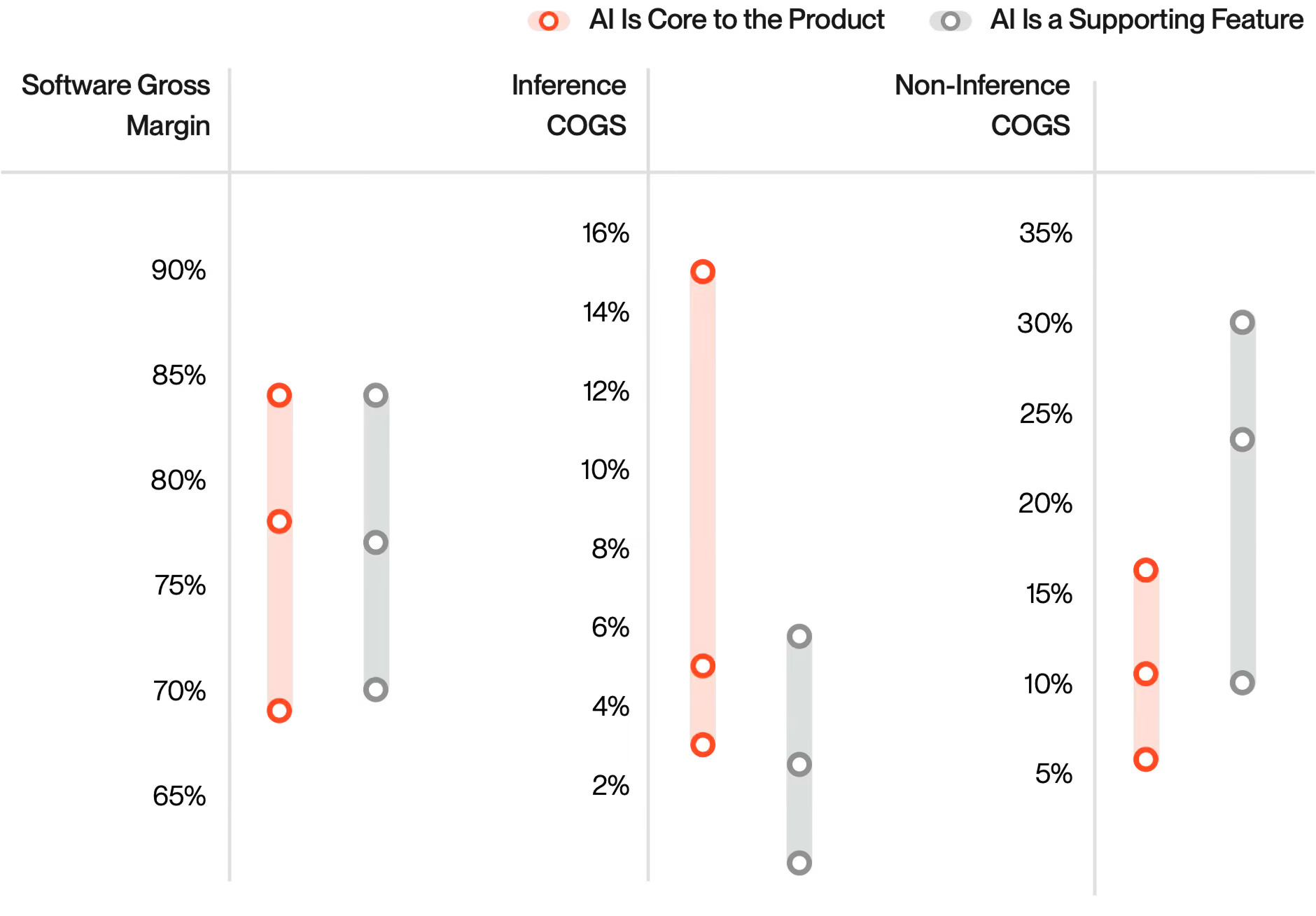
AI-Core Companies Maintain Margin Parity Despite Greater Inference Costs
The conventional thinking was that inference costs would erode AI margins. The data says otherwise. Median inference COGS is 5% of revenue for AI-core companies vs. 2.5% for AI-supporting companies. Strip inference out and the picture reverses: non-inference COGS is a median 10.5% of revenue for AI-core companies against 23.5% for the rest. AI-core companies pay for inference with leaner hosting, support, and services, which is how they land near the same margin.
Price for Usage and Outcomes
AI-era companies are less likely to rely on seat-based subscriptions alone and more likely to price on usage, outcomes, or a hybrid of both.
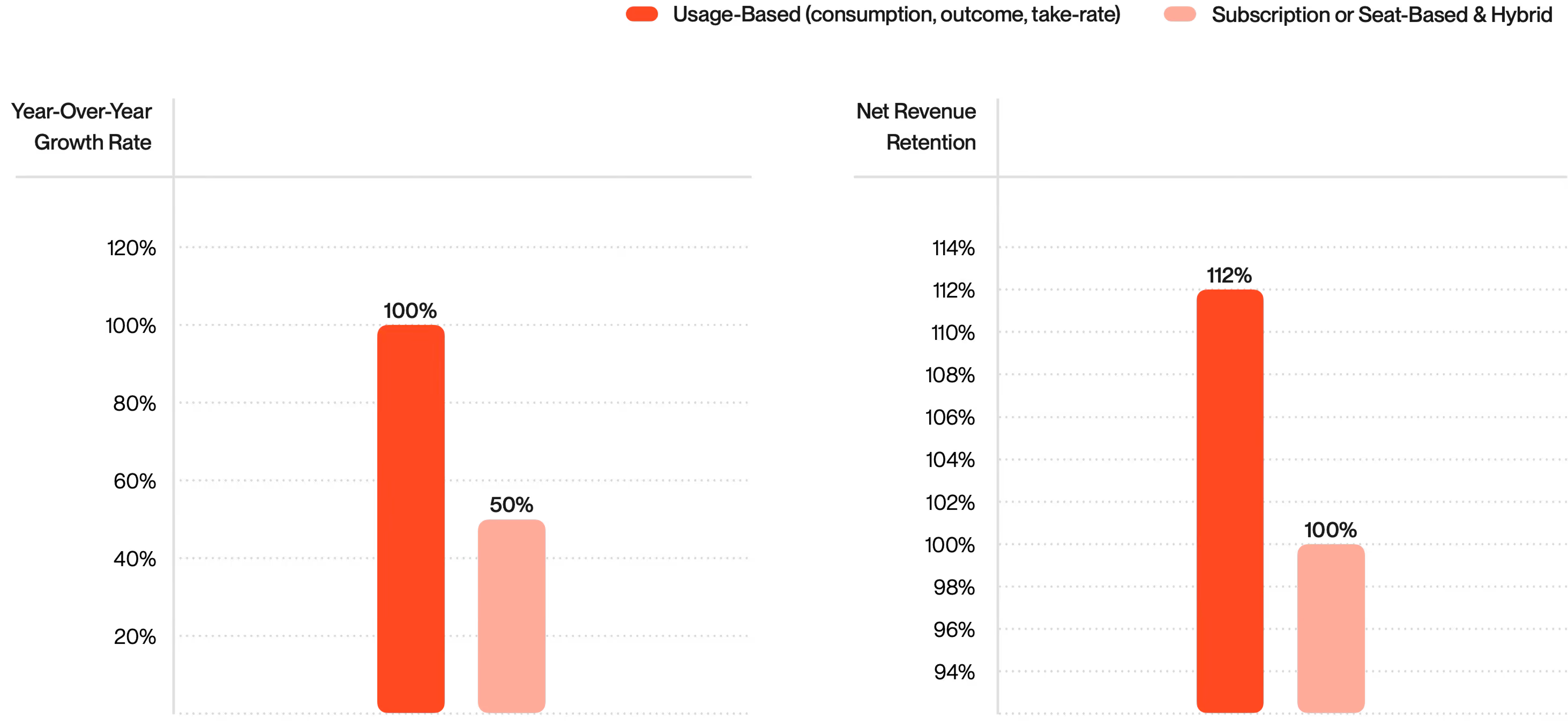
When software does the work, a seat is a poor proxy for value. More than half of companies under $5M ARR now price beyond pure subscription, and companies whose revenue rises with customer usage are growing at more than twice the pace of everyone else. The gap comes from expansion: usage pricing is engineered so revenue grows as customers get more value.
The question for founders isn't whether to experiment with pricing, but how to align price with the outcomes your product actually delivers.
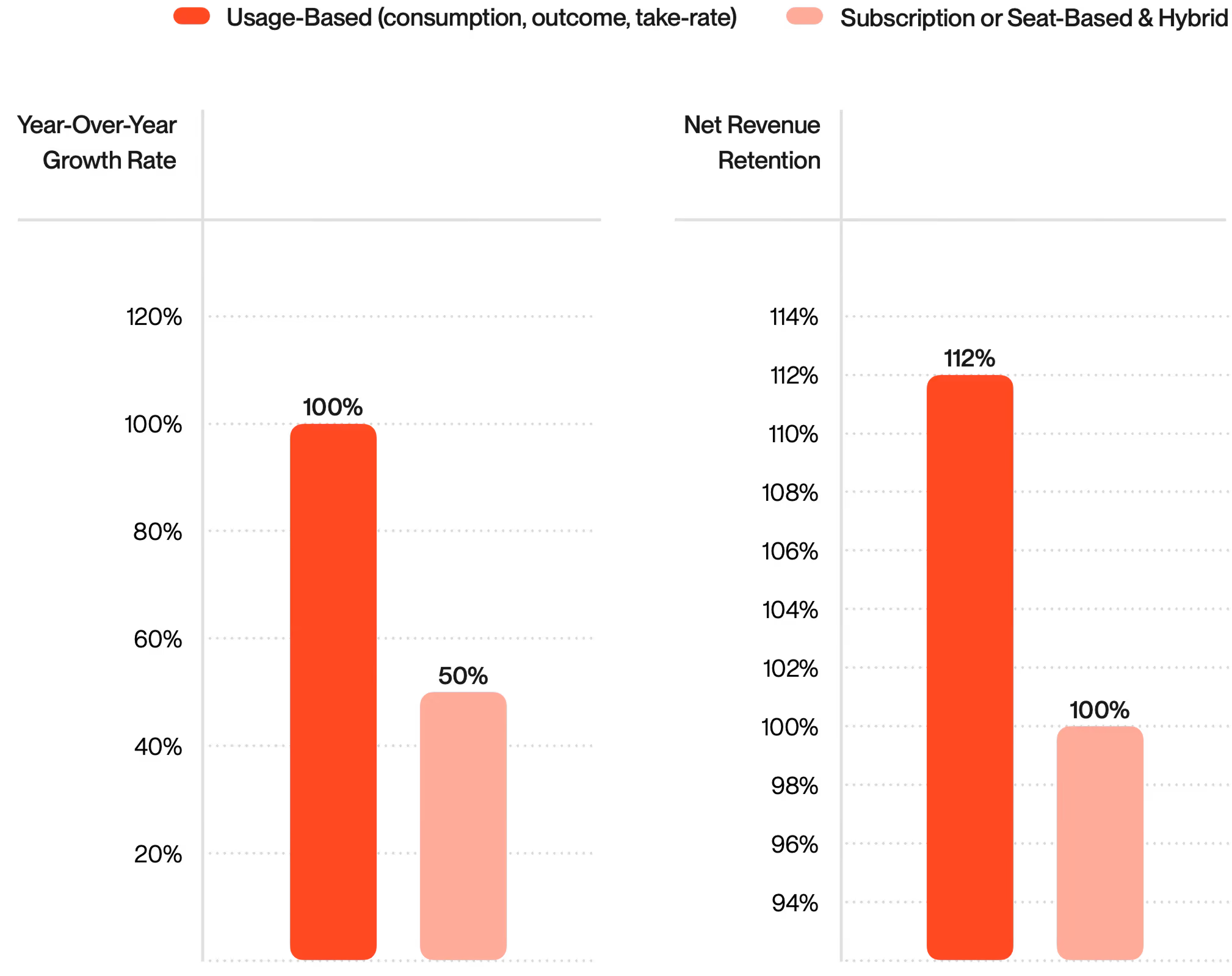
Usage-Based Pricing Finally Pays Off
Companies whose revenue scales with customer usage, volume, or outcomes grow at a median of 100%, versus 45% for subscription and hybrid peers. Nearly two-thirds report NRR of 110% or higher, versus about a third of everyone else, with median NRR of 112% vs. 103%. Gross retention is no better (90% vs. 92%), so the advantage comes from expansion rather than stickiness. The upside is wider too: the top quartile of usage-based companies grows 250% versus 100% for the rest.
Scale Favors Subscription Pricing
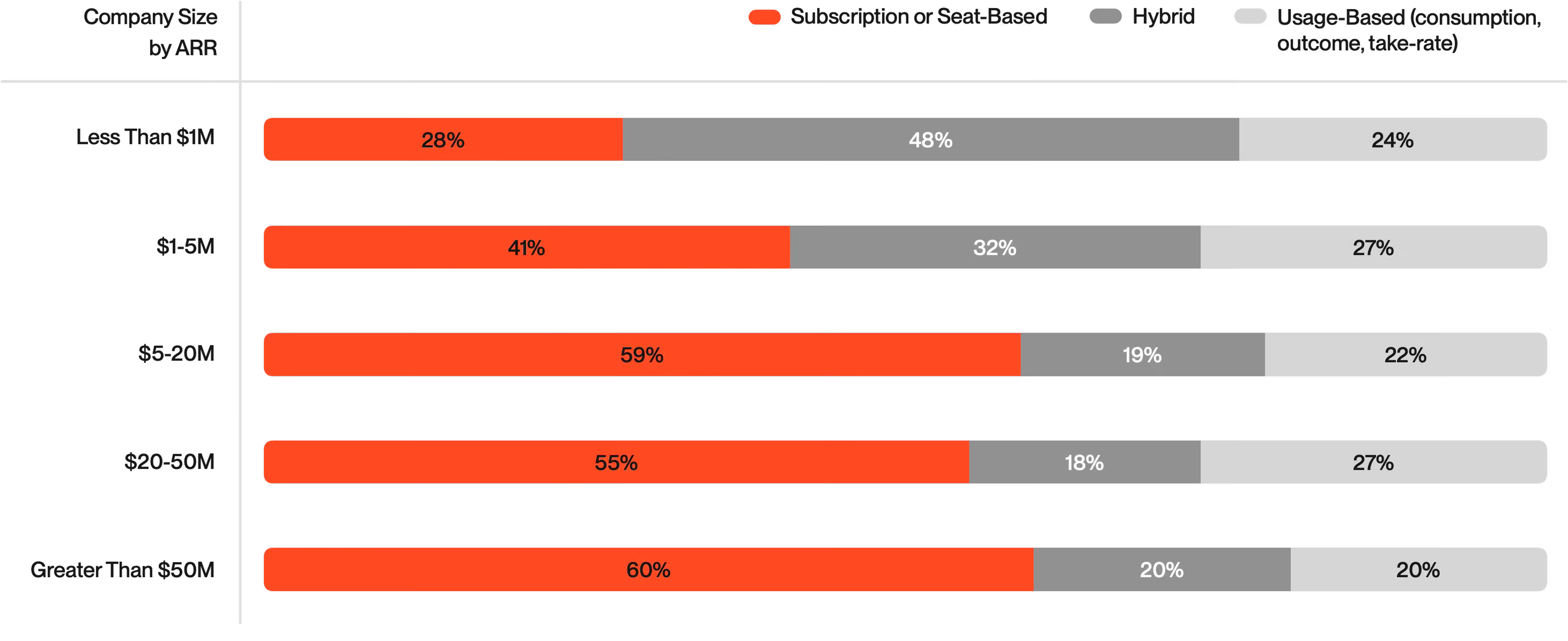
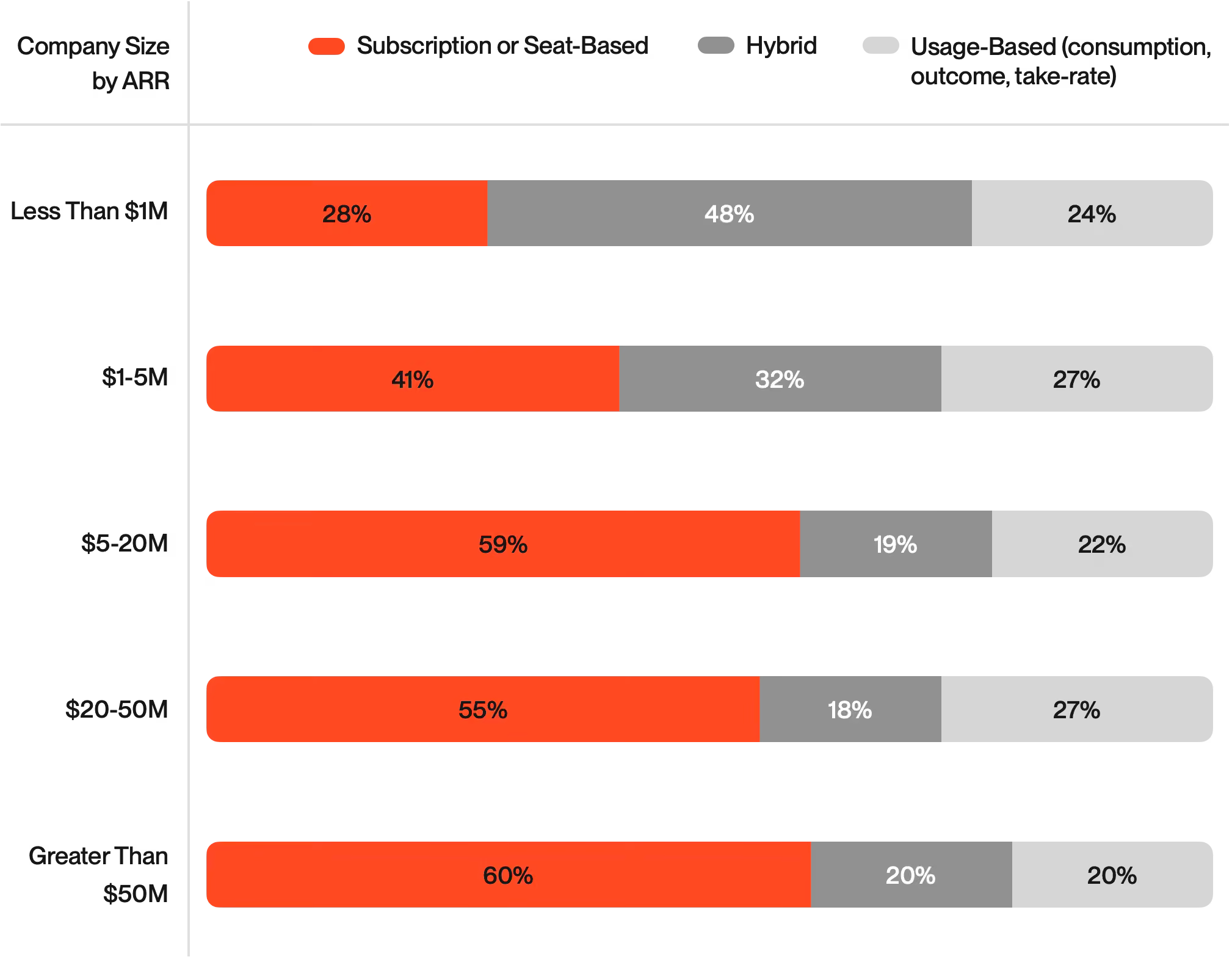
Pricing models don't thin out evenly as companies scale. Hybrid is the early-stage model, used by nearly half of companies under $1M ARR and about one in five from $5M up, while subscription takes its place. Usage-linked pricing stays near a quarter of companies at every size. The hybrid skew is largely driven by AI-core companies: more than half of those under $5M ARR are hybrid, versus 28% of companies where AI is a supporting feature.
Lean, Efficient Teams
ARR per employee continues to increase, and companies with below-median headcount for their ARR band are more likely to be growing faster.
Teams keep getting smaller, and they're getting smaller from the start. Median headcount fell in every ARR band this year, and ARR per employee hit a five-year high across the board. Early efficiency gains came from post-2021 team reductions. AI-driven efficiency has sustained the momentum since.
The benchmark for how big a company "should" be at a given ARR has moved, and staying lean did not cost companies growth. Companies with below-median headcount for their band are more likely to be growing faster (70% vs. 50%) and more than twice as likely to be cash-flow positive or neutral (36% vs. 14%).
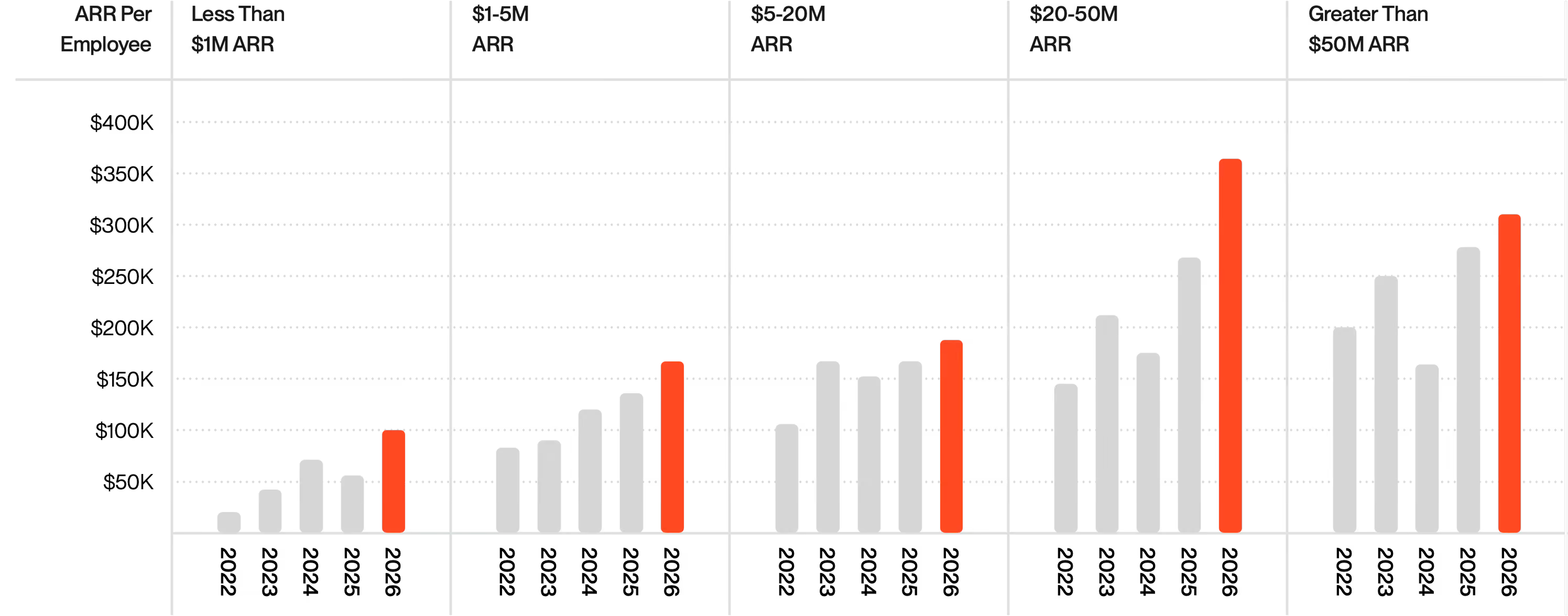
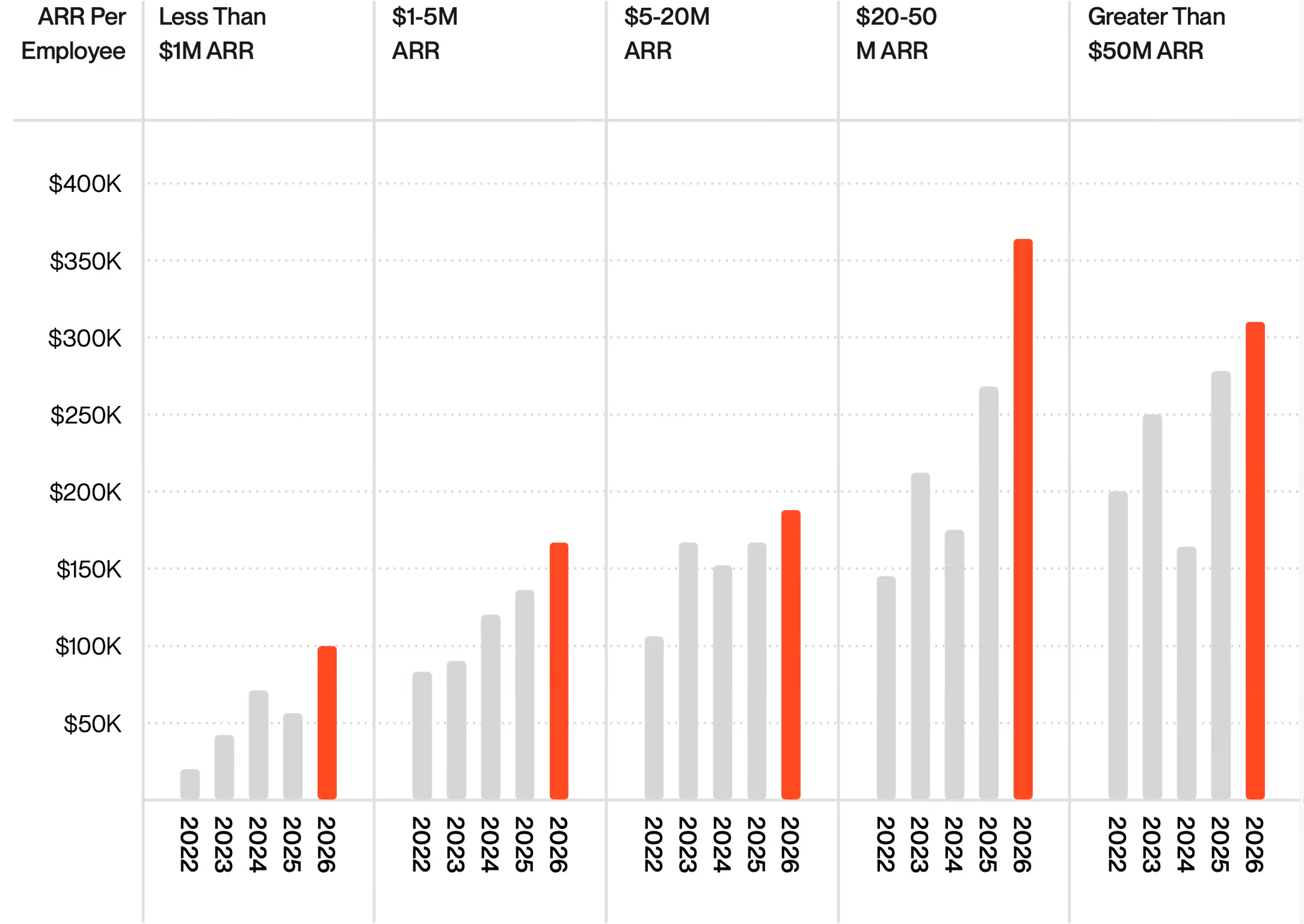
Median ARR per employee is up 11% to 80% year over year across all five ARR bands. The sharpest shift is at the earliest stage, which suggests teams are being built small from the start rather than trimmed later. At $20-50M ARR, median ARR per employee reaches $364K, and the top quartile generates about 3x the bottom quartile ($689K vs. $225K).
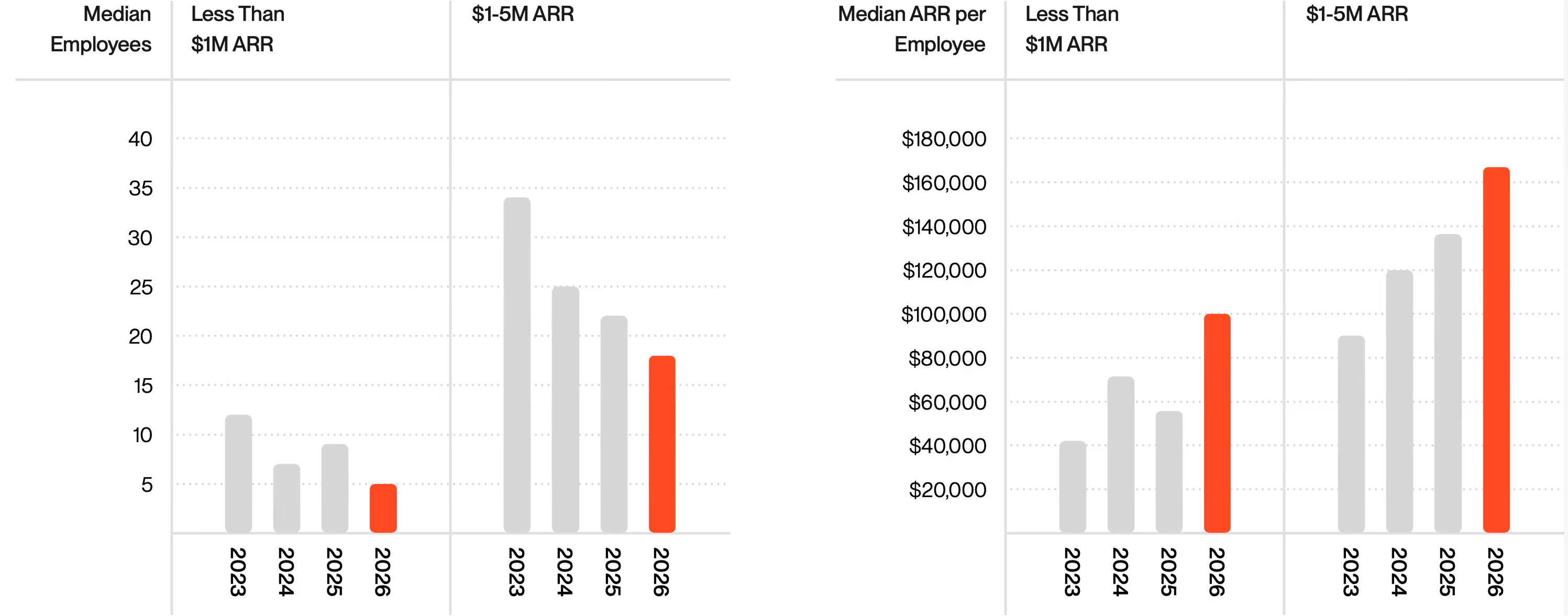
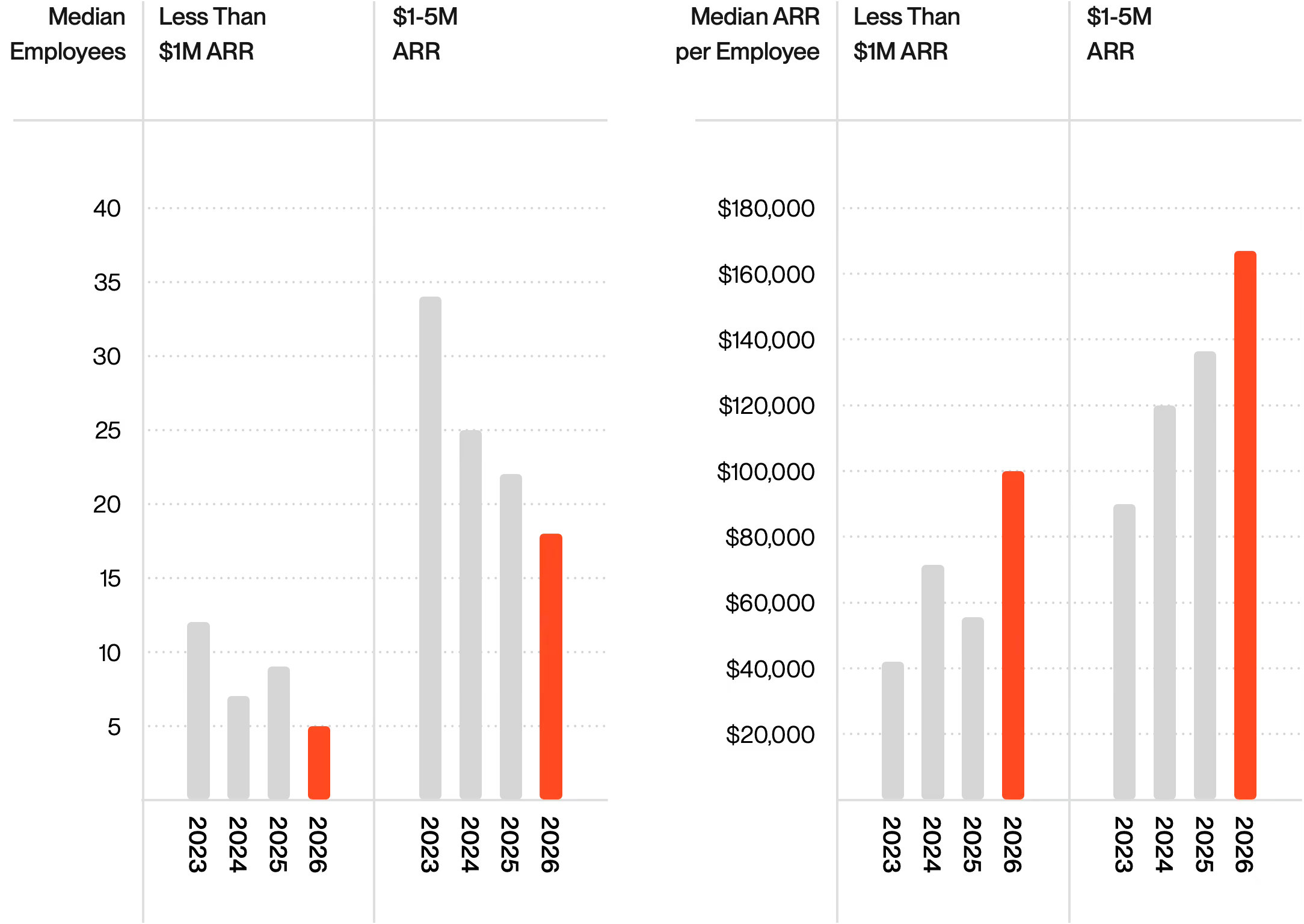
Early-stage teams are getting smaller. For companies with less than $1M ARR, median headcount is down 58% since 2023. For companies with $1-5M ARR, it's down 47%. As a result, ARR per employee has roughly doubled from 2023 levels in both bands. Companies are reaching the same revenue milestones with leaner teams.
Final Thoughts
The 2026 Startup Benchmarks Report shows that AI is no longer a layer on top of the business. It's the layer underneath. Foundation AI is reshaping how startups are built, staffed, priced, and run. Challenges persist, but like founders, we remain optimistic about what the data shows.
This is the tenth year for this report. Over that decade, we've seen a massive technology shift from SaaS to AI. What's held constant is that great businesses are built on products that deliver value for customers. The next decade will likely reward the companies that build on AI as a foundation rather than add it as a feature.
AI-era companies reported median growth of 185% at $1-5M ARR. Pre-AI companies are growing 32%. Closing that gap won't come from new tools. It will come from what a company chooses to build on, and every company, whatever its age, can make that choice from here.
Benchmarks Team
 Kristian AndersenCo-Founder & Partner, High Alpha
 Scott DorseyCo-Founder and Managing Partner, High Alpha
 Blake KoriathPartner and CFO, High Alpha
 Jon HubarttVP, Design & Product, High Alpha
 Mitch CauseyCMO, Visible
 Matt PreussMarketing Manager, Visible
See where you stand